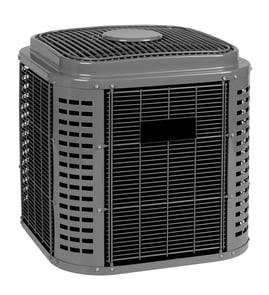

What are the components of the air conditioning system?
A York central air conditioner like model H1DB030S06A is built around four core refrigeration components: the evaporator coil, compressor, condenser coil, and a metering device (often called an expansion valve). These parts move heat from inside your home to the outdoors.
- Evaporator coil (indoor): Absorbs heat from indoor air; the refrigerant boils inside the coil.
- Compressor (outdoor unit): Pumps refrigerant and raises its pressure and temperature.
- Condenser coil (outdoor): Releases heat outdoors; the refrigerant condenses back to a liquid.
- Metering device (TXV or fixed orifice): Drops refrigerant pressure and controls flow into the evaporator.
Even though the four items above are the “big four,” these supporting components are what make the system run safely and efficiently:
- Outdoor fan motor and blade (moves air across the condenser coil)
- Indoor blower motor (moves air across the evaporator coil)
- Contactor/relay (switches high voltage to the compressor and fan)
- Run capacitor (helps start and run the compressor and fan motor)
- Filter-drier (helps protect the metering device by trapping moisture/debris)
| Component | Typical location | Main job |
|---|---|---|
| Evaporator coil | Indoor (air handler/furnace plenum) | Absorb indoor heat |
| Compressor | Outdoor condensing unit | Pump and pressurize refrigerant |
| Condenser coil | Outdoor condensing unit | Reject heat outdoors |
| Metering device | Near evaporator inlet | Control refrigerant flow and pressure drop |
When you know which component does what, troubleshooting gets faster. For example, weak cooling can point to airflow issues (blower, filter), electrical issues (contactor, capacitor), or refrigeration issues (metering device, coils, compressor). For electrical checks, we use a meter and follow safe testing practices like those shown in how to use a multimeter to test electrical parts video.
Last updated: February 2026
What is the largest residential AC unit available?
Most homes top out at a 5-ton central air conditioner (about 60,000 BTU/hr of cooling capacity), which is typically the largest size commonly used in residential applications. For a York split-system like H1DB030S06A, correct sizing depends on your home’s heat load, ductwork, and electrical capacity.
In residential HVAC, capacity is usually discussed in tons (1 ton = 12,000 BTU/hr). Common upper-end sizes include:
- 4 tons (about 48,000 BTU/hr): large homes, good ductwork, moderate heat gain
- 5 tons (about 60,000 BTU/hr): very large homes or high heat gain (sun exposure, poor insulation)
- Over 5 tons: usually treated as light commercial or multi-system residential (often better handled as two smaller systems)
Bigger is not automatically better. Oversizing can create comfort and reliability problems.
- Short cycling reduces humidity removal and comfort
- Higher starting current can stress electrical components
- Ductwork may not support the airflow a larger system needs
- Noise and uneven temperatures can increase
| Capacity | Approx. BTU/hr | Typical use case |
|---|---|---|
| 3 tons | 36,000 | average to larger homes (varies by climate) |
| 4 tons | 48,000 | large homes, higher heat gain |
| 5 tons | 60,000 | very large homes, highest common residential size |
To choose the right size for your home and avoid performance issues:
- Have a contractor run a Manual J load calculation
- Confirm duct sizing and target airflow (often about 350 to 450 CFM per ton)
- Verify breaker, disconnect, and wiring are correctly sized
- Address insulation, air sealing, and attic ventilation first
A properly sized central air conditioner runs longer cycles, removes more humidity, and puts less stress on key components like the compressor and capacitor. That usually means better comfort and fewer breakdowns over time.
For help identifying the exact model and matching parts correctly, use how to find your appliance model number (and what it means for parts).
Last updated: February 2026
How do I find the model number on my H1DB030S06A?
For a York central air conditioner like model H1DB030S06A, the model number is printed on the unit’s rating plate (data tag). We use that exact model number to match the correct diagrams and replacement parts for your split-system cooling equipment.
Check these common rating-plate locations:
- On the outside of the cabinet near the refrigerant line connections
- Inside the service panel (remove the screws and lift off the panel)
- On the back or side of the unit near the electrical compartment
- Near the top edge of the cabinet under the lid overhang
Record the full identification details exactly as shown:
- Model number (example: H1DB030S06A)
- Serial number
- Product number (if listed)
- Electrical ratings (volts and minimum circuit ampacity)
- Refrigerant type (often R-22 or R-410A on older/newer systems)
York outdoor units can look similar across multiple series; one character difference in the model number can change the correct capacitor, contactor, fan motor, or control board match.
Use this to avoid mixing up numbers from the thermostat or indoor furnace/air handler.
| Item you found | Usually correct for outdoor AC parts? | Notes |
|---|---|---|
| Rating plate on outdoor unit | Yes | Best source for condenser parts matching |
| Thermostat model | No | Identifies the thermostat, not the AC |
| Indoor furnace/air handler label | Sometimes | Used for indoor blower/coil parts |
| Utility sticker or installer label | No | Not reliable for parts lookup |
Try these practical options:
- Look on the inside of the service panel for a second sticker
- Check for a stamped number on the cabinet frame near the electrical compartment
- Use your paperwork from installation or prior service (often lists model and serial)
- Use our guide: [how to find your appliance model number (and what it means for parts)]
Last updated: March 2026