Owner’s manual
 Error Codes


How many cubic feet is my Kenmore refrigerator model 79551372011?
The exact cubic-foot capacity for Kenmore Elite model 79551372011 is listed on the model’s rating label and in the 79551372011 use & care guide. This model is a side-by-side refrigerator; most units in this class are typically in the 20 to 30 cu. ft. range.
Where to find the exact capacity
Use one of these quick checks:
- Check the rating label inside the fresh food compartment (commonly on the right-hand side wall).
- Look in the specifications section of the 79551372011 use & care guide.
- If you still have the original paperwork, the capacity is often printed on the product sheet.
Typical capacity ranges (for context)
Even within Kenmore Elite 795-series refrigerators, capacity varies by cabinet width and depth.
| Refrigerator type | Typical capacity range |
|---|---|
| Counter-depth side-by-side | 20 to 23 cu. ft. |
| Standard-depth side-by-side | 24 to 30 cu. ft. |
Why it matters
Knowing the cubic feet helps us match the right replacement parts and maintenance items (like filters), and it also helps when comparing storage space, shelf layouts, and airflow needs.
Related maintenance tip
If you are also checking specs because of water or ice performance, confirm your home water pressure meets the requirements in the 79551372011 use & care guide (models with a water filter typically need higher minimum pressure).
Last updated: January 2026
What is the average lifespan of a Kenmore Elite refrigerator?
Most Kenmore Elite refrigerators, including model 79551372011, typically last 10 to 15 years. With consistent maintenance (clean condenser coils, good door sealing, stable temperatures), it’s common to reach the upper end of that range before major sealed-system or compressor-related repairs become the deciding factor.
Typical lifespan and what to expect
A Kenmore Elite side-by-side refrigerator is built for long-term daily use, but wear items and cooling-system stress add up over time.
- 10 to 15 years is the typical service life for a full-size refrigerator
- Year 7 to 12 is when issues like fan noise, defrost problems, and water/ice dispenser failures often show up
- Year 10+ is when high-cost repairs (compressor or sealed system) become more common
- Regular cleaning and correct airflow help the unit run more efficiently and reduce run time
For model-specific care and operating guidance, follow the maintenance and operating sections in the 79551372011 use and care guide.
What shortens (or extends) refrigerator life
Common factors that affect lifespan:
- Dirty condenser coils causing longer run times and higher heat load
- Door gasket leaks leading to moisture, frost, and temperature swings
- Overpacked compartments blocking vents and reducing air circulation
- Frequent door openings and warm room conditions increasing compressor run time
- Hard water or infrequent filter changes stressing the water system and ice maker
Maintenance schedule (simple and effective)
| Task | How often | Goal |
|---|---|---|
| Clean condenser coils | Every 6 to 12 months | Reduce run time and heat stress |
| Check door seal and alignment | Every 6 months | Prevent air leaks and frost |
| Replace water filter | About every 6 months | Protect water flow and ice quality |
| Keep vents clear inside | Ongoing | Maintain even cooling |
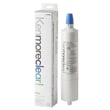
If your refrigerator uses the filter shown for this model, the Kenmore refrigerator water filter 9990 5231JA2006E is the correct match from our parts list.
Why it matters
A refrigerator that runs longer to maintain temperature uses more energy and puts more wear on key components like the compressor, evaporator fan motor, and defrost system. Preventive maintenance is the most reliable way to reach the full expected lifespan.
Last updated: January 2026
What are the common problems with Kenmore Elite refrigerators?
Common issues on Kenmore Elite model 79551372011 include not cooling (often airflow or fan related), frost or moisture from doors not sealing or frequent openings, and “normal” operating noises during defrost. We use the troubleshooting steps in the 79551372011 owner's manual to pinpoint whether the cause is power, airflow, defrost, or the dispenser system.
Most common symptoms and what usually causes them
- Not cooling or weak cooling: unit in defrost cycle, controls in Demo Mode, dirty airflow paths, or a failed evaporator fan motor.
- Frost, ice crystals, or moisture buildup: door not closing properly, doors opened often, blocked air vents.
- Noises (buzzing, popping, sizzling, water running): normal sounds from defrost heater, fans, and water draining to the pan.
- Ice tastes bad or smells: old ice, unwrapped food odors, mineral-heavy water, or a filter that needs replacement.
- Water or puddles: defrost water draining and evaporating (more noticeable in humid conditions) or a drain issue.
Quick checks we recommend first (in order)
- Confirm power and display status: make sure the cord is firmly plugged in and the display is not showing OFF.
- Rule out Demo Mode: on this model, Demo Mode disables cooling; the manual shows how to turn it off.
- Check airflow: keep packages from blocking vents between freezer and fresh food sections.
- Inspect door closing and gaskets: poor closing drives frost and temperature swings.
- Address water and ice quality: dump old ice and replace the filter on schedule.
Parts that commonly solve these problems
| Symptom | Part that often fixes it | What it does |
|---|---|---|
| Ice tastes/odors, slow water flow | Kenmore refrigerator water filter 9990 5231JA2006E | Reduces taste and odor issues from the water supply |
| Warm temps, weak airflow, noise from freezer area | Refrigerator evaporator fan motor 4681JB1029S | Circulates cold air through the compartments |
| Water under fridge or recurring drain issues | Refrigerator drain tube 5251JA3003D | Helps route defrost water to the drain pan |
Why it matters
Cooling, frost, and noise complaints often trace back to airflow and the automatic defrost cycle. Fixing simple causes (Demo Mode, blocked vents, door sealing, filter maintenance) prevents food spoilage and reduces strain on the compressor.
Last updated: January 2026