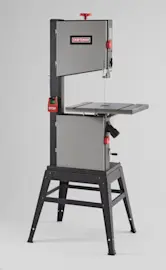
Owner’s manual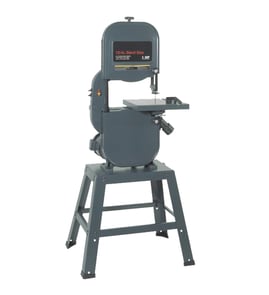

What is the 4 inch rule for bandsaw?
The 4-inch rule is a bandsaw safety guideline: when operating the Craftsman 113244510 band saw, we keep our hands and fingers at least 4 inches away from the moving blade, using a push stick, push block, or other holding aid whenever the cut would bring hands closer.
How to apply the 4-inch rule on model 113244510
We treat the 4-inch zone as a “no-hands area” around the blade path. On this 10-inch direct-drive saw, that typically means planning the cut so your hands stay on the workpiece well away from the blade, and using support devices for small or narrow stock.
- Set the upper blade guide and guard to just clear the workpiece before cutting.
- Keep the workpiece firmly against the table; feed with gentle, steady pressure.
- Use a push stick or push block for short, narrow, or thin cutoffs.
- Avoid awkward hand positions where a slip could move a hand into the blade.
- Stop the saw and wait for a complete stop before reaching near the blade area.
For model-specific operating and safety instructions, follow the 113244510 owner’s manual.
Quick decision guide
| Situation | Risk level | What we do |
|---|---|---|
| Hands can stay 4+ inches away naturally | Low | Normal feed with both hands on the workpiece |
| Cut forces hands inside 4 inches | High | Use push stick/block, clamp, or a holding jig |
| Small cutoff near the blade slot/insert | High | Let the blade stop, then remove cutoff safely |
Why it matters
Bandsaw blades cut continuously and can pull material unexpectedly. The 4-inch rule builds a buffer for slips, binding, or sudden movement so fingers do not enter the blade path.
Last updated: January 2026
How do I know the size of my bandsaw blade?
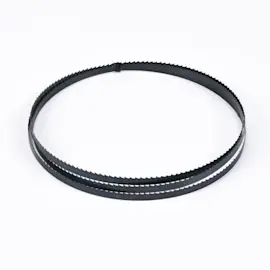
For Craftsman model 113244510, the blade size is specified in our documentation: it uses a 56-7/8 inch long, 1/4 inch wide bandsaw blade. You can also confirm blade size by measuring the blade’s length, width, and teeth-per-inch (TPI) if the blade is already off the saw; see the 113244510 owner’s manual.
Model-specific blade size for 113244510
According to the manual, this 10 inch direct-drive band saw uses only:
- Length: 56-7/8 in.
- Width: 1/4 in.
- Tooth direction when installed: teeth point downward toward the table
How to measure your blade (if you are unsure what’s installed)
If your current blade is unmarked or you suspect it is not the correct size, we recommend measuring three things:
- Length: lay the blade flat, mark a starting point (often the weld), then roll it along a tape measure until the mark returns
- Width: measure from the tooth tip to the back edge of the blade
- TPI: count how many teeth fall in 1 inch (or count 1/2 inch and double it)
Quick measurement reference
| What you’re measuring | What it tells you | Why it matters |
|---|---|---|
| Length | Fit around the wheels | Wrong length will not tension or track correctly |
| Width | Curve capability and stability | Wider blades track straighter; narrower blades turn tighter |
| TPI | Cut speed and finish | Higher TPI is smoother; lower TPI clears sawdust better |
Why it matters
Using the correct 56-7/8 inch x 1/4 inch blade helps your Craftsman 113244510 tension properly, track near the center of the tires, and reduce issues like blade slipping, wandering cuts, or premature blade breakage.
Last updated: January 2026
What is the difference between 1 2 and 3 4 bandsaw blades?
On the Craftsman band saw model 113244510, the key difference between 1/2-inch and 3/4-inch band saw blades is stiffness and turning ability: wider blades track straighter for resawing, while narrower blades turn tighter for curves. However, this specific model is designed to use 1/4-inch wide blades only, so 1/2-inch and 3/4-inch blades are not compatible. See the 113244510 owner’s manual.
What your 113244510 can actually use
Our manual for model 113244510 specifies a blade size limitation.
- Blade width supported: 1/4 inch only
- Blade length: 56-7/8 inches
- Typical use on this saw: curve cutting and light straight cuts in wood
- Not a fit for: 1/2-inch or 3/4-inch blades (too wide for the guide and wheel setup)
1/2-inch vs 3/4-inch blades (general guidance)
If you have a larger band saw that accepts those widths, here is how they typically compare:
| Blade width | Best for | Tradeoff |
|---|---|---|
| 1/2 inch | straighter cuts, light resawing | larger minimum curve radius |
| 3/4 inch | heavy resawing, maximum beam strength | even larger minimum curve radius; needs a saw rated for it |
Blade thickness and tooth choice (what to focus on instead)
Since your 113244510 is limited to a 1/4-inch blade, performance usually comes down to thickness, TPI, and sharpness.
- Choose higher TPI for thinner stock and smoother cuts
- Choose lower TPI for thicker wood and faster cutting
- Keep blade tension and tracking adjusted to reduce drift
- Replace a dull blade if the saw slows down or wanders
Why it matters
Using a blade wider than the saw is designed for can prevent proper tracking, overload the guide system, and increase the chance of poor cuts or blade problems. Staying within the 113244510 blade spec helps the saw cut straighter and run safer.
Last updated: January 2026
What is the most common cause of a ruined band saw blade?
On the Craftsman 113244510 10-inch direct-drive band saw, the most common cause of a “ruined” blade is normal wear: the teeth dull over time and stop cutting cleanly. The next most common causes are using the wrong blade or setup (especially too much blade tension or poor tracking), which can lead to cracking or breakage.
What “ruined” usually looks like
- Dull teeth that burn wood, wander, or require force to feed
- Cracks starting at the gullet (the curved area between teeth)
- A kinked blade from twisting in a tight curve
- A broken blade at the weld or from fatigue
- Teeth stripped or rounded from cutting the wrong material
Model-specific blade issues to check first
Your 113244510 manual calls out several setup items that directly affect blade life:
- Overtensioning shortens blade life and increases breakage risk.
- Poor tracking (blade not centered on the tires) can stress the blade.
- Guide and thrust bearing adjustment that pinches or mis-supports the blade can cause heat and fatigue.
- Cutting too small a radius can kink the blade and start cracks.
For the correct tensioning, tracking, and guide adjustments, follow the steps in the 113244510 owner’s manual.
Quick prevention checklist
- Use the correct blade width for the curve radius you plan to cut
- Let the blade cut; do not force the feed rate
- Set blade tension to “firm with slight deflection,” not overly tight
- Center the blade on the tires and recheck tracking after adjustments
- Keep guides close and supportive, but not squeezing the blade
Why it matters
A blade that is dull or overstressed makes the saw cut crooked, increases heat, and can overload the motor. Correct tension, tracking, and guide setup helps you get straighter cuts and longer blade life on the Craftsman 113244510.
| Symptom | Most likely cause | Best first fix |
|---|---|---|
| Burning, slow cutting | Dull teeth | Replace blade, reduce feed pressure |
| Blade breaks often | Too much tension or tight-radius twisting | Reduce tension, use wider radius or narrower blade |
| Blade walks off wheels | Tracking off-center | Adjust tracking and confirm tire condition |
Last updated: January 2026
What are the parts of a band saw?
On the Craftsman 113244510 10-inch direct-drive band saw, the main parts include the blade and wheels that carry it, the table and trunnion that support and tilt the work, and the guide and tension systems that keep the blade cutting straight and safely. For labeled diagrams, see the 113244510 band saw owner's manual.
Main parts you will see on model 113244510
- Blade: the continuous cutting band; this saw uses a 1/4-inch wide, 56-7/8-inch long blade.
- Upper and lower wheels (drive and idler): the wheels the blade rides on; the drive wheel is powered by the motor.
- Tires: rubber tires on the wheels that help the blade track.
- Blade guides and thrust bearings: support the blade from the sides and rear to reduce twisting and wandering.
- Tension system: tension adjusting knob and tension lock knob that set blade tension.
- Tracking adjustment: tracking adjustment screw/set screw that centers the blade on the tires.
- Table and table insert: supports the workpiece; the insert surrounds the blade slot.
- Trunnion and bevel scale: lets the table tilt for bevel cuts and shows the angle.
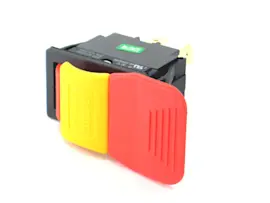
- On-off switch with removable key: helps prevent unauthorized starting.
Quick “what it does” table
| Part | What it does | When you adjust/inspect it |
|---|---|---|
| Blade tension system | Keeps blade tight enough to cut without slipping | After blade changes; if blade slips or breaks often |
| Tracking adjustment | Centers blade on the wheel tires | After installing a blade; if blade walks forward/back |
| Blade guides and thrust bearings | Supports blade for straighter cuts | If cuts drift; after blade replacement |
| Table and trunnion | Supports work and sets bevel angle | When squaring table to blade; bevel cutting |
Why it matters
Knowing these parts helps you troubleshoot common issues like blade drift, frequent blade breakage, or a blade that will not stay centered. It also helps you make the right adjustments (tension, tracking, guides) before you start cutting.
Last updated: January 2026