Owner’s manual
 Error Codes


How to tell cubic feet of Kenmore refrigerator by model number?
For Kenmore Elite refrigerator model 79572183313, the model number alone usually does not reliably tell you the exact cubic-foot capacity. The most accurate way is to look up the capacity in the specifications section of the owner's manual, or calculate it from the interior measurements.
Fast ways to find the cubic feet
- Check the specs: Look for “capacity” or “total volume” in the owner's manual.
- Look for the rating label: Inside the fresh-food section (often on a side wall or near the crisper area) there may be a label that lists capacity.
- Use a measurement-based estimate: Measure the usable interior space and calculate cubic feet.
- Use model-family clues carefully: Some Kenmore model families are commonly sold in certain size ranges, but that is not a spec you should rely on for ordering shelves, bins, or drawers.
How to calculate cubic feet (interior volume)
- Empty the section you are measuring (fresh food or freezer).
- Measure usable interior:
- Height (inches)
- Width (inches)
- Depth (inches)
- Multiply:
H x W x D = cubic inches - Convert to cubic feet:
cubic inches ÷ 1728 = cubic feet
Quick conversion table
| What you have | Convert to cubic feet |
|---|---|
| Cubic inches | Divide by 1728 |
| Cubic feet | Multiply by 1728 to get cubic inches |
Why it matters
Capacity is helpful for comparing refrigerator sizes, but it is not the best input for buying replacement parts. For model 79572183313, parts fit is determined by the exact model and component design (for example, the water filter, door gasket, or freezer drawer), not by cubic feet.
Last updated: February 2026
What does DH mean on Kenmore 79572183313 refrigerator?
On Kenmore Elite refrigerator model 79572183313, dH (or Er dH) indicates a defrost heating problem: the refrigerator is not sensing the expected temperature rise during the defrost cycle. This is commonly tied to the defrost heater circuit, a defrost sensor, or the main control.
What to check first (fast, no tools)
- Unplug the refrigerator for 5 minutes, then restore power and watch for the code returning.
- Check for heavy frost on the rear freezer panel; heavy frost supports a defrost system issue.
- Make sure doors close fully and gaskets seal; warm air leaks can worsen frost buildup.
- Confirm the freezer is set near 0°F and the fresh food section near 37°F.
Likely causes and the parts that relate
A dH code usually points to one of these:
- Defrost sensor not reading correctly (common)
- Defrost heater circuit problem (heater, wiring, connectors)
- Control not powering defrost (electronic control board)
- Airflow restriction from ice (symptom that follows a defrost failure)
If you’re troubleshooting parts for this model, these page-listed parts are often involved:
| Symptom you notice | What it often means | Example part on this model page |
|---|---|---|
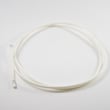
| Frost blanket on freezer back wall | Defrost not melting ice | Refrigerator defrost sensor assembly 6615JB2005R |
| Code returns after reset | Sensor or control issue | Refrigerator electronic control board CSP30242818 |
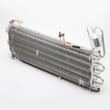
| Temps warm, fan noise changes | Ice blocking airflow | Refrigerator evaporator ADL73341411 |
Basic diagnostic path (safe, practical)
- Power off the refrigerator before removing panels.
- Inspect the freezer evaporator area for ice buildup and damaged wiring.
- If the evaporator is packed in ice, a defrost failure is likely; address the defrost circuit before replacing airflow parts.
- Use the wiring diagram and diagnostic steps in the owner's manual to identify the correct test points and expected readings.
Why it matters
When the defrost system is not working, ice can build up around the evaporator and restrict airflow. That leads to warmer temperatures, poor ice production, and longer compressor run times.
Last updated: February 2026
Where to find model number on Kenmore 79572183313 fridge?
You can find the model number for your Kenmore Elite refrigerator on the model and serial tag, which is typically inside the fresh food (refrigerator) compartment on a side wall or ceiling area. On some bottom-mount designs, it can also be inside the door area or behind the lower crisper drawers. For model-specific diagrams and identification tips, use the 79572183313 owner's manual.
Common places to check on model 79572183313
Look for a sticker or metal plate that lists the model and serial number.
- Inside the refrigerator compartment on the left or right side wall
- On the ceiling of the refrigerator compartment near the light housing
- On the wall behind or just above the lower crisper drawers (remove drawers to see it)
- Along the door frame area (open the door and check the inner frame)
- Near the front base behind the toe grille or kick plate (if your unit has one)
How to read the tag (and why it matters)
The tag usually shows a model number and a serial number. The model number (79572183313) is what we use to match the correct refrigerator parts, such as a water filter, door gasket, or control board.
Quick reference
| What you need | What it’s used for | Example for this refrigerator |
|---|---|---|
| Model number | Finding correct parts diagrams and part compatibility | 79572183313 |
| Serial number | Identifying production details for service and part revisions | Varies by unit |
Tips if the label is hard to see
- Wipe the area with a damp cloth to remove condensation or food residue
- Use a flashlight and take a close-up photo to zoom in
- If the label is inside the crisper area, fully remove the drawers for a clear view
Why it matters
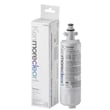
Using the exact model number prevents ordering the wrong Kenmore Elite refrigerator parts and helps us match items like the genuine Kenmore refrigerator water filter 9690 AGF80300801 to your configuration.
Last updated: February 2026
What are the common problems with Kenmore 79572183313 refrigerators?
Common problems on the Kenmore Elite 79572183313 bottom-mount refrigerator are weak or uneven cooling, ice maker and dispenser issues, water leaks, frost buildup from defrost problems, and unusual noises. We see many of these traced to airflow restrictions, door sealing issues, or failing cooling and water-system components.
Most common symptoms and what they usually point to
- Fridge warm, freezer OK (or vice versa): airflow or damper problem; check vents and the refrigerator air damper.
- Frost on back wall or poor cooling after a few days: defrost system issue; a failed defrost sensor is common.
- Water under the fridge or in crisper drawers: clogged drain path or drain tube issue.
- No ice or slow ice production: restricted water supply, clogged filter, or inlet valve problem.
- Dispenser not dispensing (but you hear clicks): switch or lever issue.
- Buzzing, rattling, or humming: fan noise, ice buildup, or compressor-related noise.
Quick checks we recommend first (before replacing parts)
- Set temps to typical targets: 37°F fresh food and 0°F freezer.
- Clean condenser coils and confirm the condenser area has good airflow.
- Make sure packages are not blocking interior air vents.
- Inspect door gaskets for gaps, tears, or areas not sealing.
- If you recently changed the filter or had water off, purge air by dispensing water for several minutes.
Parts that commonly solve these problems on this model
| Problem area | Common fix | Example part on this model |
|---|---|---|
| Water tastes bad, slow water/ice | Replace water filter | Genuine Kenmore refrigerator water filter 9690 AGF80300801 |
| Frost buildup, temp swings | Replace defrost sensor | Refrigerator defrost sensor assembly 6615JB2005R |
| No water to dispenser/ice maker | Diagnose inlet valve | Refrigerator water inlet valve AJU74532703 |
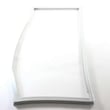
| Door not sealing, moisture/frost | Replace gasket | Refrigerator door gasket, left ADX72930460 / refrigerator door gasket, right ADX72930461 |
Why it matters
Cooling, ice, and leak complaints often share the same root causes: restricted airflow, poor door sealing, or inconsistent water flow. Fixing the underlying cause protects food temperatures, reduces frost, and prevents repeat leaks.
Helpful model-specific references
- Use the owner's manual for temperature settings, control features, and reset steps.
- If the display shows an error, match it using Kenmore 795 model bottom freezer refrigerator error codes.
Last updated: February 2026
Why is my Kenmore 79572183313 refrigerator leaking water out of the bottom?
Water leaking from the bottom of your Kenmore 79572183313 bottom-mount refrigerator is usually caused by a clogged defrost drain that overflows into the base, or a leak in the dispenser water line. Less often, a door seal problem creates heavy frost that later melts and spills. Check the 79572183313 owner's manual for the exact drain access and panel removal steps.
Most common causes (and what to look for)
- Clogged defrost drain: Water backs up, then runs under the crisper area and out the front or bottom.
- Cracked or loose water tubing: Leaks show up near the back, under the unit, or by the dispenser line routing.
- Leaking water inlet valve: Slow seepage can create intermittent puddles.
- Door gasket not sealing: Excess frost melts during defrost and can overwhelm the drain.
- Drain tube issue: A split or misrouted drain tube can dump water into the base.
Quick checks we recommend (10 to 20 minutes)
- Confirm the source: Is the water clear (often supply line) or slightly dirty (often defrost drain pan area)?
- Inspect the freezer floor: Ice sheet on the freezer bottom points to a defrost drain clog.
- Check the water filter area: Make sure the filter is fully seated; replace if the housing O-rings look damaged. Use the correct filter, such as genuine Kenmore refrigerator water filter 9690 AGF80300801.
- Look behind the refrigerator: Check for wetness at the supply connection and along the line; inspect refrigerator water tubing MJU62070602 for cracks or kinks.
- Watch for dripping at the valve: If you see moisture at the valve body or fittings, suspect refrigerator water inlet valve AJU74532703.
What to do based on where the water appears
| Where you see water | Most likely cause | Best next step |
|---|---|---|
| Under crisper drawers / front bottom | Defrost drain clog | Clear the drain and flush with hot water |
| Back right/left under unit | Supply line or inlet valve leak | Tighten fittings; inspect valve and tubing |
| Near dispenser area | Dispenser line leak | Inspect tubing routing and connections |
| After heavy frost buildup | Door gasket leak | Warm and reshape gasket; replace if torn |
Why it matters
A bottom leak can lead to floor damage and can also indicate airflow or defrost issues that reduce cooling performance. Fixing the root cause (drain, tubing, valve, or gasket) prevents repeat puddles and protects the compressor and control components from moisture.
Related DIY help: how to get rid of refrigerator puddles.
Last updated: February 2026