Owner’s manual
 Error Codes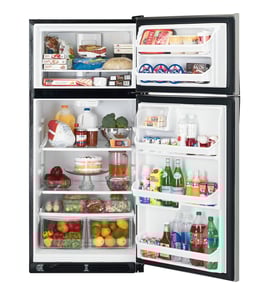



How to tell cubic feet of Kenmore refrigerator by model number?
For Kenmore model 10662153111, the most reliable way to confirm cubic feet is to look up the capacity listed for your exact model in the 10662153111 owner's manual. If you only have the model number and no spec label, you can still estimate capacity by measuring the interior and converting cubic inches to cubic feet.
Best ways to find the cubic feet (in order)
- Check the specifications/capacity section in the 10662153111 owner's manual.
- Look for a rating/spec label inside the fresh food compartment (often on a side wall or near crisper drawers).
- If the label is missing or unreadable, measure the interior and calculate an estimate.
- Use the model number to confirm you are searching the right family: Kenmore 106 models are commonly Whirlpool-built top-mount designs.
How to estimate cubic feet by measuring
- Empty the compartment enough to measure accurately.
- Measure the usable interior of the refrigerator section:
- Width (inches)
- Depth (inches)
- Height (inches)
- Multiply:
W x D x H = cubic inches. - Convert:
cubic inches ÷ 1728 = cubic feet.
Quick conversion table
| What you have | What to do | Result |
|---|---|---|
| Interior inches (W x D x H) | Multiply to get cubic inches | Total cubic inches |
| Cubic inches | Divide by 1728 | Estimated cubic feet |
Why the model number alone is not enough
Kenmore model numbers identify the manufacturer series and configuration, but they do not consistently encode the exact interior volume. Capacity can vary within the same series due to insulation thickness, shelf design, and ice maker options.
Related tip if you are comparing sizes
When comparing two top-mount refrigerators, also compare:
- Exterior width (many are around 30 to 33 inches)
- Door swing clearance and ventilation spacing (outlined in the 10662153111 owner's manual)
- Ice maker presence, which can reduce usable freezer space
Last updated: January 2026
What is the top part of a fridge called?
On a Kenmore 10662153111 top-mount refrigerator, the top compartment is the freezer. It is the section designed to keep foods frozen, and it is also where an optional ice maker typically mounts and makes ice.
What the freezer does (and what to expect)
- Keeps food at freezing temperatures for long-term storage
- Sends cold air down to help cool the fresh food section (airflow moves between sections)
- Often houses the ice maker and related wiring/water line routing (if equipped)
- Uses vents that must stay clear so temperatures stay stable
Freezer vs. refrigerator section: quick comparison
| Section | Typical purpose | Common items inside |
|---|---|---|
| Freezer (top) | Freezing and long-term storage | Frozen foods, ice, ice trays/ice bin |
| Refrigerator (bottom) | Chilled, ready-to-eat storage | Milk, produce, leftovers |
Tips that prevent temperature problems
We see airflow issues cause a lot of “not cold enough” complaints in top-mount units. For best performance:
- Do not block freezer or refrigerator vents with food packages
- Wait about 24 hours after first start-up for temperatures to stabilize
- Keep controls near the recommended setting, then adjust in small steps
- Keep doors closed as much as possible during loading
- Make sure the door seals close fully so warm air does not leak in
Why it matters
Knowing the top section is the freezer helps with troubleshooting. If the freezer is cold but the refrigerator is warm, the issue is often blocked vents, a fan/airflow problem, or control settings. The airflow and control details for your exact setup are shown in the 10662153111 owner's manual.
Last updated: January 2026
What are the common problems with Kenmore Elite refrigerators?
On the Kenmore 10662153111 top-mount refrigerator, the most common issues we see are not cooling well, excess frost or moisture, ice maker or water-related complaints, and new or unusual noises. Many are caused by airflow restrictions, door sealing problems, or a defrost-system fault; the 10662153111 owner's manual troubleshooting section helps narrow it down.
Most common symptoms and what they usually point to
- Warm refrigerator or freezer: controls off, blocked vents, dirty condenser area, or a failed evaporator fan
- Frost buildup on the back wall or freezer floor: defrost heater, defrost thermostat, or door gasket not sealing
- Noisy operation: normal compressor/fan cycling, or a failing fan motor or compressor component
- Ice tastes bad or looks gray: new plumbing, old ice, food odors, or minerals in the water (filter recommended)
- Runs a lot: first 24 hours after install, warm room, frequent door openings, or heavy food load
Quick checks we recommend first (fast, no parts)
- Confirm the control is ON and set to a normal mid-range setting.
- If it is a new setup or recently moved, allow 24 hours to cool completely.
- Make sure air vents are not blocked by food packages.
- Listen for fan noise in the freezer; no fan sound often points to the evaporator fan circuit.
- Check door closing and gasket contact all the way around.
Normal vs. problem noises (what you hear matters)
| Sound | Often normal when | More concerning when |
|---|---|---|
| Buzzing | water valve fills ice maker | constant buzzing with no ice production |
| Pulsating | fans/compressor adjust | loud grinding or squealing |
| Hissing/rattling | refrigerant flow or items on top | rattling continues after removing items |
| Sizzling/gurgling | defrost cycle | heavy frost plus warming temps |
Parts that commonly fix these symptoms on model 10662153111
- If cooling is weak and the freezer fan is not running, the refrigerator evaporator fan motor WP2315539 is a common repair.
- If frost buildup suggests a defrost failure, the refrigerator defrost heater WPW10316428 and the refrigerator bi-metal thermostat WPW10392132 are common suspects.
Why it matters
Cooling, frost control, and airflow are linked. A small issue like a weak evaporator fan or a poor door seal can cause temperature swings, excess run time, and ice quality problems.
Last updated: January 2026