 Installation guide
 Owner’s manual
 Error Codes






What is the average life expectancy of a GE dishwasher?
A GE dishwasher like model GDT545PSJ2SS typically lasts 10 to 12 years with normal household use. With consistent cleaning and prompt repairs, it’s common to reach 12 to 15 years before major components (pump, controls, seals) make replacement more practical.
What affects lifespan the most
- Water quality (hard water speeds up mineral buildup)
- How often you run it (daily use wears moving parts faster)
- Filter and spray arm cleanliness (clogs strain the circulation system)
- Door sealing and leaks (small leaks can damage wiring and controls)
- Detergent choice and loading habits (poor wash performance leads to repeat cycles)
For model-specific care and operating guidance, follow the GDT545PSJ2SS owner’s manual.
Typical lifespan ranges (what we see most often)
| Usage pattern | Typical lifespan | Notes |
|---|---|---|
| Light (2 to 4 loads/week) | 12 to 15 years | Less wear on pump and door system |
| Average (5 to 7 loads/week) | 10 to 12 years | Most common household range |
| Heavy (1 to 2 loads/day) | 8 to 10 years | Faster wear on pump, heater, latch |
Maintenance that helps you get the full lifespan
- Clean the filter area regularly; remove debris before it recirculates.
- Inspect and rinse spray arms so the jets stay open.
- Run a monthly cleaning cycle to reduce grease and mineral buildup.
- Keep the door sealing surfaces clean and dry.
- Fix small leaks early; seals and gaskets are cheaper than control damage.
If wash performance drops because the lower spray arm is clogged or cracked, replacing the dishwasher spray arm, lower WD22X33499 can restore cleaning and reduce strain on the circulation system.
Why it matters
A dishwasher that’s struggling to wash or drain often runs longer and works harder, which shortens the life of high-cost parts like the circulation pump, heater, and electronic controls. Basic upkeep helps your GDT545PSJ2SS stay efficient and reliable.
Last updated: January 2026
How do you do a hard reset on a GE dishwasher?
To hard reset a GE dishwasher like model GDT545PSJ2SS, we recommend cutting power at the breaker (or unplugging) for a few minutes, then restoring power and starting a new cycle. You can also cancel a running cycle by holding Start/Reset for 3 seconds.
Reset options for GDT545PSJ2SS
Use the method that matches what the dishwasher is doing.
- Control reset (quick cancel/drain): Press and hold Start/Reset for 3 seconds to cancel the cycle and begin draining.
- Hard reset (power cycle): Turn OFF the dishwasher’s power at the breaker (or unplug it), wait 2 to 5 minutes, then turn power back ON.
- After reset: Close the door firmly, select a cycle, then press Start/Reset to begin.
For model-specific button locations and cycle behavior, refer to the GDT545PSJ2SS owner’s manual.
What to check if it still will not start after a reset
A reset clears many control glitches, but it will not fix a door-latch or power-supply problem.
- Confirm the door is fully latched (a loose latch can prevent starting).
- Check the breaker is fully reset (OFF then ON).
- Make sure Delay Start is not selected.
- If the dishwasher starts then stops, look for an error code and use GE dishwasher error codes.
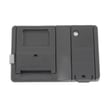
- If the controls respond inconsistently, the user interface may be involved (see configured ui control WD21X31910).
Quick comparison: hard reset vs. Start/Reset
| Reset method | What it does | When to use it |
|---|---|---|
| Hold Start/Reset 3 seconds | Cancels cycle and drains | Stuck mid-cycle, needs cancel |
| Power off 2 to 5 minutes | Reboots control memory | Frozen keypad, odd behavior, repeated glitches |
Why it matters
Resetting the control is a safe first step because it can clear temporary electronic faults without replacing parts. If the issue returns quickly, it often points to a latch, wiring, or control-related problem that needs troubleshooting.
Last updated: January 2026
Can a clogged drain cause an FTD error?
Yes. On the GE GDT545PSJ2SS dishwasher, an FTD error can happen when the unit cannot drain the tub down properly before it tries to fill again. A clogged drain path leaves water in the sump, which can confuse the fill and level sensing.
What to check first (fast, no-parts steps)
- Cancel the cycle and let the dishwasher drain; then open the door and confirm whether water is still standing.
- Remove the lower rack and check the sump area for food debris, labels, or broken glass.
- Clean the coarse filter area and rinse it thoroughly; reinstall it fully seated.
- Check the sink drain and garbage disposer connection; make sure the disposer inlet plug was removed.
- Inspect the drain hose under the sink for kinks, pinches, or a low loop that can cause backflow.
Drain system items that commonly cause FTD
If the drain path is clear but the dishwasher still will not drain, the issue is often in one of these components.
| Symptom you see | Most likely area | What it means |
|---|---|---|
| Water remains in tub after cancel/drain | Drain pump or blockage at pump inlet | Pump cannot move water out |
| Drains slowly | Partial clog in hose or air gap | Restriction limits flow |
| Drains but error returns | Intermittent restriction or sensor/controls logic | Drain down is not consistent |
Parts to consider if it will not drain
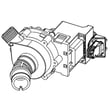
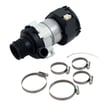
If troubleshooting points to a failed pump, the compatible replacement for this model is the dishwasher drain pump kit WD19X25187.
Why it matters
FTD is often a “fill-time” style fault, but the dishwasher has to start from an empty (or properly drained) tub. Fixing the drain restriction first prevents repeat errors, poor cleaning, and standing water odors.
Helpful reference
For model-specific setup details like drain hose routing and high loop guidance, use the GDT545PSJ2SS installation guide.
Last updated: January 2026
What is the most common problem with a GE dishwasher?
For the GE GDT545PSJ2SS dishwasher, the most common issues we see are draining problems (water left in the tub), not starting, and leaking. These usually trace back to a clog in the drain path, a door-latch problem, or a worn seal rather than a major failure.
Most common GE dishwasher problems (and what to check first)
- Won’t drain / standing water: check the filter area for debris, then confirm the disposer drain plug is removed and the drain hose is not kinked.
- Won’t start: confirm the door closes and latches firmly; a weak latch can prevent the cycle from beginning.
- Leaks: inspect the tub gasket and door area for tears, gaps, or buildup that prevents sealing.
- Poor cleaning: look for blocked spray arm holes and verify the spray arms spin freely.
- Filling issues: confirm the water supply is on and the inlet valve is not restricted.
For installation-related drain and fill checks (air gap, high drain loop, hose routing), follow the steps in the GDT545PSJ2SS installation guide.
Parts that commonly solve these symptoms on GDT545PSJ2SS
If troubleshooting points to a failed component, these model-compatible parts are common fixes:
| Symptom | Likely area | Example model-compatible part |
|---|---|---|
| Won’t drain / drains slowly | Drain pump or drain path | Dishwasher drain pump kit WD19X25187 |
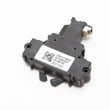
| Won’t start / stops when door moves | Door latch | GE dishwasher door latch lock WD21X10490 |
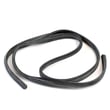
| Leaks at the door/tub edge | Door/tub sealing | Dishwasher tub gasket WD08X23476 |
| Poor cleaning / weak spray | Spray system | Dishwasher spray arm, lower WD22X33499 |
Why it matters
Drain, latch, and seal problems can look like “big” failures, but they often cause the most common complaints: water left in the bottom, cycles that won’t begin, and puddles on the floor. Catching them early helps prevent repeat clogs, odor, and water damage.
Last updated: January 2026





