Installation guide
 Owner’s manual
 Error Codes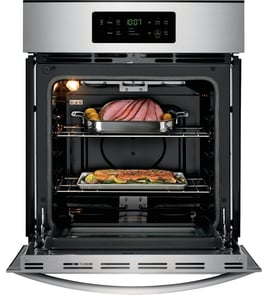



How do I reset a wall oven?
To reset your Kenmore wall oven model 79049413314, turn the oven off, then cycle power at the circuit breaker for about 1 minute and restore power. After power returns, reset the clock and reselect your cooking function as needed (a power interruption can require this). See the 79049413314 owner's manual for the exact control steps.
Quick reset steps (most common)
- Press STOP/CANCEL to end any active cooking cycle.
- Turn OFF the breaker (or remove the fuse) that supplies the wall oven.
- Wait 60 seconds.
- Turn the breaker ON.
- Reset the clock, then test Bake at 350°F.
If the display shows “LOC” or “DOOR LOCKED”
Your oven may be in Oven Lockout mode, which prevents the oven from turning on.
- Press and hold the Oven Lockout key for 3 seconds.
- Wait up to 15 seconds for the door to fully unlock.
- Try starting a normal Bake cycle again.
Reset options: power reset vs. factory default
| Reset type | What it fixes | What you may lose |
|---|---|---|
| Power reset (breaker off/on) | Frozen keypad, odd display behavior after a power glitch | Usually nothing, but you may need to reset the clock |
| Factory default reset | Restores user preferences to original settings | Temperature offset, stored recipes, preference settings |
How to restore factory default settings
When the oven is idle (no cooking function running):
- Press and hold the 7 key for about 6 seconds (until the acceptance tone).
- Press START to confirm.
Why it matters
A proper reset clears control glitches and ensures the electronic oven control is operating with the correct time and settings. This helps prevent unexpected operation after a power interruption and improves temperature and timing accuracy.
Last updated: January 2026
Are all 30 inch wall ovens the same size?
No. “30-inch” is a category, not an exact measurement. For Kenmore wall oven model 79049413314, the installation guide shows a 30-inch cabinet cutout width range of 28 1/2 to 29 inches, so different 30-inch wall ovens can vary and are not automatically interchangeable. See the installation guide for the exact cutout dimensions.
What “30-inch” usually means
Manufacturers label wall ovens by a nominal width (24, 27, 30 inches), but the required cabinet cutout and the oven’s overall dimensions can differ by model.
Common differences between “30-inch” wall ovens include:
- Cutout width minimum and maximum
- Cutout height (single vs. double oven)
- Cutout depth (often critical for trim to sit flush)
- Door depth when open and required clearance
- Electrical junction box location and conduit routing
Key dimensions to compare before you buy or swap
Use this checklist when comparing your existing opening to a replacement oven:
- Cutout width (side-to-side opening)
- Cutout height (especially if switching single to double)
- Cutout depth (the guide notes depth is critical for proper fit)
- Support/base capacity (the guide references higher weight capacity for 30-inch models)
- Clearances for door swing and nearby cabinets
Quick comparison (what to measure)
| Measurement | Where you measure | Why it matters |
|---|---|---|
| Cutout width | Inside cabinet opening | Prevents binding or large gaps |
| Cutout height | Inside cabinet opening | Ensures trim covers the opening |
| Cutout depth | Front of cabinet to back wall | Helps the oven sit flush and reduces vibration/noise |
Why it matters
A wall oven that is “30-inch” but has a different cutout range can leave gaps, prevent the trim from sealing to the cabinet, or require cabinet modification. Matching the cutout specs avoids fit issues and helps the oven cool and vent as designed.
Last updated: January 2026
Are electric wall ovens 110 or 220?
Most electric wall ovens, including Kenmore model 79049413314, are designed for a 240-volt (often called 220-volt) circuit, not a standard 120-volt (110-volt) outlet. The exact electrical hookup method (cord vs. junction box) and requirements are listed in the 79049413314 installation guide.
What to expect for power and wiring
In U.S. homes, electric wall ovens typically use a dedicated 240V circuit because heating elements need higher wattage than a 120V circuit can safely provide.
Common setup details:
- Dedicated 240V circuit with the correct breaker size for the oven
- Hardwired connection to a junction box (common for built-in wall ovens)
- Proper grounding per electrical code
- Correct wire gauge for the circuit and distance
- Installation that follows local codes and ordinances
Quick comparison: 120V vs. 240V for ovens
| Item | 120V (110V) outlet | 240V (220V) circuit |
|---|---|---|
| Typical use | Small countertop appliances | Electric wall ovens, electric ranges |
| Heat output | Limited | High, supports bake and broil elements |
| Connection | Plug-in receptacle | Often hardwired to junction box |
How to confirm what your oven needs
We recommend checking these items before installation or troubleshooting power issues:
- Review the electrical connection section in the 79049413314 installation guide
- Verify the home supply at the breaker panel (a 2-pole breaker usually indicates 240V)
- Confirm the oven is properly grounded
- Make sure the junction box location and cable routing match the install requirements
Why it matters
Using the wrong voltage can prevent the oven from heating correctly, cause nuisance breaker trips, or damage wiring connections. Correct voltage and grounding also help the control board, bake element, and broil element operate reliably.
Last updated: January 2026