Error Codes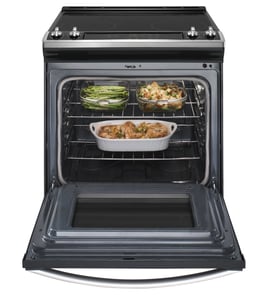

How do I tell what model Kenmore stove I have?
Your Kenmore stove’s model number is printed on the appliance ID label; once you find it, match that exact number to the parts list for accurate fit. For this page, the model is Kenmore 91195582992.
Check these common locations on Kenmore electric ranges:
- Oven door frame: open the oven door and look around the frame
- Storage drawer area: pull the bottom drawer out and look on the frame behind it
- Under the cooktop: lift the cooktop (if your design allows) and look near the burners/elements
- Back panel: look on the rear of the range near the power cord entry
- Side frame: sometimes on the lower side panel near the front
Kenmore model numbers are usually numbers with no spaces (sometimes with dots or dashes on the label). Use the full model number exactly as shown.
| Label text you might see | What to copy | Example |
|---|---|---|
| Model, Model No., MOD | The full model number | 91195582992 |
| Serial, S/N | Serial number (optional for parts) | Varies |
Small model differences can change which bake element, temperature sensor, door hinge, or surface element switch fits.
- Wrong model number can mean wrong electrical connectors or mounting points
- Some parts vary by color/finish (for example, door panels)
- Heating and temperature-control parts must match the correct design
If your goal is to identify the range because of an error or heating problem, our DIY guides can help narrow it down:
Once you confirm your model number, you can choose parts that are listed for that exact model, such as a sensor or heating element. For example:
Last updated: February 2026
What causes a Kenmore oven to stop working?
On the Kenmore electric range model 91195582992, an oven that “stops working” is usually caused by a loss of power to the range, a failed heating circuit (bake or broil), or a temperature-sensing/control problem that prevents the oven from heating even though the display and lights may still work.
- Tripped breaker or loose power cord connection: Electric ranges typically need a full 240V supply.
- Failed bake element: The oven may not heat, or heats very slowly.
- Failed broil element: Some models use broil to help preheat; baking can be weak.
- Bad oven temperature sensor: The control may shut heat off early or not heat at all.
- Control or wiring issue: Burned wire terminals, a failed relay, or a damaged harness can stop heating.
- Confirm the range has full power (reset the double breaker fully OFF, then ON).
- Set Bake to 350°F and watch for heat after 5 to 10 minutes.
- Look for visible damage:
- Bake element blistering, cracks, or holes
- Broil element hot spots or breaks
- Melted or darkened wire connectors at the element terminals
- If the oven heats erratically or shows wrong temps, suspect the sensor.
- If the cooktop works but the oven never heats, focus on bake/broil circuits and sensor.
| Symptom | Most likely part | Example part for 91195582992 |
|---|---|---|
| No bake heat | Bake element | G.e. range bake element WB44T10014 |
| No broil heat | Broil element | Range broil element WB44T10009 |
| Temps way off or no heat command | Oven temperature sensor | Wall oven temperature sensor WB23X5340 |
When an electric oven stops heating, the cause is often a single failed component (like a bake element or sensor). Checking power first prevents unnecessary parts replacement, and inspecting wiring helps avoid repeat failures from overheated terminals.
Last updated: February 2026
Where is the fuse on a Kenmore oven?
On the Kenmore 91195582992 electric range, the “fuse” people mean is usually a thermal fuse or high-limit safety device; it’s typically mounted on the back of the oven cavity or rear panel area, near where the bake or broil wiring connects.
Many Kenmore electric ranges protect the oven with one or more heat-safety parts rather than a simple plug-in fuse.
- A thermal fuse or high-limit device is commonly on the rear of the range (behind the back panel).
- It’s often close to the oven wiring harness and element terminals.
- Some models use a temperature sensor instead of a fuse for temperature control issues.
- A tripped house breaker can look like a “blown fuse” symptom (dead oven, no heat).
- Access usually requires pulling the range out and removing the rear cover.
Before you remove panels, we recommend these basics:
- Turn off power at the breaker (240V); confirm the cooktop and oven are fully off.
- Pull the range forward carefully to avoid damaging the power cord.
- Remove the rear access panel screws and lift the panel off.
- Look for a small, flat device with two wires (often on the back of the oven cavity).
- If you see heat damage on wiring or terminals, stop and correct that before replacing parts.
If the oven is not heating or heats erratically, these parts are the most common suspects.
| Symptom | Most likely area | Common part to inspect |
|---|---|---|
| Oven won’t heat at all | Oven safety circuit or element | G.e. range bake element WB44T10014 |
| Oven overheats or shows temp-related faults | Temperature sensing circuit | Wall oven temperature sensor WB23X5340 |
| Broil doesn’t work | Upper element circuit | Range broil element WB44T10009 |
A thermal fuse or high-limit device is a safety cutoff; replacing it without fixing the overheating cause (blocked venting, failed cooling airflow, damaged wiring, stuck relay) can lead to repeat failures and unsafe operation.
Last updated: February 2026