Owner’s manual
 Error Codes




How to remove bottom grille on GE refrigerator?
On the GE GNE25JMKAFES bottom-mount refrigerator, we remove the bottom (base) grille by taking out the two Phillips-head screws, then pulling the grille off. This gives access to the leveling legs and the lower front area. See the GNE25JMKAFES owner's manual for the exact screw locations.
Steps to remove the bottom grille
- Unplug the refrigerator if you will be working near wiring or moving the unit.
- Open the fresh-food doors for easier access to the lower front edge.
- Locate the two Phillips-head screws securing the base grille.
- Remove both screws and set them aside.
- Pull the grille straight off the front (it will release once the screws are out).
Reinstalling the grille (quick check)
After leveling, cleaning, or service, reinstall the grille so it sits flush and does not rattle.
| Task | What to do | What to look for |
|---|---|---|
| Refit grille | Position grille on the lower front | Even gaps left to right |
| Secure | Reinstall the 2 Phillips screws | Grille does not shift |
| Final check | Open/close doors and listen | No rubbing or vibration |
Why it matters
The base grille is part of routine service access on this GE refrigerator. You typically remove it to adjust the leveling legs (to stop wobbling), clean dust from the lower front area, or access components during troubleshooting.
Last updated: January 2026
What is the most common problem with a GE refrigerator?
The most common issue we see with GE refrigerators like model GNE25JMKAFES is a cooling complaint (fresh food too warm, freezer too warm, or temperature swings). In many cases, the root cause is airflow or heat removal problems, not the sealed system itself.
Most common causes to check first
- Dirty condenser coils causing poor heat release and weak cooling
- Door not sealing well (warm air leaks in, moisture and frost increase)
- Evaporator fan not running or running intermittently (cold air not circulating)
- Defrost system trouble leading to frost buildup on the evaporator
- Temperature sensing or control issues (sensor or main board)
Quick checks you can do in 10 minutes
- Confirm controls are set to normal operating temperatures (avoid extreme settings).
- Make sure doors close fully and nothing is holding them open.
- Listen for the evaporator fan when the doors are closed; it should run during cooling.
- Look for heavy frost on the freezer back wall (often points to a defrost problem).
- Clean condenser coils and verify the condenser fan is running when the compressor runs.
Parts that commonly relate to cooling problems on this model
| Symptom | Common area | Example part for GNE25JMKAFES |
|---|---|---|
| Warm refrigerator section | Airflow in freezer | Evaporator fan motor |
| Frost buildup, warming over time | Defrost system | Defrost heater or defrost thermostat |
| Temperature swings | Sensing/control | Temperature sensor |
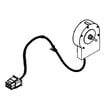
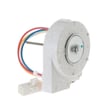
If testing points to a failed component, common matches for this model include the refrigerator evaporator fan motor WR60X32614 and the GE GNE25JMKAFES manual for access steps and safety notes.
Why it matters
Cooling problems can spoil food quickly and can also make the refrigerator run longer than normal. Catching airflow, defrost, or gasket issues early often prevents bigger failures and reduces energy use.
Last updated: January 2026
Which is better top mount or bottom mount fridge?
A bottom-mount refrigerator like the GE GNE25JMKAFES is better for everyday convenience because the fresh-food section sits higher, so you bend less for the items you use most. A top-mount is better when you want a simpler layout that is typically easier and cheaper to maintain.
Quick comparison: top mount vs bottom mount
| Feature | Top mount (freezer on top) | Bottom mount (freezer drawer) |
|---|---|---|
| Fresh-food access | More bending | Less bending, easier daily access |
| Freezer access | Eye-level shelves | Pull-out drawer, good for sorting |
| Organization | Basic shelves and bins | Often more baskets and dividers |
| Energy use (typical) | Often slightly lower | Often slightly higher |
| Repairs (typical) | Often simpler | More drawer hardware and seals |
How to choose based on how you use your refrigerator
- If you cook often and use fresh items daily, bottom-mount feels more efficient.
- If you use the freezer more than the fridge, top-mount can be more convenient.
- If you want fewer moving parts, top-mount designs are typically simpler.
- If you store lots of frozen bulk items, a bottom drawer can be easier to organize with baskets.
- If you have limited mobility, bottom-mount reduces bending for everyday items.
Fit and installation notes for GE GNE25JMKAFES
Clearances and exact dimensions vary depending on whether you measure cabinet depth, door swing, and handles. Use the GNE25JMKAFES owner’s manual to confirm the correct measurement method for your kitchen and to follow GE’s guidance for moving the refrigerator through doorways and setting proper clearances.
Why it matters
The “better” style is the one that matches your daily habits. The freezer location changes how often you bend and reach, how groceries stay organized, and how easy the refrigerator is to service over time.
Last updated: January 2026