 Owner’s manual
 Error Codes




Are bottom mount fridges better?
Yes, a bottom-mount refrigerator is better for many households because the fresh-food section sits at eye level, so you reach for everyday items with less bending. For the Kenmore 59679272990 bottom-mount design, it is a strong choice if you use the refrigerator compartment more often than the freezer.
When a bottom-mount refrigerator is the better fit
- You want fresh food (produce, drinks, leftovers) at a more comfortable height
- You open the refrigerator door far more often than the freezer drawer
- You prefer wider refrigerator shelves and easier visibility of items
- You are OK bending to access frozen foods
- You want a layout that typically feels more “kitchen-workflow friendly”
Trade-offs to consider
Bottom-mount models are not automatically “better” for every home. Here is what to weigh:
| What you care about | Bottom-mount refrigerator | Top-freezer refrigerator |
|---|---|---|
| Daily access to fresh food | Easier | More bending |
| Daily access to frozen food | More bending | Easier |
| Organization | Often easier to see fresh items | Often easier to see frozen items |
| Door swing and clearance | Needs planning near walls/cabinets | Needs planning near walls/cabinets |
Installation details that matter for performance
A bottom-mount refrigerator works best when it is installed with proper clearance and leveling. In the owner's manual, we call out common setup needs such as:
- Allowing about 1 inch of space above the refrigerator for ventilation
- Leaving extra space behind the unit if you have an ice maker and water line
- Leaving about 2 1/2 inches on the hinge side (varies by model) if installed next to a fixed wall so the door can open 90°
- Leveling so the front is slightly higher than the back (helps doors seal and close properly)
Why it matters
“Better” usually comes down to comfort and food visibility. If fresh-food access is your priority, a bottom-mount layout reduces daily bending and helps you spot items sooner, which can cut down on forgotten food and temperature swings from long door-open time.
Last updated: February 2026
How do I know what model Kenmore refrigerator I have?
Your Kenmore refrigerator’s model number is printed on the serial plate inside the fresh food (refrigerator) compartment. For Kenmore model 59679272990, the Use and Care Guide notes the serial plate is typically on the top left wall of the refrigerator compartment; record that number to match the correct parts and instructions in the 59679272990 owner's manual.
Where to look for the model number
Check these common spots first (use a flashlight):
- Top left wall inside the refrigerator compartment (most common for this Kenmore style)
- Side wall inside the fresh food compartment
- Ceiling area inside the fresh food compartment
- Behind or above the crisper drawers
- On the frame just inside the door opening (near the gasket)
What the model number looks like (Kenmore)
Kenmore model numbers are usually a string of numbers and may include a prefix.
| What you see | What it means | What to do next |
|---|---|---|
596... |
Kenmore model family identifier (common on many bottom-freezer units) | Use the full number to match diagrams and parts |
Full model like 59679272990 |
Your exact model | Use this exact number when searching parts |
| Serial number | Production identifier | Helpful for confirming version/series |
Why it matters
Using the exact model number prevents ordering the wrong refrigerator water filter, door bin, crisper drawer, ice maker parts (some models), or control components. Even small design updates can change fit and wiring.
Quick tips before you order parts
- Write down the full model number and serial number exactly as shown
- Take a clear photo of the serial plate for reference
- Use the model number to cross-check diagrams and troubleshooting steps in the 59679272990 owner's manual
- If the label is damaged, look for a second label near the door frame or behind drawers
Last updated: February 2026
How to tell if a Kenmore refrigerator compressor is bad?
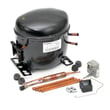
A bad compressor on your Kenmore 59679272990 bottom-mount refrigerator shows up as poor or no cooling with repeated clicking, a loud hum that stops quickly, or long run times with warm temperatures. First rule out power, controls, and a normal defrost cycle.
Quick checks first (common look-alikes)
- Make sure the freezer control is turned on.
- Verify the outlet has power (plug in another item).
- Check the house fuse or circuit breaker.
- If the light works but the fans and compressor are not running, wait about 40 minutes; it may be in a defrost cycle.
- Clean the condenser coils; dirty coils cause warm temps and excessive run time.
Normal sounds vs. warning signs
Your model can make normal sounds such as a control click when the compressor starts or stops, refrigerant gurgling, and a high-pitched hum while running. Warning signs are clicking every few minutes with no sustained run, or a hum followed by a quick shutoff.
Symptom guide
| What you notice | More likely cause | Next step |
|---|---|---|
| Clicks repeatedly, not cooling | Start device/overload or compressor not starting | Inspect wiring, then electrical tests |
| Runs a lot, still warm | Dirty coils, airflow issue, or sealed-system problem | Clean coils, confirm fans run |
| Loud hum then stops | Compressor struggling to start | Test compressor circuit |
Basic electrical confirmation (when you are qualified)
- Unplug the refrigerator before accessing components.
- Inspect for loose, burnt, or damaged wires and connectors.
- Use a multimeter to check winding resistance and check for a short to ground.
Why it matters
Compressor and sealed-system repairs are major; ruling out defrost, power, and condenser-coil issues prevents unnecessary replacement.
For model-specific troubleshooting and operating notes, use the owner's manual.
Last updated: February 2026
What are the most common problems with Kenmore refrigerators?
The most common issues we see on Kenmore refrigerators like model 59679272990 are cooling problems (warm fridge or freezer), frequent running, moisture or water droplets, door sealing issues, and ice maker water-supply leaks on equipped models. Many of these start with airflow restrictions, dirty condenser coils, or control settings.
Most common symptoms and what usually causes them
- Not cooling or temperatures too warm: blocked return air vents, warm food load, doors opened often, dirty condenser coils, or control settings needing adjustment
- Runs too frequently: dirty condenser coils, poor door gasket seal, frequent door openings, or warm food recently added
- Moisture inside the refrigerator: high humidity, frequent door openings, unwrapped food, damp containers
- Moisture outside the refrigerator: door gasket not sealing tightly, high humidity, frequent door openings
- Ice maker not making ice (some models): water supply not turned on, ice maker arm not in the “on” position, or first ice harvest still within the 24-hour startup window
Quick checks we recommend first (in order)
- Confirm controls are on and give the unit time to stabilize after changes (several hours).
- Check airflow: make sure the return air vent behind the crispers is not blocked by food or debris.
- Inspect door gaskets: gaskets should seal tightly all the way around the cabinet.
- Clean condenser coils: dirty coils commonly cause warm temps and long run times.
- Verify power: confirm the refrigerator is firmly plugged into a properly grounded 3-prong outlet; check the breaker or fuse.
Symptom-to-fix guide
| Symptom | Most likely first fix | What to watch for |
|---|---|---|
| Fridge warm | Clear vents; adjust controls | Temps improve over a few hours |
| Runs constantly | Clean condenser coils | Compressor run time drops |
| Water droplets inside | Reduce door openings; wrap food | Moisture decreases |
| Water droplets outside | Reseat/clean gasket | No sweating around doors |
| No ice (some models) | Turn on water; set ice maker arm “on” | Up to 24 hours for first batch |
Why it matters
Cooling and moisture complaints often trace back to airflow and heat rejection. When vents are blocked or condenser coils are dirty, the refrigerator cannot move heat out efficiently, so temperatures rise and the unit runs longer.
For model-specific operating checks (controls, vent locations, leveling, and the “before calling for service” checklist), use the owner's manual.
Last updated: February 2026





