Installation guide
 Owner’s manual
 Error Codes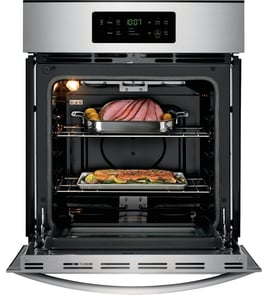


Are electric wall ovens 110 or 220?
Most Kenmore electric wall ovens, including model 79048452410, are wired for a 208/240-volt supply (often called “220V”), not a standard 120-volt (110V) outlet. This model is typically hardwired to a junction box rather than plugged into a regular receptacle; see the 79048452410 installation guide.
What power supply this wall oven uses
For built-in electric wall ovens, the normal setup is a dedicated circuit feeding a junction box.
- Voltage: 208/240 VAC supply (common for electric wall ovens)
- Connection type: hardwired to a junction box (not a standard plug)
- Circuit: dedicated breaker sized for the oven’s electrical load
- Grounding: required; follow local electrical codes
Quick comparison: 120V vs 208/240V
| Item | 120V (standard outlet) | 208/240V (wall oven supply) |
|---|---|---|
| Typical use | small appliances, some gas ranges | electric wall ovens, electric ranges, dryers |
| Connection | receptacle and plug | junction box hardwire |
| Breaker | usually 15A or 20A | commonly 30A to 50A (varies by model) |
Before you install or troubleshoot
We recommend confirming the supply at the breaker panel and junction box before moving the oven into place.
- Turn off the breaker before opening any electrical box
- Verify you have a dedicated 2-pole breaker for the oven circuit
- Check for tight, undamaged wire connections at the junction box
- If the oven is completely dead, inspect for heat-damage at connections and consider testing the terminal block 5304409888 if your installation uses one
Why it matters
Using the wrong voltage or an undersized circuit can cause no-heat symptoms, nuisance breaker trips, or damage to electrical components like the relay control board and wiring harness.
Last updated: January 2026
What is the best electric wall oven to buy?
For most homes, the “best” electric wall oven is the one that fits your cabinet cutout, matches your electrical supply, and has the features you will actually use. If you already own a Kenmore Elite wall oven like model 79048452410, the best value is often keeping it running with the right parts and correct installation details from the 79048452410 installation guide.
How we recommend choosing the best wall oven
Focus on fit, power, and cooking performance first; brand and smart features come after.
- Size and cutout fit: Most wall ovens are 27-inch or 30-inch; confirm your cabinet cutout width, height, and depth.
- Electrical requirements: Built-in ovens typically need a dedicated 120/240V or 120/208V, 60 Hz circuit with proper breaker sizing.
- Cooking features: Convection, self-clean, probe cooking, and multi-rack baking can matter more than Wi-Fi.
- Serviceability: Availability of common parts (sensor, control board, door seal, bake element) helps long-term ownership.
- Budget: A reliable single oven can be a better buy than a feature-heavy model that does not fit your cutout.
Quick comparison: what “best” means for most shoppers
| Priority | What to verify | Why it matters |
|---|---|---|
| Fit | 27-inch vs 30-inch cabinet cutout | Avoids costly cabinet modifications |
| Power | Correct voltage and breaker size | Prevents nuisance trips and overheating |
| Performance | Convection fan, accurate temperature | More even baking and roasting |
| Ownership | Parts availability and repair access | Lower lifetime cost |
If you are deciding whether to replace or repair your Kenmore Elite 79048452410
If your oven heats unevenly, runs hot/cold, or will not maintain temperature, repair is often practical because the most common failure items are replaceable.
Common parts that affect baking accuracy and heating:
- Range oven temperature sensor 5304504897 (helps regulate oven temperature)
- Wall oven bake element, 2,200-watts 5304501015 (primary heat source for bake)
- Wall oven relay control board 316475806 (routes power to heating circuits)
- Wall oven door seal 139036700 (reduces heat loss and improves temperature stability)
Why it matters
Wall ovens are built-in appliances; the wrong size or electrical setup can turn a “top-rated” oven into a bad purchase. Starting with cutout dimensions and electrical requirements ensures the oven you choose will install safely and perform correctly.
Last updated: January 2026
What size breaker and wire for 20 amp wall oven?
For the Kenmore Elite wall oven model 79048452410, a 20-amp, 120/240V (or 120/208V) dedicated circuit is used when the oven’s nameplate wattage falls in the lowest range shown in the installation requirements table. Use wire size that matches the breaker and local electrical code; confirm the exact rating on the serial plate and in the 79048452410 installation guide.
How to choose the correct breaker size (use the oven’s wattage)
We size the breaker from the oven’s nameplate wattage (serial plate), not from a guess. The installation instructions direct you to find the wattage on the serial plate and then use the table to select protection.
Typical guidance from the installation requirements table:
| Oven rating (watts) | Recommended protection (240V) | Recommended protection (208V) |
|---|---|---|
| Less than 4800W | 20A | Less than 4100W: 20A |
| 4801W to 7200W | 30A | 4101W to 6200W: 30A |
| 7201W to 9600W | 40A or 50A | 6201W to 8300W: 40A or 50A |
| 9601W and up | 50A | 8301W and up: 50A |
Wire size and circuit setup basics
Your wall oven should be on an individual, properly grounded branch circuit with protection on both hot legs.
Key points to follow:
- Use a dedicated circuit (no other loads on the same breaker).
- Use copper conductors sized for the breaker and the run length (voltage drop matters on long runs).
- Use a time-delay fuse or circuit breaker if fuses are used.
- Do not fuse the neutral (if present).
- Use the correct supply type: 3-wire or 4-wire, single-phase 120/240V or 120/208V, 60 Hz.
Why it matters
An undersized breaker or wire can cause nuisance tripping, overheating at connections (junction box or terminal block), and unreliable baking performance. Correct sizing protects the oven’s controls, heating elements, and wiring.
Quick safety checklist before any electrical work
- Turn off power at the breaker and verify power is off.
- Follow the wiring diagram and connection method in the 79048452410 installation guide.
- If you see heat damage at the connection point, inspect the terminal block 5304409888 and wiring before restoring power.
Last updated: January 2026
Can a 30 inch wall oven fit in a 30 inch cabinet?
Yes, a 30-inch wall oven can fit in a 30-inch cabinet when the cabinet cutout is built to the required cutout width, height, and depth. For the Kenmore Elite 79048452410 30-inch single wall oven, the installation guide shows a minimum cabinet cutout width of about 30 1/8 inches and a cutout height around 28 1/4 inches (with shimming options if the opening is taller); confirm your exact opening using the installation guide.
What “30-inch cabinet” really means
Cabinet and oven sizes are nominal. What matters is the cutout (the opening the oven slides into), not the label on the cabinet.
Check these before you buy or install:
- Cutout width: must meet the oven’s minimum (often slightly over 30 inches)
- Cutout height: must match the oven’s required range
- Cutout depth (Dimension G): must be correct so the trim sits flush and convection models do not rub or make noise
- Door clearance: allow space in front for the door when open
- Electrical junction box location: must be accessible and within the allowed area
Cutout sizing guidance for this model
Based on the installation excerpt for 27-inch and 30-inch single wall ovens, the 30-inch cutout width is slightly larger than 30 inches.
| Measurement (single wall oven) | Typical requirement shown | Why it matters |
|---|---|---|
| Cutout width (cabinet opening) | Min. ~30 1/8 in. | Prevents binding and allows the oven to slide in |
| Cutout height | ~28 1/4 in. standard | Ensures the oven side rails sit correctly |
| Cutout depth (G) | Critical (verify) | Ensures trim fits tight to cabinet and avoids noise |
If your opening is slightly off
These are common, safe fit-up options mentioned in the installation instructions:
- If the cutout height is greater than 28 1/4 inches, use 2-inch wide wood shims under the appliance side rails (one on each side)
- If the opening is taller than the standard range, a larger bottom trim may be available through a service center
- If the trim does not sit against the cabinet, re-check cutout depth (G) and cabinet squareness
Why it matters
A wall oven that is forced into a too-tight cutout can sit crooked, leave gaps around the trim, or cause vibration and noise (especially on convection models). Correct cutout dimensions also help the oven mount securely to the cabinet.
Last updated: January 2026