Owner’s manual
 Error Codes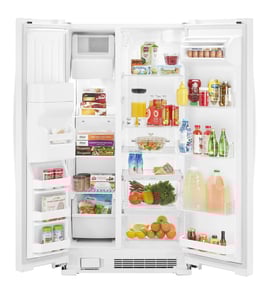


How to reset a GE side by side refrigerator?
To reset your GE GSS25SGMDBS side-by-side refrigerator, we recommend a simple power reset first: unplug the refrigerator (or switch off the breaker) for about 2 to 5 minutes, then restore power and allow temperatures to stabilize. This clears many minor control glitches.
Quick reset methods that work on most GE side-by-side models
- Power cycle reset: Unplug for 2 to 5 minutes, then plug back in.
- Breaker reset: Turn the refrigerator circuit breaker OFF, wait 2 to 5 minutes, then turn it ON.
- Control “OFF” reset (cooling stop): Set the freezer control to 0 to stop cooling, wait about 5 minutes, then return it to your normal setting.
- Stabilization time: After any reset or control change, allow 12 hours for temperatures to stabilize.
What to check after the reset
After power is restored, confirm these basics so the refrigerator can recover normally:
- Make sure the freezer control is not still set to 0 (off).
- Verify the plug is fully seated in the outlet.
- Check for a tripped breaker or blown fuse.
- Confirm doors are closing fully and not being held open by packages.
- If the dispenser is unresponsive, press and hold LOCK CONTROL for 3 seconds to unlock it.
Recommended starting settings (GSS25SGMDBS)
The owner’s manual guidance for initial temperature setup is:
| Compartment control | Recommended starting point | What to expect |
|---|---|---|
| Fresh food | 5 | Stabilizes in about 12 hours |
| Freezer | 5 | Stabilizes in about 12 hours |
For exact control locations and your model’s specific features, use the owner's manual.
Why it matters
A reset restores normal operation after brief power interruptions or minor electronic “bugs,” but the refrigerator still needs time to pull temperatures back down. Changing settings too quickly can make cooling performance look worse than it is.
Last updated: February 2026
How long do GE side by side refrigerators last?
Most GE side-by-side refrigerators, including model GSS25SGMDBS, typically last 13 years with normal household use and basic maintenance (cleaning, correct temperatures, and good airflow). Keeping the doors sealing well and the condenser area clean helps you reach that lifespan.
Typical lifespan and what affects it
A refrigerator’s life depends more on operating conditions than brand alone.
- Heat and airflow: blocked airflow under/behind the cabinet makes the sealed system work harder
- Door openings: frequent, long door openings increase run time and wear
- Cleaning habits: dust buildup around the condenser area raises operating temperatures
- Water quality: heavy sediment can shorten the life of water system parts and filters
- Power quality: repeated outages or tripped breakers can stress controls and motors
What “end of life” usually looks like
These symptoms often show up as a refrigerator approaches the end of its service life:
| Symptom | Common cause area | What to check first |
|---|---|---|
| Warm fresh food section | airflow/defrost issue | frost buildup on rear freezer panel |
| Freezer warms, fridge warms | sealed system or fans | condenser fan running, vents clear |
| Ice maker or dispenser problems | water supply/valve/filter | filter age, water pressure, frozen line |
| Temperature swings | sensors/control | settings, door seals, airflow |
If you’re troubleshooting temperature problems on GSS25SGMDBS, the owner's manual is the best place to confirm control settings and basic checks.
Maintenance that helps you hit the full lifespan
We recommend these practical steps for GE side-by-side units:
- Keep freezer near 0°F and refrigerator near 37°F
- Clean dust from the condenser area regularly (more often with pets)
- Avoid overpacking; leave space for air to circulate
- Replace the water filter on schedule; for this model, use the refrigerator water filter MWFP
- Confirm doors close fully and gaskets seal all the way around
Why it matters
A side-by-side that runs hot, has restricted airflow, or has neglected filter and cleaning intervals can lose years of service life. Simple upkeep reduces compressor run time and helps protect major components.
Last updated: February 2026
What is the most common problem with a GE refrigerator?
The most common GE refrigerator complaint is not cooling properly, which is often caused by simple issues like doors being left open, controls set incorrectly, or airflow being blocked. For your GE GSS25SGMDBS side-by-side, our owner's manual troubleshooting charts focus heavily on cooling and temperature-control checks.
What to check first (fast, no tools)
- Make sure both doors fully close; look for packaging holding a door open.
- Confirm the temperature controls are not set to OFF and are set cold enough.
- After a power outage or first plug-in, allow 24 hours for temperatures to stabilize.
- Reduce frequent or long door openings, especially in hot weather.
- Avoid overpacking; keep vents clear so cold air can circulate.
Other very common GE refrigerator problems
Even when cooling is the top complaint, these issues come up often on side-by-side models:
- Ice maker not making ice (bin issues, cubes stuck, temperature too warm)
- Water or ice tastes bad (often a clogged filter)
- Strange noises (normal sounds during defrost, or vibration from leveling)
- Dispenser issues (ice jammed in chute)
- Interior light not working (burned-out bulb)
Quick symptom-to-likely-cause guide
| Symptom | Most likely cause | Good next step |
|---|---|---|
| Fresh food section warm | Door left open, controls not cold enough | Adjust controls; allow 24 hours |
| Freezer warm | Frequent openings, controls too warm | Set one step colder |
| Ice tastes bad or slow water | Filter clogged | Replace refrigerator water filter MWFP |
| No interior light | Bulb burned out or no power | Check breaker; replace refrigerator light bulb 40A15 |
| Rattling/vibration | Unit not level | Adjust front rollers (leveling) |
Why it matters
Cooling problems can quickly lead to food spoilage and can also trigger secondary complaints like weak ice production. Starting with door closure, control settings, and the 24-hour stabilization window solves many “not cooling” calls without replacing parts.
Last updated: February 2026