Owner’s manual
 Error Codes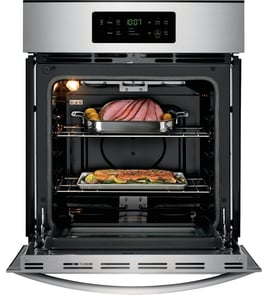




How to tell if a wall oven is gas or electric?
Your GE JTP13GT1BB is an electric wall oven. In general, electric wall ovens heat with hidden or exposed electric elements and are powered by a dedicated circuit breaker, while gas wall ovens connect to a gas supply line and use a burner and igniter.
- Check the model label: On this oven, the model and serial label is on the front frame behind the oven door; match it to your paperwork and parts list. See the owner's manual.
- Look for a gas line: Gas ovens have a flexible gas connector or rigid gas pipe at the back or in the cabinet.
- Look for a power setup: Electric wall ovens typically use a 240V hardwired connection or a heavy-duty cord and a dedicated breaker.
- Look inside the oven cavity: Electric ovens use bake and broil elements; gas ovens have a burner (often at the bottom) and an igniter.
- Cooling fan behavior: Many electric wall ovens cycle a cooling fan on and off, and it can run after shutoff (normal operation).
| Feature | Electric wall oven (like JTP13GT1BB) | Gas wall oven |
|---|---|---|
| Heat source | Electric bake and broil elements | Gas burner + igniter |
| Utility connection | 240V electrical circuit | Gas line + 120V power |
| Common clue | No flame visible during normal baking | Burner flame (not always visible) |
Before inspecting wiring or removing panels:
- Shut off power at the household distribution panel (switch off the circuit breaker or remove the fuse)
- Let the oven cool completely
- Avoid touching any exposed terminals or wires
- If you smell gas at any time, stop and have a qualified technician check the installation
Gas and electric wall ovens use different heating systems, wiring, and replacement parts. Correctly identifying the fuel type helps you choose the right troubleshooting steps and order the right components for your GE JTP13GT1BB.
Last updated: February 2026
Are wall ovens hardwired or plug-in?
GE electric wall ovens like model JTP13GT1BB are hardwired (direct-wired) to a household junction box; they are not designed to plug into a standard receptacle. For safe servicing, we always shut off power at the breaker or remove the fuse before touching any wiring.
A hardwired wall oven connects to your home wiring inside an approved junction box, typically behind the oven cutout. This setup provides a secure, code-compliant connection for a high-amperage appliance.
- The oven is connected with a strain relief and wire nuts inside a junction box
- Power is controlled by a dedicated circuit breaker (or fuses)
- The oven is grounded as part of the direct-wire connection
- There is no cord-and-plug connection to unplug for service
Because the oven is direct-wired, the safe “off” step is at the electrical panel.
- Switch OFF the oven circuit breaker (or remove the fuse)
- Confirm power is off before handling any wires
- Let the oven cool completely before working near heating components
- Avoid DIY electrical changes; use a qualified technician for wiring work
| Connection type | Typical for wall ovens | How you disconnect power | Common location |
|---|---|---|---|
| Hardwired (junction box) | Yes | Breaker OFF or fuse removed | Behind oven cutout |
| Plug-in (cord and receptacle) | No (for this style) | Unplug cord | Nearby outlet |
Hardwiring affects how you plan installation, troubleshooting, and repairs. For example, if you are diagnosing heating issues, you may test components like the sensor WB23X5340 only after power is safely disconnected per the owner's manual.
Last updated: February 2026
How to reset a GE wall oven?
To reset your GE JTP13GT1BB electric wall oven, turn the oven’s circuit breaker OFF (or remove the fuse) for 1 minute, then restore power. This power-cycle resets the electronic oven control and clears many temporary control glitches.
- Set the oven control to OFF.
- Turn the dedicated oven circuit breaker to OFF (or remove the fuse).
- Wait 1 full minute.
- Turn the breaker back ON (or reinstall the fuse).
- Set the clock if needed; some timed features require the clock to be set.
If you see “F----” with a number and the control beeps:
- Press CLEAR/OFF.
- Let the oven cool for 1 hour.
- Try using the oven again.
- If the same code returns, disconnect power again and schedule service.
During or after self-clean, the door stays locked until the oven cools below the lock temperature.
| What you see | What it means | What to do |
|---|---|---|
| “LOCK” light on | Oven is above unlock temperature | Wait for cooling; do not force the door |
| “door” in display | Door not closed when clean was set | Press CLEAR/OFF, close door, reset cycle |
| Fan running | Cooling fan cycling is normal | Let it run until it stops |
A reset restores normal operation after a power surge, a control “freeze,” or a canceled cycle. It also helps you confirm whether the issue is a temporary control problem or a part problem (such as a temperature sensor or door lock system).
For control and display details specific to this model, use the JTP13GT1BB owner's manual.
Last updated: February 2026
Does a wall oven need a special outlet?
Yes. A built-in electric wall oven like the GE JTP13GT1BB typically needs a dedicated 240-volt circuit and a proper grounding connection; it is not designed to plug into a standard 120V kitchen receptacle. We recommend following the electrical requirements and safety steps in the owner's manual.
Most electric wall ovens are hardwired or connected to a junction box rather than using a regular plug-in outlet. The key requirements are:
- Dedicated 240V circuit (no other major loads on the same breaker)
- Correct breaker or fuse size for the oven’s rating
- Proper grounding (critical for safety)
- Correct wire gauge for the circuit amperage
- Approved strain relief and junction box connection
We follow the same safety approach called out in the manual: shut off power at the household distribution panel before servicing.
- Switch off the circuit breaker (or remove the fuse) feeding the oven
- Verify power is off before touching wiring
- Do not attempt repairs not specifically recommended for the oven
- Keep the oven properly installed and grounded
- Use a qualified technician for installation or wiring changes
Wire colors can vary by home and by installation method, but a common 240V setup includes two hot conductors plus ground (and sometimes neutral).
| Conductor | Typical color | Purpose |
|---|---|---|
| Hot 1 | Black | Supplies 120V leg |
| Hot 2 | Red | Supplies 120V leg (together = 240V) |
| Ground | Green or bare | Safety ground |
| Neutral (if used) | White | Some controls/lighting configurations |
Using the correct 240V circuit, wire size, and grounding helps the oven heat properly, prevents nuisance breaker trips, and reduces the risk of electrical shock or overheated wiring.
Last updated: February 2026