Installation guide
 Owner’s manual
 Error Codes


How wide is a 25.6 cubic foot refrigerator?
Most 25.6 cu. ft. side-by-side refrigerators are about 36 inches wide. For your Frigidaire FFSS2615TD4, confirm the exact cabinet width and required installation clearances in the FFSS2615TD4 installation guide before ordering cabinetry, moving the unit through doorways, or planning water line access.
Typical width and what to plan for
A 25.6 cu. ft. capacity is commonly paired with a standard side-by-side footprint.
- Typical exterior width: ~35 7/8 to 36 inches
- Typical depth/height: varies by handle style and hinge design
- Door swing space: you need extra room so drawers and bins can fully open
- Water line access: required if you use the ice maker and dispenser
Installation clearances (FFSS2615TD4)
Your installation instructions call for these minimum clearances for air circulation and hookups:
| Location | Minimum clearance |
|---|---|
| Sides and top | 3/8 inch |
| Rear | 1 inch |
Why it matters
Width alone is not enough. If the opening is tight, the refrigerator can be difficult to slide into place, doors may not open fully, and airflow can be restricted. Planning for clearance also helps protect the water supply line and power cord during installation.
Quick measuring checklist
Use this before you commit to a space:
- Measure the opening width in at least 3 spots (top, middle, bottom)
- Measure the pathway (doorways, hallways, turns) to the kitchen
- Account for trim, baseboards, and toe grille clearance
- Confirm you have a grounded outlet nearby (no extension cord)
- If using the dispenser, confirm water pressure is 30 to 100 psi
For model-specific dimensions and door removal guidance, use the FFSS2615TD4 owner’s manual.
Last updated: January 2026
What is the most common problem with a Frigidaire refrigerator?
The most common issue we see with Frigidaire refrigerators like model FFSS2615TD4 is a cooling-related problem: the unit runs too long, temperatures drift, or frost and moisture build up. In many cases, the root cause is airflow or heat-release trouble (dirty condenser coils, a door not sealing, or a fan issue). See the FFSS2615TD4 owner's manual for model-specific troubleshooting steps.
Most common symptoms and what they usually point to
- Refrigerator runs too much/too long: dirty condenser coils, doors opened often, or a door not fully closing
- Warm refrigerator or freezer: restricted airflow, evaporator fan problem, or damper issue
- Moisture between doors or on cabinet: door slightly open or gasket not sealing well
- Flashing temperature display: control system detected a performance problem
- Ice/water dispenser acting up: clogged filter or air in the water line after service
Quick checks we recommend first (safe, no tools)
- Confirm doors close easily and nothing blocks them.
- Inspect gaskets for gaps, tears, or grime; clean with mild soap and water.
- Clean condenser coils (unplug first); dirty coils commonly cause long run times.
- Verify control settings; allow 24 hours after changes for temperatures to stabilize.
- If the display is flashing, follow the guidance in the manual and use Frigidaire refrigerator error codes to interpret what you see.
Parts that commonly solve “most common” problems on FFSS2615TD4
| Symptom | Common fix | Example part for this model |
|---|---|---|
| Poor cooling, noisy freezer area | Evaporator fan not moving air | Frigidaire refrigerator evaporator fan motor 242077705 |
| Frost, sweating, long run times | Door seal leaking | Refrigerator freezer door gasket 241786014 |
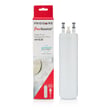
| Bad-tasting water, slow dispensing | Clogged water filter | Refrigerator water filter WF3CB |
Why it matters
Cooling problems usually get worse over time. A refrigerator that runs too long can struggle to hold safe food temperatures and can also create excess moisture, frost, and uneven cooling.
Last updated: January 2026
How to troubleshoot a Frigidaire refrigerator?
For a Frigidaire FFSS2615TD4 side-by-side refrigerator, we troubleshoot by confirming correct temperature settings, checking door sealing and airflow, and then inspecting common cooling and dispenser-related causes (coils, fans, filter, and frost). Use the FFSS2615TD4 owner's manual to match symptoms to the “Before You Call” checks.
Quick checks we recommend first
- Verify the temperature controls are set correctly; allow 24 hours for temperatures to stabilize after changes.
- Make sure doors close fully and self-close; these doors are designed to shut by themselves within about a 20-degree opening.
- Check for gaps, tears, or warping in the door seals; a leaking gasket makes the refrigerator run longer and cool poorly.
- Clean the condenser coils (dust buildup reduces cooling efficiency).
- Confirm the refrigerator is plugged into a properly grounded 3-prong outlet (no extension cord or adapter).
Symptom-based troubleshooting (most common)
| Symptom | Most likely causes | What to do next |
|---|---|---|
| Not cold enough | Warm control setting, dirty condenser, door seal leak, airflow restriction | Adjust temp, clean coils, check gaskets, avoid overpacking |
| Runs a lot | Door seal leak, dirty condenser, hot/humid room | Clean coils, inspect seals, minimize door openings |
| Water dispenser sputters after filter change | Air in water lines | Flush water for about 4 minutes; spurting is normal while purging |
| Display flashing | Control detected a performance issue | Note any codes/messages and follow the manual’s guidance |
Water and ice system checks (if dispenser or ice is acting up)
- If you recently replaced the filter, flush the dispenser for about four minutes.
- Reset the filter status by holding the Water Filter button for 3 seconds (until it changes from red to green).
- Replace the filter on schedule; Frigidaire recommends at least every 6 months.
- If flow is weak, confirm the filter is seated correctly and check for kinks in the supply line.
Helpful references:
- How to replace the water filter in a Frigidaire refrigerator
- If you need the correct replacement, use the refrigerator water filter WF3CB.
Why it matters
Most “not cooling” complaints come from airflow restrictions, dirty condenser coils, or door seal leaks. Fixing those first prevents unnecessary part replacement and helps protect the compressor from running under strain.
Last updated: January 2026
Where is the defrost timer located on a Frigidaire side by side?
On many Frigidaire side-by-side refrigerators, the defrost timer is mounted in the control housing (often in the fresh food section near the temperature controls) or behind the toe grille at the bottom front. For your FFSS2615TD4, confirm the exact access point and panel removal steps in the FFSS2615TD4 owner's manual.
Common defrost timer locations (what to check first)
- Control housing inside the refrigerator compartment, near the temperature control panel
- Behind the toe grille (kick plate) at the bottom front of the cabinet
- Rear service area behind a small access cover (less common on side-by-sides)
- Near the compressor compartment if the design uses a mechanical timer in the machine area
How to access it safely
- Unplug the refrigerator (or switch off the breaker).
- Remove food items that block the control housing (if applicable).
- Remove the cover screws (typically Phillips-head) and lower the housing/cover.
- Locate the timer module and note wire positions before disconnecting.
Quick safety checklist
- Unplug power before removing covers or disconnecting wiring
- Wear gloves when working around sheet metal edges
- Keep screws organized by panel so reassembly is straightforward
Defrost timer vs. electronic defrost control (why this matters)
Some FFSS2615TD4 configurations use an electronic control board instead of a mechanical defrost timer. If you do not see a timer dial or small timer module in the common locations above, the defrost function is typically managed by the main control.
| What you see | What it usually means | Next step |
|---|---|---|
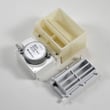
| Small module with a dial/advance slot | Mechanical defrost timer | Locate and test/replace timer |
| No timer module; wiring goes to a board | Electronic defrost control | Check diagnostics and control operation |
Related symptoms that point to a defrost problem
- Frost or ice buildup on the freezer back wall
- Freezer cold but refrigerator warm (restricted airflow)
- Evaporator fan noise changes as ice builds up
- Temperature display issues or unusual cycling
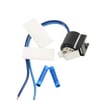
If you are troubleshooting cooling problems at the same time, checking the defrost thermostat can also be relevant on this model; see the refrigerator defrost bi-metal thermostat 5303918214.
Why it matters
Finding the correct defrost control location saves time and prevents broken trim panels. It also helps you avoid replacing the wrong part when the real issue is airflow, a defrost component, or the electronic control.
Last updated: January 2026