Installation guide
 Owner’s manual
 Error Codes



Is a top mount or bottom mount fridge better?
A bottom-mount refrigerator like the Frigidaire FGHD2368TF3 is usually “better” for everyday convenience because fresh food sits at eye level and the freezer is in a pull-out drawer. A top-mount is often simpler and can be a bit more energy-efficient, but it depends on how you shop and cook.
| Feature | Bottom-mount (like FGHD2368TF3) | Top-mount |
|---|---|---|
| Fresh food access | Easier; less bending | More bending |
| Freezer access | Drawer style; great for organization | Shelf style; easy to see everything |
| Organization | Strong; baskets and drawers | Basic; fewer compartments |
| Installation fit | Needs door swing and drawer clearance | Usually easier in tight spaces |
Bottom-mount designs tend to work best when you use the refrigerator section most.
- You want everyday items (milk, produce, leftovers) at eye level
- You like freezer baskets for sorting meats, frozen meals, and bulk items
- You want full access to drawers and baskets with doors fully open
- You have space for proper airflow clearances (typically 3/8 inch at sides and top, 1 inch at the back)
For model-specific placement and clearance guidance, follow the installation guide.
Top-mount models are a good fit when you want a straightforward layout.
- You use the freezer more often than the fresh-food section
- You want a simpler design with fewer moving drawer parts
- You have a tighter kitchen layout where a large freezer drawer could be awkward
- You want to prioritize lower upfront cost in many product lines
Choosing the right mount style affects daily ergonomics, how well you can organize food, and whether the doors and freezer drawer can fully open in your kitchen. Proper leveling and clearance also help doors close correctly and keep cooling performance steady.
Last updated: February 2026
What are the disadvantages of a bottom freezer refrigerator?
Bottom-freezer refrigerators like the Frigidaire FGHD2368TF3 keep fresh food at eye level, but the tradeoffs are mostly about freezer access and maintenance. The most common disadvantages are more bending to reach frozen items, deep-drawer organization challenges, and a higher chance of drain or defrost-related water issues if airflow and leveling are not right.
- More bending and lifting: you reach down for frozen food, ice bins, and heavy items.
- Deep drawer organization: items can stack and get buried, especially in lower baskets.
- Freezer access can feel slower: you often pull out a basket instead of opening a simple shelf.
- Door swing and clearance needs: you need enough space for doors to fully open to access drawers and baskets.
- Drain and defrost sensitivity: if the unit is not level or airflow is restricted, you can see puddles or frost issues sooner.
Your installation choices can make the “cons” feel bigger or smaller. For FGHD2368TF3, proper leveling and clearances help prevent nuisance issues and improve access.
| Factor | What can go wrong | What to do |
|---|---|---|
| Leveling | Doors may not seal consistently; water can misroute to the drain pan | Level the cabinet per the installation guide |
| Clearances | Drawers may not pull out fully; airflow can be restricted | Allow typical clearances (sides/top and rear) per the installation guide |
| Air circulation | Warm temps, longer run time, uneven cooling | Keep the toe grille unblocked and vents clear |
Bottom-freezer designs are great for everyday refrigerated items, but the freezer layout and door clearance requirements can impact ergonomics and organization. Installation basics (level floor, proper airflow, and enough door swing room) reduce the most common frustrations.
Last updated: February 2026
What is the most common problem with Frigidaire refrigerators?
The most common Frigidaire refrigerator problem is a cooling complaint: the refrigerator section gets warm, the freezer may still feel cold, or temperatures swing because airflow is restricted or a fan/sensor is failing. On the FGHD2368TF3, ice maker and water-supply issues are also very common.
- Fresh food section warm but freezer cold
- Frost buildup on the back wall of the freezer
- Loud humming, rattling, or a fan noise that comes and goes
- Ice maker not making ice or making small/hollow cubes
- Doors not sealing well, causing moisture and temperature swings
Start with these basics before replacing parts:
- Confirm vents are not blocked by food packages (air must circulate)
- Clean dust from condenser coils and make sure the unit has breathing room
- Verify doors close gently and seal all the way around
- Set temperatures back to normal targets (about 37°F fridge, 0°F freezer)
- Listen for the evaporator fan running when the compressor is on
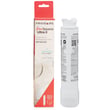
Your FGHD2368TF3 manual’s “Before you call” section lists frequent causes of no ice, including the ice maker being off, the water valve being closed, a kinked supply line, or a filter that is not seated or is clogged. See the FGHD2368TF3 owner's manual for the model-specific checks.
| Symptom | Most likely cause | What to do first |
|---|---|---|
| No ice | Ice maker off, water valve closed, kinked line | Turn ice maker on, open valve, straighten line |
| Slow ice | Clogged or mis-seated filter | Reseat or replace the filter |
| Warm fridge | Airflow problem, fan issue, dirty coils | Clear vents, check fans, clean coils |
If troubleshooting points to a failed component, these are common replacements for this model:
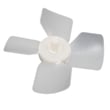
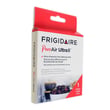
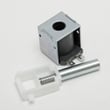
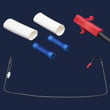
- Frigidaire refrigerator evaporator fan motor 809069206 (air circulation in the freezer)
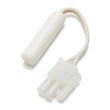
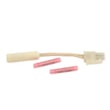
- Refrigerator temperature sensor 5303918775 (temperature feedback to controls)
- Refrigerator water inlet valve assembly 242253002 (water supply to dispenser and ice maker)
- Refrigerator ice maker 243297613 (ice production)
Cooling and ice maker problems usually trace back to airflow, sealing, or water supply. Catching them early helps prevent food spoilage, excessive frost, and strain on the compressor.
Last updated: February 2026