Installation guide
 Owner’s manual



How do I tell what model my Kenmore dryer is?
Your Kenmore dryer’s model number is printed on the appliance ID label; on model 11061632610, it’s typically found in the door opening (around the door frame) and is the number you should use to match the correct parts, manual, and wiring information.
Where to look for the model number
Check these common locations in this order:
- Inside the dryer door opening on the door frame or cabinet lip
- On the back panel of the dryer cabinet
- Near the lint screen housing (some designs place the label close to the filter duct)
- On the side panel edge (visible when the door is open)
If you find multiple numbers, use the one labeled Model (not the serial number).
How to read what you find (Kenmore specifics)
Many Kenmore dryers use a prefix that helps identify the manufacturing source. For example, the Use and Care Guide for this family lists models like 110.6163*610 (the asterisk is the color code). Use the full model number from the label to avoid ordering the wrong drum belt, thermal fuse, or control parts.
Quick ID checklist
- Model number: used to look up parts diagrams and the correct replacement parts
- Serial number: used to identify production run details
- Color code (often shown as an asterisk or suffix): helps match cosmetic parts
What to do once you have the model number
Use the model number to confirm documentation and parts compatibility:
| What you need | What to use | Why it matters |
|---|---|---|
| Operating instructions | 11061632610 owner's manual | Cycle features, settings, and care steps match your exact control panel |
| Installation and hookups | 11061632610 installation guide | Correct power connection, venting, and leveling steps |
| Common wear parts | Model number + part ID | Prevents ordering the wrong belt, roller, or fuse |
Why it matters
Kenmore dryers can look similar across series, but internal parts (like the heating circuit, drum support system, and console layout) vary by model. Using the exact model number keeps repairs accurate and avoids repeat disassembly.
Last updated: February 2026
How to open Kenmore dryer control panel?
To open the control panel on a Kenmore 11061632610 electric dryer, we unplug the dryer first, then remove the top panel so we can access the console mounting screws and lift the control panel/console forward for service. Use the steps in the 11061632610 owner's manual for safe access and handling.
Safety first (before you remove any screws)
- Unplug the dryer (or switch off the breaker) before opening the console.
- If the dryer was running, let it cool down.
- Wear cut-resistant gloves; sheet-metal edges can be sharp.
- Keep screws organized by location so reassembly is straightforward.
- Avoid pulling on wires; support the console as you open it.
Typical steps to open the control panel/console
Most Kenmore 110-series dryers like model 11061632610 open in this general order:
- Remove the top panel: release the top (usually from the back or with spring clips near the front seam), then lift it up and set it aside.
- Locate console fasteners: with the top off, find the screws securing the control panel/console to the cabinet.
- Lift/tilt the console forward: once screws are out, lift the console slightly and tilt it forward to access the user interface and wiring.
- Disconnect wiring only if needed: if you must remove the console completely, label connectors before unplugging them.
What you may see once it’s open
| Area | What it does | Common service need |
|---|---|---|
| User interface harness | Connects buttons/knob inputs to the control | Reseat loose connector, replace harness |
| Electronic control board | Runs cycles, reads sensors | Replace control if dead/no response |
| Console overlay/fascia | Labels and button surface | Replace if cracked or peeling |
Parts that are commonly involved
If you’re opening the control panel because buttons are unresponsive or the display acts erratically, these model-specific parts are often involved:
- Electronic control W11367337 (main control board)
- Dryer user interface wire harness W10680749 (console wiring)
Why it matters
Opening the control panel correctly prevents broken plastic tabs, pinched wires, and intermittent electrical connections that can cause no-start symptoms, cycle interruptions, or false error behavior.
Last updated: February 2026
How do I change the motor on a Kenmore dryer?
To change the motor on your Kenmore electric dryer model 11061632610, we unplug the dryer, open the cabinet, release the belt and blower housing connections, then remove the motor mounting clips and wiring harness so the motor can slide out and the new motor can be installed in the same orientation.
Before you start (safety and prep)
- Unplug the dryer (or switch off the breaker) before opening any panels.
- If your model is direct-wired, disconnect power at the junction box.
- Wear cut-resistant gloves; cabinet edges can be sharp.
- Take a quick photo of wire routing and connector positions.
- Use the wiring diagram and disassembly steps in the 11061632610 owner's manual.
Motor replacement steps (typical for this Kenmore 110 series design)
- Remove the lint screen and the screws under the lint screen opening (common access point on many Kenmore 110 dryers).
- Lift or remove the top panel, then remove the front panel to access the drum.
- Release belt tension by moving the idler pulley, then slip the belt off the motor pulley.
- Pull the drum out to expose the motor and blower housing.
- Disconnect the motor wire harness plug (release the locking tab, then pull the connector straight off).
- Remove the blower wheel from the motor shaft (thread direction varies by design; follow the 11061632610 owner's manual).
- Release the motor retaining clips and lift the motor out.
- Install the new motor, reattach clips, reinstall blower wheel, reconnect wiring, then reinstall drum, belt, and panels.
Parts that are commonly involved
| Symptom during teardown | Part that often needs attention | Example part for this model |
|---|---|---|
| Belt is cracked, glazed, or stretched | Drum belt | Dryer drum belt, 4-rib W11568627 |
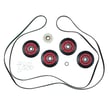
| Squealing or rumbling while drum turns | Rollers and idler | Dryer repair kit 4392067 |
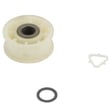
| Belt will not stay tight on motor pulley | Idler pulley | Dryer idler pulley W10837240 |
Why it matters
A dryer motor swap is usually straightforward, but correct belt routing, blower wheel installation, and secure wiring connections prevent repeat failures like no-start, overheating, or poor airflow.
Last updated: February 2026
How much does it cost to replace a heating element in a Kenmore dryer?
For a Kenmore electric dryer model 11061632610, replacing the heating element typically runs $20 to $100+ for the part and about $100 to $350 total when you include professional labor. Exact cost depends on whether you replace only the element or also repair heat-damaged wiring.
What changes the price most
- Part style: element-only vs. element assembly with housing
- What failed: a broken coil vs. an overheating issue that also trips safety fuses
- Extra parts needed: terminals, wire leads, or a thermostat/fuse kit
- Labor rate: local shop minimums and service call fees
- Vent restriction: poor airflow can cause repeat failures and add diagnostic time
Common parts that may be replaced with the element
On many Kenmore 110-series electric dryers, a no-heat complaint is sometimes caused by a safety device or heat control part, not only the element. These model-specific parts are commonly involved:
| Symptom | Often checked/replaced | Example part for 11061632610 |
|---|---|---|
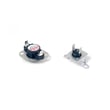
| Runs but no heat | Thermal fuse | Thermal fuse W10909685 |
| Heats then stops, overheats | High-limit thermostat | Dryer high-limit thermostat WP8557403 |
| Repeated overheating | Thermal cut-off kit | Dryer thermal cut-off fuse kit 279973 |
| Temperature swings, long dry times | Thermistor | Dryer thermistor WP8577274 |
DIY vs. pro replacement (what to expect)
If we are doing this repair ourselves, we follow the disassembly and wiring routing shown in the 11061632610 owner's manual and match wire positions exactly.
- DIY cost: usually the part(s) only
- Pro cost: part(s) plus labor, plus a service call in many areas
- Time: many element-related repairs are completed in 1 visit once the correct parts are on hand
Why it matters
A failed heating element can be the result of restricted airflow or overheating, which can also damage wiring and trip the thermal fuse. Fixing the root cause (lint buildup, crushed vent, blocked exterior hood) helps prevent another no-heat failure.
Last updated: February 2026