Error Codes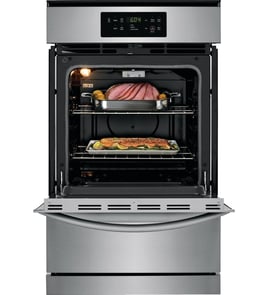

Are there wall ovens that are gas?
Yes. Gas wall ovens are a real product category, and your Modern Maid PGO191 is an example of a gas wall oven model. They are less common than electric wall ovens, but they’re used in many homes where a gas supply is available.
A gas wall oven uses natural gas or LP (propane) for baking and typically uses household electricity for ignition, lights, and controls.
Common features you’ll see:
- Gas bake burner for heat
- Hot surface igniter or spark ignition system
- Gas safety valve/regulator components
- Thermostat or electronic oven control (varies by model)
- Electrical wiring for ignition and controls
Gas wall ovens have a few fit and hookup requirements that matter as much as brand.
- Cutout size: wall ovens must match the cabinet opening
- Fuel type: natural gas vs LP conversion capability
- Electrical needs: most require a standard household circuit for ignition/controls
- Ventilation: follow local code and safe clearances
- Ignition type: older models often differ from Modern designs
| Feature | Gas wall oven | Electric wall oven |
|---|---|---|
| Heat source | Gas burner | Electric elements |
| Power needed | Usually for ignition/controls | Always for heating and controls |
| Commonness | Less common | Most common |
| Typical service items | Igniter, valve, burner parts | Bake/broil elements, relays |
Knowing that PGO191 is a gas wall oven helps you troubleshoot correctly. For example, “no heat” on a gas oven often points to the igniter, gas valve, or burner circuit, not a bake element.
If you’re diagnosing power or control issues (common on gas ovens because ignition is electrical), use our guide: how to use a multimeter to test electrical parts video.
Last updated: February 2026
What are the most common issues with PGO191?
The most common problems we see with the Modern Maid PGO191 gas wall oven are no-heat or weak baking, uneven temperatures, ignition failures, and control or wiring-related faults. These issues usually trace back to the igniter, gas safety valve, thermostat/temperature sensor, or loose/burned wiring.
- Oven will not heat: weak or failed hot-surface igniter, failed gas safety valve, or no power to controls
- Igniter glows but burner will not light: igniter is too weak to open the gas valve, or the valve is failing
- Slow preheat or low temperature: weak igniter, drifting thermostat, or calibration issue
- Uneven baking or hot spots: burner/airflow issues, heat loss at door gasket, or rack position problems
- No broil (if equipped): broil igniter/burner issue or selector/control problem
- Intermittent operation: loose wire connection, overheated connector, or failing control
- Confirm the oven is getting power (clock/control lights on, breaker not tripped).
- Set to BAKE and watch for ignition: igniter should glow, then burner should light.
- Smell for gas only briefly during an ignition attempt; if you smell gas, stop and ventilate.
- Inspect the door seal for gaps, tears, or compression.
- Look for burned or loose wires at the igniter and valve connections.
| Symptom | Most likely cause | Best next step |
|---|---|---|
| No heat | Failed/weak igniter | Test igniter circuit and replace if weak |
| Glow, no flame | Weak igniter or bad gas valve | Amp-draw test; replace the failing part |
| Temperature off | Thermostat drift | Verify with oven thermometer; calibrate if possible |
| Cuts out | Loose/burned wiring | Repair connectors and damaged wiring |
Gas ovens rely on the igniter to open the gas safety valve; a weak igniter is the most common reason a PGO191 will not light or heats poorly. Fixing the root cause restores safe ignition and stable temperatures.
- Use a meter safely for diagnosis: how to use a multimeter to test electrical parts video
- If you find damaged wiring: how to repair broken or damaged wires video
Last updated: March 2026
How do I find the model number on my PGO191?
For a Modern Maid gas wall oven like model PGO191, the model number is printed on the oven’s identification label (also called a rating plate). We use that exact model number to match the correct diagrams and replacement parts.
Check these common spots first (use a flashlight):
- Along the oven frame behind the door, near the hinge area
- On the front frame (the lip around the oven opening)
- On the side trim or inner side panel visible when the door is open
- On the lower front frame near the broiler or lower access area (if your unit has one)
- On the back of the oven (usually only visible if the oven is pulled out)
Most wall oven ID labels include several fields. Here is what to capture:
- Model (this is the key field)
- Serial (helps identify production run)
- Gas type (natural gas or LP/propane)
- Electrical rating (volts and amps)
| Label field | What it’s used for | Should you record it? |
|---|---|---|
| Model | Correct parts lookup and diagrams | Yes |
| Serial | Version changes within a model | Yes |
| Gas type | Correct regulator/orifice setup | Yes |
| Electrical rating | Safe replacement of electrical parts | Helpful |
Modern Maid ovens can have similar-looking variants; one character difference in the model number can change the correct igniter, thermostat, valve, or door parts. Using the exact label information prevents ordering the wrong part and delays in repair.
Use these practical options:
- Look for a second label on the back panel if the front label is damaged
- Check for a stamped plate on the frame near the storage/broiler area
- Search your paperwork for the installation receipt or service invoice
- Use our guide: [how to find your appliance model number (and what it means for parts)]
Last updated: March 2026