 Installation guide
 Owner’s manual


How do I turn on a Hotpoint dishwasher?
To turn on your Hotpoint dishwasher model HDA2100V00WW, load the racks, add detergent, select a wash cycle, then start the cycle with the START pad (electronic controls) or by setting the dial to begin (dial controls). See the HDA2100V00WW owner's manual for the exact control layout.
- Latch the door fully; the dishwasher will not run with the door unlatched.
- Select NORMAL WASH for everyday loads.
- Press START one time (electronic models).
- If your model uses a dial, press NORMAL and HOT START (if present), then turn the dial just enough to start.
- Wait for the initial fill; water entry can take up to about 4 minutes.
| Control type | What you do | What to watch for |
|---|---|---|
| Electronic pads | Choose cycle, press START once | Door must be latched; listen for fill within a few minutes |
| Dial timer | Set options (if present), turn dial slightly to start | Do not turn past the first fill position |
- Confirm the door is closing and latching smoothly.
- Make sure the control panel is not pressed against adjacent cabinets (binding can prevent proper operation).
- Verify the dishwasher is level; a rack that rolls in or out on its own is a leveling clue.
- If the unit is unresponsive, follow the checks in the dishwasher wont start video.
Starting correctly prevents “no fill” and “no wash” symptoms that look like a pump or control problem. A fully latched door and the right start sequence are the two most common fixes on Hotpoint dishwashers.
Last updated: February 2026
Where is the dishwasher filter on a Hotpoint dishwasher?
On the Hotpoint HDA2100V00WW dishwasher, the filter area is in the bottom of the tub under the lower dishrack. We access it by sliding the lower rack out (or lifting it out) so we can reach the sump area where food and debris collect; see the HDA2100V00WW owner's manual for the exact layout.
- Turn off power at the breaker, then open the door.
- Pull the lower rack out; if needed, lift it off the rails.
- Look at the bottom center of the tub (the sump area) for screens and filter pieces.
- Remove any visible debris (glass, labels, bones) by hand.
- Rinse the screen or filter parts with warm water; use a soft brush if grease is present.
- Reinstall everything securely, then run a quick rinse to confirm normal flow.
| Filter-related piece | Where it sits | What it prevents |
|---|---|---|
| Coarse screen | Bottom of tub near the sump | Large food pieces entering the pump |
| Fine screen or micro-filter | Under or within the screen assembly | Grit recirculating onto dishes |
| Sump inlet area | Center bottom | Debris buildup that can restrict wash and drain |
- Dishes come out gritty or with food redeposited
- Poor spray pressure or a weak wash sound
- Standing water after the cycle (often alongside a drain restriction)
- Odors from trapped debris
Keeping the filter area clear helps the circulation system maintain strong spray and protects the pump and motor from debris. If you are also dealing with poor cleaning, inspect the dishwasher spray arm, lower WD12X10244 for clogged spray holes while the lower rack is out.
Last updated: February 2026
What does F03 mean on a Hotpoint dishwasher?
On a Hotpoint dishwasher, an F03 code means the unit is timing out while trying to drain (a water drain failure). On model HDA2100V00WW, focus first on the drain path (hose, air gap/disposal connection) and the drain components that move water out.
- Cancel the cycle and let the dishwasher attempt to drain again.
- Inspect the drain hose for kinks, crushing, or a high loop that is sagging.
- Check the sink/disposal inlet where the dishwasher hose connects; clear any food plug.
- If you have an air gap, remove the cap and clean out debris.
- Verify the dishwasher has standing water above the filter area; heavy debris can slow draining.
If the drain path is clear, the issue is usually a drain control part or a restriction inside the pump area.
- Drain solenoid not actuating: g.e. dishwasher drain solenoid assembly WD21X10268
- Drain hose restricted or collapsing: dishwasher drain hose WD24X10014
- Pump or motor not moving water (noise, hum, or weak drain): g.e. dishwasher pump and motor assembly WD26X10051
| What you notice | Most likely cause | What we do next |
|---|---|---|
| Hums but water stays | Jammed pump area or weak pump | Check for blockage; consider pump/motor assembly |
| Drains slowly | Partial clog in hose or sink connection | Clear hose, air gap, disposal inlet |
| No drain sound at all | Drain solenoid or control issue | Check solenoid operation and wiring |
A drain timeout leaves dirty water in the tub, which can cause poor cleaning, odors, and repeated cycle failures. Fixing the drain path early also helps protect the pump and motor from overheating.
For model-specific operating and cycle-cancel steps, use the HDA2100V00WW owner's manual.
Last updated: February 2026
Can I replace dishwasher parts myself?
Yes, for the Hotpoint HDA2100V00WW dishwasher, many common repairs are DIY-friendly if you shut off power and water first and follow the steps in the installation guide. Jobs involving wiring, leaks, or motor components take more skill but are still manageable with careful prep.
These repairs are typically straightforward with basic hand tools:
- Lower spray arm and wash components (for example, a worn dishwasher spray arm, lower WD12X10244)
- Drain hose routing or replacement (for example, dishwasher drain hose WD24X10014)
- Door switch replacement (for example, dishwasher door switch WD21X10261)
- Drain solenoid linkage issues (for example, g.e. dishwasher drain solenoid assembly WD21X10268)
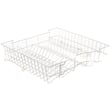
- Rack issues such as bent wheels or poor rolling (for example, dishwasher dishrack, lower WD28X31819)
The installation instructions for this platform call out basic mechanical, electrical, and plumbing skills, plus safety gear. Before any repair:
- Turn off power at the breaker (not just the control panel)
- Shut off the dishwasher water supply
- Wear gloves and safety glasses
- Keep wiring secured and away from moving parts (like door springs)
- Level the dishwasher after moving it; racks should not roll in or out on their own
Some repairs are higher risk because they involve water sealing, electrical connections, or heavy components:
| Repair type | Why it is harder | Common symptom |
|---|---|---|
| Pump and motor work | Heavy assembly, seals, wiring | Loud grinding, no wash action |
| Circulation pump/impeller | Leak risk if seals are disturbed | Poor cleaning, weak spray |
| Door sealing and alignment | Leaks can be caused by leveling or fit | Water at the front corners |
DIY repairs can save time and money, but dishwashers are sensitive to leveling, drain setup, and safe wiring. For example, the install guide specifies a high drain loop or air gap in many setups, and it also limits drain hose length to 10 feet; getting those details right prevents repeat drain problems.
Last updated: February 2026
How much does it cost to run a Hotpoint dishwasher?
For a Hotpoint HDA2100V00WW dishwasher, the typical cost to run it is about $0.15 to $0.40 per cycle in combined electricity and water, depending on your utility rates, cycle selection, and incoming water temperature. Most households land around $50 to $120 per year.
A dishwasher’s operating cost is mostly hot water heating plus a smaller amount of electricity for the motor and controls. For HDA2100V00WW, the installation specs call for 120°F to 150°F hot water and 20 to 120 PSI supply pressure; hotter water and longer cycles generally increase cost. See the HDA2100V00WW installation guide.
Ways we typically reduce cost without sacrificing cleaning:
- Use Normal instead of Pots/Pans for everyday loads
- Skip heated dry when you can; air-dry by cracking the door after the cycle
- Run full loads and avoid heavy pre-rinsing
- Keep the spray path clear; don’t block the lower spray arm
- Fix draining issues quickly so the unit does not rewash dirty water
Use this simple approach with your own rates:
- Electricity per cycle: about 0.8 to 1.5 kWh (varies by cycle and water heating)
- Water per cycle: about 4 to 8 gallons (varies by cycle)
| What you need | Typical value | Example cost per cycle |
|---|---|---|
| Electric rate | $0.12 to $0.25 per kWh | $0.10 to $0.38 |
| Water + sewer | $0.01 to $0.03 per gallon | $0.04 to $0.24 |
| Estimated total | $0.15 to $0.40 |
Knowing your per-cycle cost helps you choose the right cycle and options, and it also helps spot problems. A sudden jump in cost often points to longer run times, poor cleaning that forces rewashing, or a circulation issue.
If the dishwasher is running but not cleaning well, we recommend the dishwasher not cleaning dishes video. If you suspect weak spray or poor circulation, a worn lower spray arm can contribute; the HDA2100V00WW uses the dishwasher spray arm, lower WD12X10244.
Last updated: February 2026
Why is my Hotpoint dishwasher leaking from underneath?
On the Hotpoint HDA2100V00WW dishwasher, an underneath leak usually comes from a drain hose connection that drips during draining, a water supply fitting that seeps during fill, or door interference that lets water run down into the base. Use the HDA2100V00WW installation guide leak-check steps to isolate when the leak starts.
- Turn off power at the breaker; shut off the water supply.
- Remove the toe-kick/lower access panel; find the first wet spot (front, center, or by the drain hose).
- Run a short cycle and watch for leaks during fill, wash, and drain.
- Confirm the drain hose is routed through the strain relief and not kinked under or behind the unit.
- Make sure the dishwasher is centered and the door opens and closes freely without rubbing cabinets.
| When you see water | Most likely source | What to do next |
|---|---|---|
| During fill (first minutes) | Water supply line or 90° elbow | Tighten fittings; reseat ferrule/compression nut; recheck for drips |
| During wash (spraying) | Door leak running down to the base | Relevel and re-center; check for door rubbing/hitting cabinets |
| During drain (often after first fill) | Drain hose or drain connection | Check clamps and routing; replace a cracked hose |
- Drips at the drain connection or a split hose: replace the dishwasher drain hose WD24X10014.
- Water tracks from the door area down to the base: inspect and replace the dishwasher door seal WD08X10057 if it is flattened, torn, or gapped.
- Leak centered under the tub near the pump: inspect for seal wear; replace the shaft seal WD8X181 if it is leaking.
Water under the dishwasher damages flooring and cabinets and can also lead to poor draining if the hose is kinked. Correct routing, centering, and sealing stops repeat leaks.
Last updated: February 2026





