Installation guide
 Owner’s manual
 Error Codes


How wide is a Kenmore side-by-side refrigerator?
Most Kenmore side-by-side refrigerators are about 32 to 36 inches wide; your Kenmore 10653232300 is in that same typical range. For the exact cabinet width and required clearances for your specific unit, use the measurements and spacing guidance in the owner's manual.
Typical width ranges (what you can expect)
Kenmore side-by-side models commonly fall into these width bands:
- 32 to 33 inches: space-saving or smaller-capacity designs
- 35 to 36 inches: most common full-size side-by-side footprint
- 42 inches: larger, premium built-in style (less common)
How to measure width the right way
To avoid ordering the wrong fit for a cutout or doorway, we recommend measuring two ways:
- Cabinet width: metal box only, not including handles
- Door/handle projection: total depth and swing space can affect “fit” more than width
- Door swing clearance: needed so doors open fully without hitting a wall
- Entry path: doorways, hallways, and turns from delivery point to kitchen
Clearance guidance that affects “real-world” fit
Your model’s manual calls out ventilation and wall clearance needs that can change how much space you must leave around the refrigerator:
| Space to plan for | Typical guidance for this style | Why it matters |
|---|---|---|
| Side and top ventilation gap | About 1/2 inch | Helps airflow and cooling efficiency |
| Clearance next to a fixed wall | About 2 inches minimum (varies by setup) | Allows the door to swing open |
| Back clearance (if ice maker/water line) | Extra space needed | Prevents kinks and leaks |
Why it matters
Width is only one part of “will it fit.” Door swing clearance, ventilation spacing, and water line room (if you have an ice maker) often determine whether a side-by-side refrigerator installs cleanly and operates efficiently.
Last updated: February 2026
How do I find the model number on my 10653232300?
On Kenmore side-by-side refrigerators like model 10653232300, the model number is printed on the appliance identification label; we most often find it inside the fresh food compartment on a side wall or near the door opening. Use the owner's manual for the exact label location and examples.
Where to look (most common spots)
- Inside the refrigerator section on the left or right wall
- Along the front frame near the door gasket (door opening area)
- On the ceiling of the fresh food compartment near the light housing
- Behind the crisper drawers on the side wall
- On the back exterior panel (less common for daily access)
What the label looks like
The ID label typically includes:
- Model number (for example, 10653232300)
- Serial number
- Electrical ratings (volts/amps)
- Sometimes a bar code
Tips to read it correctly
- Write the model number exactly as shown; include all digits.
- If the label is smudged, take a photo with flash and zoom in.
- Use the model number (not the serial number) when ordering parts like an ice maker, water inlet valve, or thermostat.
Why it matters
Kenmore refrigerators often have similar-looking doors and dispensers across multiple models; the exact model number ensures diagrams and replacement parts match your unit.
Last updated: March 2026
How do I troubleshoot my 10653232300?
For Kenmore model 10653232300, we troubleshoot by matching the symptom (no cooling, ice maker not working, leaks, or dispenser issues) to the system involved (airflow, defrost, water supply, or controls), then testing the most common failure points in a safe, step-by-step order using the owner's manual.
Quick checks first (most problems)
- Confirm temperatures: set fresh food to about 37°F and freezer to about 0°F.
- Make sure vents inside both compartments are not blocked by food packages.
- Verify doors seal fully; a poor seal causes warm temps, frost, and long run times.
- Listen for the evaporator fan in the freezer; no fan sound often means airflow failure.
- Check for heavy frost on the freezer back panel; that points to a defrost problem.
- For water and ice issues, confirm the household shutoff valve is fully open.
Symptom-based troubleshooting map
| Symptom | Most likely area | Common parts to check on this model |
|---|---|---|
| Warm fridge/freezer | Airflow or sealed system | Evaporator fan, condenser fan, compressor start components |
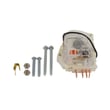
| Frost buildup, warm temps | Defrost system | Refrigerator defrost timer W10822278, defrost thermostat |
| No ice or small cubes | Water supply to ice maker | Refrigerator inlet valve W10408179, frozen fill tube |
| Water dispenser not working | Dispenser switch or valve | Refrigerator dispenser switch WP2162361, inlet valve |
What to do for the most common issues
Not cooling well
- Clean condenser coils and confirm the condenser fan runs.
- If the freezer fan is not running, inspect the fan blade and motor area.
- If you see a solid frost sheet on the evaporator cover, troubleshoot the defrost system.
Ice maker not making ice
- Make sure the ice maker is turned on and the bin is seated.
- Check for a frozen fill tube and thaw it.
- Test water flow; a weak or no fill often points to the inlet valve or supply restriction.
Why it matters
Troubleshooting in this order prevents unnecessary part replacement and helps protect food safety; cooling and airflow problems can quickly lead to unsafe temperatures.
Last updated: March 2026