Owner’s manual
 Error Codes



What is the most common problem with Samsung refrigerators ice?
The most common ice problem we see on Samsung refrigerators like model RF265AASH is little or no ice production, usually caused by restricted water flow (often a clogged filter), a frozen fill path, or an ice maker that is jammed or not cycling correctly. Use the owner's manual to confirm the exact checks for your control panel and ice maker style.
Most common causes (and what to check first)
- Water filter is clogged or overdue; replace it and flush the system.
- Ice maker is turned off (or in a test/lock mode) after cleaning or a power outage.
- Fill tube or ice maker area is freezing up; this can happen when the bin is full and the unit does not cycle.
- Low water pressure or a kinked supply line behind the refrigerator.
- Freezer temperature too warm; most units make ice best around 0°F.
- Ice clumps/jams in the bin preventing the ejector from moving.
Quick troubleshooting steps for RF265AASH
- Replace the filter with the correct part and run several cups of water to purge air.
- Empty the ice bin; break up clumps and reinstall it fully.
- Verify freezer temp is set correctly and vents are not blocked by food packages.
- Inspect the water line behind the unit for kinks; confirm the shutoff valve is fully open.
- If the ice maker still will not cycle, test the ice maker module and related wiring per the manual.
Parts that commonly solve “no ice” symptoms
| Symptom | Most likely area | Part to consider (if applicable) |
|---|---|---|
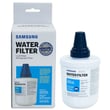
| Slow or no ice, weak water flow | Filtration/water flow | Samsung refrigerator water filter DA29-00003G |
| Ice maker not cycling or inconsistent harvest | Ice maker module | Refrigerator ice maker DA59-00294A |
| Ice maker freezes up, water leaks then refreezes | Drain/icing conditions | Refrigerator drain cap DA97-04049A |
Why it matters
Ice issues are usually a water flow or temperature problem first; fixing those early prevents repeat freezing, overflow, and strain on the ice maker components.
Last updated: February 2026
Why does my Samsung fridge have a water puddle on the floor?
A water puddle on the floor with your Samsung RF265AASH refrigerator is typically caused by a clogged or frozen defrost drain. When the drain can’t carry defrost water to the drain pan, water overflows inside the cabinet and eventually leaks out onto the floor.
Quick checks (fastest wins)
- Look for water under the crisper drawers or on the bottom of the fresh food compartment.
- Check for a sheet of ice on the freezer floor (classic sign of a frozen drain).
- Make sure the refrigerator is level; slightly higher in front helps doors close fully.
- Confirm doors close tightly and nothing is holding them open.
- If the puddle started after a filter change, inspect for drips at the filter area.
Clear a clogged or frozen defrost drain
- Unplug the refrigerator.
- Remove drawers/shelves to access the rear interior panel where you see ice or water.
- Melt ice in the drain trough using warm water.
- Flush the drain hole with hot water until it flows freely to the drain pan underneath.
- If it backs up, clean the drain tube and flush again.
If the drain tube or cap is cracked, loose, or not sealing, replace the drain component; a common service part is the refrigerator drain cap DA97-04049A.
Symptom guide
| What you notice | Most likely cause | Best first step |
|---|---|---|
| Water after defrosting; ice buildup inside | Clogged/frozen defrost drain | Melt ice and flush drain |
| Water near front; doors not closing well | Leveling or door seal issue | Level unit; check gasket contact |
| Drips near filter area | Filter not seated | Reinstall filter; check for leaks |
Why it matters
A blocked drain keeps refreezing into a larger ice mass, which causes repeat puddles and can restrict airflow, leading to temperature problems.
For model-specific access points and panel removal, use the owner's manual.
Last updated: February 2026
How do I find the model number on my RF265AASH?
Your Samsung refrigerator’s model number is printed on the rating label; on RF265AASH units it’s typically inside the fresh food compartment on a side wall near the crisper area, or on the door frame. Use the full model and any suffix when ordering parts.
Where to look on the refrigerator
Check these common label locations first:
- Inside the refrigerator section on the left or right side wall
- On the ceiling of the fresh food compartment near the lights
- On the door frame (hinge side) when you open the refrigerator doors
- Behind the crisper drawers or on the wall just above them
- On the back exterior panel (less common, but worth a quick look)
What the model label looks like
The label usually includes several identifiers. Here’s what to capture:
- Model number (example format: RF265AASH/XAA)
- Version or revision code (often after a dash, such as “-00”)
- Serial number (helps identify production run)
- Electrical ratings (voltage and amps)
| What to write down | Why it matters |
|---|---|
| Model number (full) | Ensures diagrams and parts match your exact refrigerator |
| Suffix/revision (such as “/XAA-00”) | Prevents ordering a similar-looking but incompatible part |
| Serial number | Helps confirm the correct part variation when multiple fit |
Tips for reading and using the model number
- Take a clear photo of the label so you do not miss characters.
- Match letters, slashes, and dashes exactly (for example, “RF265AASH/XAA-00”).
- Use the model number to reference diagrams and part lists in the RF265AASH owner’s manual.
Why it matters
Samsung refrigerators often have multiple revisions under the same base model family; using the complete model number helps us match the correct components (like the ice maker, evaporator fan motor, or water filter) for proper fit and function.
Last updated: March 2026