Owner’s manual
 Error Codes


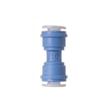
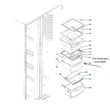
How to tell if a GE water filter is clogged?
On the GE GSS25GSHGCSS side-by-side refrigerator, a clogged water filter shows up as reduced water flow at the dispenser and slower ice production. If the dispenser stream is weak, sputters, or the filter light is red (or turns orange then red), the filter is due for replacement; see the GSS25GSHGCSS owner’s manual.
Quick checks that point to a clogged filter
- Water flow from the dispenser is noticeably slower than normal.
- Ice maker output drops, or cubes look smaller or “hollow.”
- The water filter indicator light turns orange (replace soon) or red (replace now), if your dispenser has the light.
- Water spurts or sputters after the system has been sitting (often worsens as the filter loads up).
- Flow improves when the filter is removed and a bypass plug is installed (temporary diagnostic step).
Simple 20-second flow test
Use this quick test to confirm low flow:
| Test step | What to do | What it means |
|---|---|---|
| Measure flow | Dispense water into a measuring cup for 20 seconds | Confirms whether flow is low |
| Compare result | Less than about 8 oz in 20 seconds | Flow is inadequate; filter restriction is likely |
What to do next
- Replace the filter and flush the system by running about 1-1/2 gallons (roughly 3 minutes) of water.
- Reset the filter indicator by pressing and holding the WATER FILTER pad for 3 seconds (on models that have it).
- If flow is still low after a new filter, check the household shutoff valve and water supply line; then consider diagnosing the inlet valve.
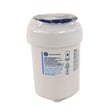
If you need the correct replacement cartridge for this model, use the GE refrigerator water filter MWFP.
Why it matters
A restricted filter can starve the dispenser and ice maker of water, causing slow dispensing, poor ice production, and inconsistent cube quality. Replacing the filter on schedule (about every 6 months, sooner with low flow) keeps water delivery steady.
Last updated: January 2026
Why is my GE side by side refrigerator not dispensing ice?
If your GE GSS25GSHGCSS makes ice but will not dispense it, the most common causes are a blockage in the ice chute, clumped ice in the bucket, the icemaker being turned off, or a dispenser-door issue at the chute. Use the GSS25GSHGCSS owner's manual steps to clear jams and restore normal dispensing.
Quick checks we recommend first
- Make sure the icemaker is turned on and the water supply is on.
- Pull out the ice bucket and break up irregular clumps; discard old ice.
- Check the ice chute in the freezer door for a cube or item blocking it.
- Confirm the bucket is fully seated; a mis-seated bucket can stop dispensing.
- If the freezer is a little warm, set it colder one step at a time to reduce clumping.
What to inspect if the chute keeps jamming
Ice can freeze together and jam the chute or bucket, especially if ice is not used often.
| Symptom | Likely cause | What we do next |
|---|---|---|
| Motor sound but no ice comes out | Chute jam or clumped ice | Clear chute; break up clumps; reinstall bucket |
| No sound when pressing dispenser | Dispenser switch or control issue | Check for stuck lever; inspect wiring connections |
| Chute door does not close well | Chute door not sealing | Replace the chute door kit |
If the chute door is torn, warped, or not sealing, replacing the refrigerator dispenser ice chute door kit WR17X11653 typically restores proper operation and helps prevent frost buildup around the chute.
Why it matters
A blocked chute or a chute door that does not seal can let humid air into the dispenser area. That moisture refreezes into frost and clumps, which leads to repeated ice jams and inconsistent dispensing.
Helpful how-to guidance
For model-specific dispenser and ice system tips, we follow the same process shown in how to disassemble the ice and water dispenser on a GE refrigerator when we need to access the chute area and clear obstructions safely.
Last updated: January 2026
What are signs my GE ice maker is broken?
If your GE GSS25GSHGCSS ice maker is broken, you will typically see no ice production after the freezer is cold, repeated buzzing without ice, or cubes that never eject into the bin. On this model, the ice maker only fills once the freezer reaches about 15°F, and a new install can take 12 to 24 hours to start making ice (see the GSS25GSHGCSS owner's manual).
Quick signs the ice maker has failed (or is being blocked)
- No ice after 24 hours with the ice maker switched ON and the door closed normally
- Buzzing sound (fill attempt) but the mold stays dry
- Ice cubes form but do not dump into the bucket (ejector stalls)
- Cubes are very small or hollow (often low water flow)
- Ice is stuck together, cloudy, or tastes stale (often old ice or infrequent use)
- Feeler arm cannot move freely because the bin or ice is interfering
What to check first (most common causes)
Start with the basics that stop ice production even when the ice maker itself is fine:
- Freezer temperature: ice maker fill starts around 15°F; warmer temps slow or stop cycling
- Ice maker power: confirm the ice maker switch is ON
- Feeler arm: make sure nothing blocks its sweep; a blocked arm can stop production
- Water supply: verify the shutoff valve is fully open and the supply line is not kinked
- Water filter: a clogged or missing filter can restrict water; replace the GE refrigerator water filter MWFP and flush the system
Normal vs. problem symptoms
| Symptom | Often normal | Often a problem |
|---|---|---|
| No ice right after install | First 12 to 24 hours | Still none after 24 hours and freezer is cold |
| Buzzing during fill | Brief buzzing during fill | Buzzing repeats but no water enters mold |
| Joined cubes | A few cubes joined | Large clumps, frequent jams, or no ejection |
Why it matters
Ice makers depend on freezer temperature, water flow, and a free-moving shutoff (feeler) arm. Fixing a simple water filter restriction or a blocked arm prevents unnecessary part replacement and gets ice production back faster.
Last updated: January 2026
What is the most common problem with a GE refrigerator?
Cooling problems are the most common issue we see on GE refrigerators like model GSS25GSHGCSS. In many cases, the root cause is restricted airflow or a defrost-related problem that lets frost build up on the evaporator, which reduces cooling and can lead to warm temperatures and spoiled food.
Most common causes (and what to check first)
Start with the simple checks that solve a large share of “not cold enough” complaints:
- Confirm the temperature controls are not set to OFF; set them colder if needed (the GSS25GSHGCSS owner's manual covers control settings and basic operation).
- Give the unit time after changes; after a power interruption or setting change, temperatures can take several hours to stabilize.
- Clean dust from the condenser area (dirty coils reduce heat removal and cooling performance).
- Make sure doors close fully and seals are clean; air leaks cause long run times and weak cooling.
- Listen for the evaporator fan; if airflow is weak, cooling in both sections suffers.
- If the refrigerator seems “dead,” remember it may be in a defrost cycle; waiting about 30 minutes is a normal first step.
Parts that commonly relate to cooling complaints
If basic checks do not help, these model-related parts often come up during diagnosis:
- Refrigerator evaporator fan motor WR60X10307 (moves cold air through the compartments)
- Refrigerator defrost heater WR51X10055 (melts frost off the evaporator during defrost)
- GE profile refrigerator temperature sensor WR55X10025 (feeds temperature information to the control)
Quick symptom-to-likely-cause guide
| Symptom | Most likely area to check | Common next step |
|---|---|---|
| Fresh food warm, freezer cold | Airflow from freezer to fridge | Check vents, fan operation, frost buildup |
| Both sections warm | Heat removal or sealed system | Clean condenser area; verify fans; then deeper diagnosis |
| Heavy frost on back freezer panel | Defrost system | Inspect defrost heater, sensor, and wiring |
| Runs constantly, temps drift | Door sealing or airflow restriction | Check gaskets, door alignment, blocked vents |
Why it matters
A refrigerator can still “run” while not cooling correctly. Catching airflow restrictions, dirty condenser areas, or defrost frost buildup early helps prevent food loss and reduces strain on the compressor and control system.
For model-specific troubleshooting steps and normal operating behaviors (including defrost-cycle timing and common sounds), use the GSS25GSHGCSS owner's manual.
Last updated: January 2026