Owner’s manual
 Error Codes


Which is better, top mount or bottom mount refrigerator?
A bottom-mount refrigerator like the Amana ABB2227DEW is better for most households because the fresh-food section sits at eye level, so you bend less for everyday items. A top-mount is usually the better pick when you want the lowest upfront cost and simplest layout.
| Feature | Top-mount (freezer on top) | Bottom-mount (freezer on bottom) |
|---|---|---|
| Everyday access | More bending for fresh food | Easier access to fresh food |
| Freezer access | Easier access to freezer | More bending for freezer |
| Organization | Simple shelves and bins | Often better fresh-food organization |
| Energy use | Often slightly lower | Often slightly higher |
| Typical price | Lower | Higher |
- If you cook often and use fresh food daily, choose bottom-mount for comfort and convenience.
- If you use the freezer more than the refrigerator, choose top-mount.
- If you want the simplest design with fewer moving drawer parts, choose top-mount.
- If you want easier fridge organization (produce, deli, leftovers), choose bottom-mount.
- If your kitchen opening is tight, measure carefully and plan for ventilation clearances.
For model-specific installation and clearance guidance for your ABB2227DEW, use the owner's manual.
Bottom-mount designs reduce bending for the items you reach for most, which improves day-to-day usability. Whichever style you choose, correct placement and airflow matter; the manual guidance on clearances and indoor temperature range helps prevent cooling problems and noise.
Last updated: February 2026
What are the disadvantages of a bottom freezer refrigerator?
Bottom-freezer refrigerators like the Amana ABB2227DEW keep fresh food at eye level, but the tradeoffs are mostly about freezer access and wear: you bend more for frozen items, the freezer drawer can feel heavy when loaded, and drawer slides and seals can need attention sooner with frequent use.
- More bending for frozen food: the freezer is low, so frequent freezer use is less convenient.
- Heavier, bulkier freezer drawer: a fully loaded drawer takes more effort to open and close.
- Organization can be trickier: deep drawers can hide items unless you use bins.
- More stress on moving parts: repeated opening with a heavy load can wear drawer hardware over time.
- Door seal sensitivity: if the drawer is slightly misaligned or overpacked, it can compromise the seal and cause temperature swings.
A bottom-mount design depends on good airflow and stable temperatures. Our owner's manual recommends leaving space between freezer packages so cold air can circulate, and avoiding overloading with warm food because it slows freezing and can raise temperatures.
If you notice symptoms that feel like “bottom-freezer problems,” these are the most common:
- Frost buildup or warming in the freezer
- Soft ice cream on the door shelf area
- Longer run times after big grocery loads
- Drawer not closing smoothly or sealing tightly
| Feature | Bottom freezer | Top freezer |
|---|---|---|
| Fresh food access | Best (eye level) | Requires bending |
| Freezer access | Requires bending | Easier access |
| Drawer/slide wear | Higher (heavy drawer) | Lower (lighter door) |
| Organization | Deep drawer, needs bins | Shelves, easier visibility |
When the freezer drawer is overpacked or not sealing well, temperatures fluctuate more with door openings. That can lead to freezer burn and food quality issues, and it can make the refrigerator run longer (which the manual notes can happen when airflow is restricted or doors are opened often).
Last updated: February 2026
What is the bottom part of the fridge called?
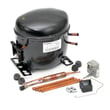
On an Amana ABB2227DEW bottom-mount refrigerator, the “bottom part” people usually mean is the machine compartment area, which houses key cooling components like the compressor (the pump that circulates refrigerant) and the condenser fan parts.
Depending on where you’re looking, the bottom area can mean different things:
- Toe grille (kick plate): the vented cover at the very bottom front
- Machine compartment cover: the rear lower cover that helps direct airflow
- Compressor compartment: where the compressor and start components sit
- Freezer drawer section: the lower drawer area on bottom-freezer models
For model-specific diagrams and terminology, use the ABB2227DEW owner's manual.
| Where you’re looking | Common name | What it does |
|---|---|---|
| Bottom front (vented) | Toe grille | Lets air flow; provides access for leveling on many models |
| Bottom back (lower cover) | Machine compartment cover | Protects components; supports proper air circulation |
| Bottom back (behind cover) | Compressor compartment | Contains compressor, condenser fan, and electrical start parts |
| Bottom inside (drawer) | Freezer drawer | Stores frozen food; slides/gears help it open smoothly |
Using the right name helps you order the correct replacement part and troubleshoot faster. For example, a warm refrigerator with a running compressor points you toward airflow, fans, or defrost issues, not the freezer drawer hardware.
If you’re diagnosing a noise, no-cool, or poor-cool issue, these are common bottom-area parts for ABB2227DEW:
- Refrigerator compressor W10160407 (core cooling component)
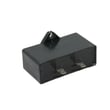
- Refrigerator overload release W10613606 (compressor start protection)
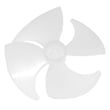
- Blade, cond W10156818 (condenser fan blade)
- Refrigerator condenser WP67006132 (heat-rejecting coil)
Last updated: February 2026