Installation guide
 Owner’s manual
 Error Codes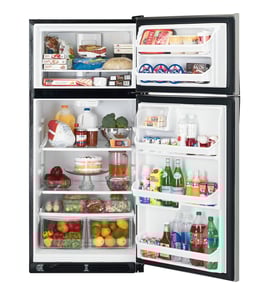





What are the advantages of a top mount fridge?
A top-mount refrigerator like the Frigidaire FRT18L4JW3 gives you a classic layout with the freezer on top and fresh food below; it is easy to live with, typically efficient, and usually offers strong usable refrigerator space for everyday groceries. For setup details, use the FRT18L4JW3 owner’s manual.
- More usable fresh-food space for common items (milk, leftovers, produce) at comfortable reach.
- Simple, proven design with fewer complex features to maintain.
- Good airflow and cooling performance when installed with proper clearances.
- Often lower purchase and repair costs compared with more complex configurations.
- Door swing flexibility; many top-mount models allow door reversal to fit your kitchen.
| Feature | Top-mount refrigerator | Bottom-freezer refrigerator |
|---|---|---|
| Fresh-food access | Good, most items mid-level | Best, fresh food at eye level |
| Frozen-food access | Easy for many users (upper compartment) | Easier for heavy frozen items (pull-out drawer) |
| Complexity | Typically simpler | Often more complex |
| Space efficiency | Strong usable space | Varies by design |
Proper installation helps any top-mount refrigerator cool evenly and avoid noise or door-seal issues.
- Keep recommended clearances for airflow (commonly 3/8 inch at sides and top, 1 inch at back).
- Level the cabinet so it sits solid on all corners; many units are set slightly tilted back so doors close well.
- Avoid extension cords; use a grounded outlet.
- If your model has an ice maker, connect the water supply and recheck for leaks after 24 hours.
For step-by-step leveling and clearance guidance, use the FRT18L4JW3 installation guide.
A top-mount layout is popular because it balances capacity, reliability, and everyday convenience. When the refrigerator is level and has proper air circulation, temperatures stay steadier and door seals last longer.
Last updated: January 2026
Why is my Frigidaire top mount freezer not freezing?
If your Frigidaire FRT18L4JW3 top-mount freezer is not freezing, the most common causes are incorrect control settings, blocked airflow, or a fan/defrost issue. Adjust the freezer control in small steps and give temperatures time to stabilize, then confirm air vents are clear and the door is sealing.
- Make sure the refrigerator is powered and running; the temperature control is not set to 0 (Off).
- If the unit was just started or recently unplugged, allow 8 to 12 hours of cool-down time with doors closed.
- Adjust temperatures gradually; move the knob slightly and wait for the temperature to stabilize.
- Do not block cold air vents with food; airflow is required to keep the freezer cold.
- If you have an ice maker, remember it will not make ice during the first 24 hours after startup.
On this model style, the refrigerator control can affect both compartments, while the freezer control changes only the freezer temperature. If the freezer is warm, turn the freezer control slightly toward Colder and wait.
| What you notice | What it usually means | What to do |
|---|---|---|
| Freezer warm, fridge also warm | Overall cooling problem | Check condenser area for dust, confirm doors close fully |
| Freezer warm, fridge OK | Airflow/defrost issue | Clear vents, listen for evaporator fan, check for frost buildup |
| Temps change too slowly | Normal stabilization time | Wait 24 hours after adjustments |
If you hear the refrigerator running but the freezer stays warm, we focus on airflow and defrost components.
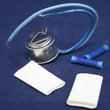
- Heavy frost on the freezer back wall often points to a defrost problem; a common component is the refrigerator defrost bi-metal thermostat 5303918202.
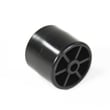
- If the fan is noisy, stalled, or not moving air, the blade can be damaged; inspect the refrigerator evaporator fan blade 5308000010.
A freezer that is not freezing can quickly lead to unsafe food temperatures and can also force the compressor to run longer than normal. Correct settings and clear airflow solve many “not freezing” complaints without replacing parts.
For model-specific control guidance and operating details, use the FRT18L4JW3 owner’s manual.
Last updated: January 2026
What is the upper part of a fridge called?
On the Frigidaire FRT18L4JW3 top-mount refrigerator, the upper section is the freezer compartment. It’s the insulated space designed to hold frozen foods at the coldest temperatures, and it often houses the ice maker (if equipped) and freezer temperature control settings.
The freezer compartment is built to maintain temperatures cold enough for long-term storage of frozen foods.
- Keeps foods frozen for longer storage
- Helps make and store ice (when an ice maker is installed and turned on)
- Works with the refrigerator section to balance overall cooling
- Uses door gaskets to seal in cold air and reduce frost and temperature swings
Depending on how your FRT18L4JW3 is configured, the freezer area commonly includes shelves, bins, the evaporator cover area, and door sealing surfaces.
| Area | What you’ll typically see | Why it matters |
|---|---|---|
| Freezer door | Door gasket, bins/shelves | Prevents warm air leaks and frost buildup |
| Rear freezer wall | Evaporator cover area | Directs airflow for even freezing |
| Freezer airflow | Fan-driven circulation | Helps prevent warm spots and slow freezing |
Knowing the correct name helps when you’re troubleshooting cooling problems, checking door sealing, or ordering parts. For example, warm temperatures in the upper section often point to airflow, door sealing, or defrost-related issues.
- Use the FRT18L4JW3 owner’s manual to confirm control locations and recommended temperature settings.
- If the freezer door is not sealing well, inspect the gasket for gaps, tears, or hardened areas; a common replacement is the Frigidaire refrigerator door gasket (black) 241872512 when it matches your door color.
- If you notice unusual noises or weak airflow, review how to fix your evaporator cooling fan for common fan-related symptoms.
Last updated: January 2026
What is the most common problem with a Frigidaire refrigerator?
Cooling problems are the most common issue we see with Frigidaire refrigerators like model FRT18L4JW3; the fridge or freezer runs but temperatures drift warm, food spoils faster, or frost builds up. In many cases, the cause is airflow related (dirty condenser area, a weak fan, or a door that is not sealing tightly).
- Refrigerator section warm but freezer still partly cold
- Freezer frost buildup on the back wall or around vents
- Compressor seems to run a lot, or cycles oddly
- Louder-than-usual fan noise, rattling, or buzzing
- Water puddles after defrost cycles
- Confirm controls are set correctly and allow 24 hours for temperatures to stabilize after changes.
- Check the door seal for gaps, tears, or areas that do not grip paper when the door is closed.
- Listen for normal operating sounds; many modern compressors hum or pulse, and fans can be more noticeable on hard floors.
- Inspect for dust and pet hair around the condenser area; some versions are “Never Clean,” but dusty or greasy homes can still need periodic cleaning.
- If the unit will not run at all, verify power (plug seated, breaker/fuse) and remember the refrigerator may be in a defrost cycle for about 20 minutes.
| Likely cause | What you notice | What to do next |
|---|---|---|
| Dirty condenser area or restricted airflow | Warm temps, long run times | Clean airflow paths; recheck temps in 24 hours |
| Door gasket not sealing | Moisture, frost, warm spots | Inspect and correct sealing; replace if damaged |
| Evaporator fan issue | Warm fridge, weak airflow, unusual fan noise | Diagnose fan operation and airflow |
| Defrost system issue | Heavy frost on evaporator cover/back wall | Check defrost components and airflow |
If you confirm a sealing problem, a door gasket is a common fix on this model family; match color and fit carefully.
Cooling problems usually get worse over time; catching airflow restrictions or a poor door seal early helps protect the compressor and keeps food at safe temperatures.
For model-specific operating guidance and care steps, use the FRT18L4JW3 owner’s manual.
Last updated: January 2026