Installation guide
 Owner’s manual
 Error Codes


Is Amana a low-end brand?
Yes. Amana is positioned as a value-focused, budget-friendly appliance brand, and the Amana NTW4631BQ1 washer is built around simple, practical features rather than premium options. That makes it a solid choice when you want straightforward washing performance and lower upfront cost.
Amana typically emphasizes essentials over extras. In day-to-day use, that usually looks like:
- Fewer specialty cycles and advanced settings than premium lines
- More basic controls and simpler user interface
- Lower purchase price compared with many mid-range and premium washers
- Repairs that often focus on core wear items (belt, lid lock, suspension)
- Good fit for rentals, guest laundry, and budget replacements
For model-specific operation, cycle guidance, and troubleshooting steps, use the NTW4631BQ1 owner’s manual.
| What you’re comparing | Amana (value line) | Premium washer lines |
|---|---|---|
| Controls | Simple, straightforward | More electronic features |
| Features | Essentials | More specialty options |
| Cost | Lower upfront | Higher upfront |
| Typical repairs | Common wear parts | More feature-related parts |
Knowing Amana’s value positioning helps you decide what to prioritize: if you want dependable basics at a lower price, Amana is a strong match; if you want more convenience features and customization, a higher-tier line may fit better.
Last updated: February 2026
Does my top load Amana washer have a filter?
Yes. Your Amana top-load washer model NTW4631BQ1 uses internal filtering rather than a front-access lint filter; most filtering happens through the wash action and drain system, so routine care focuses on proper loading, detergent use, and keeping the drain path clear (see the NTW4631BQ1 use and care guide).
Many top-load washers do not have a removable, user-cleanable lint filter. Instead, they rely on the tub design and the drain pump path.
- Check under the agitator cap only if your design includes a removable cap and screen
- Watch for small items (coins, socks) that can migrate toward the pump area
- Keep the drain hose installed correctly to prevent slow draining
- Use the right amount of detergent to avoid excess suds that can slow draining
- Load items in loose heaps around the basket wall to reduce lint redeposit
If the washer is not draining or spinning well, it is often a restriction in the drain path or a load/suds issue.
| What you notice | Most common cause | What we do first |
|---|---|---|
| Loads still wet after spin | Overloading or unbalanced load | Redistribute load; run Drain/Spin |
| Slow drain, gurgling | Drain hose install or partial blockage | Check hose height and standpipe depth |
| Suds, long drain time | Too much detergent | Reduce detergent; rerun cycle |
| Intermittent stopping | Lid not closed/latched | Confirm lid closes and locks |
- Unplug the washer.
- Confirm the lid closes fully and the cycle is not being interrupted.
- Verify the drain hose is not kinked and is installed correctly (see the NTW4631BQ1 installation guide).
- Rerun a cycle using about half the normal detergent amount for a medium load.
- If draining issues continue, inspect the drain hose for internal clogs; replace if soft, split, or restricted using the washer drain hose W11244231.
A true “filter” problem is usually a drain restriction or excess suds. Fixing the drain setup and detergent amount prevents wet loads, long cycle times, and unnecessary strain on the drive system.
Last updated: February 2026
How long do Amana washers last?
Most Amana top-load washers, including model NTW4631BQ1, typically last 10 years with normal household use. Consistent care (correct detergent amount, balanced loads, and periodic hose replacement) is what most often separates a shorter lifespan from a full decade of service.
Amana washers are designed to be straightforward and serviceable; lifespan depends heavily on usage and maintenance.
- Typical lifespan: about 10 years
- Heavy use (large family, daily loads): often 7 to 9 years
- Light use (few loads per week): often 10 to 12 years
- Biggest wear drivers: chronic overloading, frequent unbalanced spins, and excess detergent residue
The NTW4631BQ1 manual emphasizes habits that reduce residue, odor, and stress on components.
- Use only the recommended detergent amount; too much can cause buildup and performance issues
- Mix in warm or hot washes sometimes (not only cold) to help reduce residue
- Load items in loose heaps around the basket wall to reduce imbalance and strain
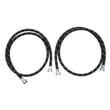
- Replace water inlet hoses at 5 years; inspect for bulges, kinks, cuts, wear, or leaks
- Keep the washer level to reduce vibration and suspension wear
For the exact care and operating guidance for your washer, follow the NTW4631BQ1 owner's manual.
| Care level | What it looks like | Expected outcome |
|---|---|---|
| Basic | Cold-only, frequent overloading, too much detergent | More repairs; shorter life |
| Good | Correct detergent, balanced loads, occasional warm/hot | Typical life (around 10 years) |
| Excellent | Good habits plus periodic inspections and hose replacement | Often reaches the high end of the range |
A washer usually fails early from preventable stress: unbalanced spinning can wear suspension parts, and detergent overuse can lead to residue and odor that affects cleaning performance. Simple habits protect the drive system, tub support, and water system.
Last updated: February 2026
Is 4.7 cubic feet a large washer?
Yes; 4.7 cubic feet is a large-capacity washer size (large typically starts around 4.5 cubic feet). That said, your Amana NTW4631BQ1 washer is not a 4.7 cubic foot model; use the load-size and cycle guidance in the NTW4631BQ1 owner’s manual to avoid overloading and poor performance.
Capacity is the tub volume; real-world performance depends on how freely clothes can move during wash and rinse.
- Large capacity is typically 4.5 cu. ft. and up
- Medium capacity is typically about 3.0 to 4.4 cu. ft.
- Overfilling reduces agitation and rinsing
- Overloading increases vibration and can leave clothes wetter after spin
- Bulky items need extra space even in a large tub
These loading habits match common Amana top-load guidance and help prevent out-of-balance spins.
- Load dry items in loose heaps, evenly around the basket wall
- Do not tightly pack; keep space at the top for turnover
- Wash bulky items (comforters, jackets) with the correct load size selection
- Avoid washing one heavy item alone; add a few similar items to balance
- If the washer bangs or walks, stop and redistribute the load
| Tub capacity | Common label | Best for |
|---|---|---|
| 2.8 to 3.9 cu. ft. | Small to medium | Everyday loads, smaller households |
| 4.0 to 4.4 cu. ft. | Medium to large | More towels, larger mixed loads |
| 4.5 to 5.3 cu. ft. | Large | Comforters, bulky items, fewer loads |
“Large” capacity only helps when the load can circulate. Correct loading and load-size selection help your Amana NTW4631BQ1 clean better, spin smoother, and reduce wear on suspension and drive components.
Last updated: February 2026