Owner’s manual
 Error Codes


What size is Kenmore refrigerator model 79577713700?
Kenmore Elite refrigerator model 79577713700 is a bottom-freezer (bottom-mount) refrigerator in the Kenmore 795.7771* family. For exact exterior dimensions (width, depth, height) and capacity for your specific color/trim version, use the 79577713700 owner's manual.
What “size” usually means for this model
When customers ask for “size,” they typically mean one or more of these:
- Exterior dimensions: width, depth (with and without handles), and height
- Capacity: total cubic feet (fresh food plus freezer)
- Fit clearances: space needed for airflow and door swing
- Door and drawer clearance: room to fully open the refrigerator doors and freezer drawer
How to find the exact dimensions for 79577713700
We recommend pulling the measurements from the specification section in the manual, then confirming with a tape measure in your kitchen (floors and cabinets are rarely perfectly square).
- Check the manual for overall width, height, and depth
- Look for separate depth specs for doors closed and doors/handles included
- Confirm whether the spec lists case depth (cabinet only) versus overall depth
- Measure your opening and compare to the spec, then add clearance
Typical fit planning clearances (helpful rule-of-thumb)
These clearances help the compressor and condenser airflow and reduce door interference.
| Location | Typical clearance to plan | Why it helps |
|---|---|---|
| Sides | 1/8 to 1/4 inch | Prevents cabinet rub and vibration noise |
| Top | 1 inch | Improves airflow and heat release |
| Back | 1 to 2 inches | Protects water line and improves ventilation |
Why it matters
A bottom-freezer refrigerator like the Kenmore 79577713700 can look like it “fits” by width, but still run into problems with door swing, handle depth, or airflow clearance, which can affect cooling performance and day-to-day usability.
Last updated: January 2026
What does DH mean on Kenmore Elite refrigerator?
On Kenmore Elite model 79577713700, DH commonly indicates a defrost heater (defrost heating) issue, meaning the refrigerator is not heating the evaporator enough during the defrost cycle. This can lead to frost buildup, warm temperatures, and reduced airflow; use the 79577713700 owner's manual to confirm the display message and recommended checks.
What you’ll usually notice when DH shows
- Frost or ice building up on the rear freezer panel
- Freezer temperature rising, then refrigerator section warming
- Evaporator fan noise changing as airflow gets restricted
- Water leaking or ice forming near the drain area after partial defrost
Quick checks we recommend before replacing parts
- Power reset: Unplug the refrigerator (or turn off the breaker) for 5 minutes, then restore power.
- Airflow basics: Make sure vents are not blocked by food packages.
- Door sealing: Confirm doors close fully; warm, moist air increases frost load.
- Listen for the fan: If the evaporator fan is struggling due to ice, cooling performance drops quickly.
Parts that commonly relate to a DH/defrost-heating problem
If the code returns after a reset, these are the most common suspects in a defrost-heating circuit:
| What can fail | What it affects | Typical symptom |
|---|---|---|
| Defrost heater | Melts frost off evaporator | Heavy frost, warming temps |
| Defrost control (board) | Sends power to heater | Intermittent or no defrost |
| Wiring/connector | Power path to heater | Code comes and goes |
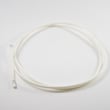
For this model, the defrost heater is a common replacement part: lg refrigerator defrost heater 5300JK1005D.
Why it matters
Defrost heat keeps the evaporator coil clear so the evaporator fan can move cold air through the refrigerator. When defrost heat fails, frost blocks airflow, and temperatures rise even though the compressor may still run.
Related help
If you’re seeing a code on the display and want to match it to symptoms and fixes, use Kenmore 795 model bottom freezer refrigerator error codes.
Last updated: January 2026
What are the common problems with Kenmore Elite refrigerators?
Common problems on the Kenmore Elite 79577713700 bottom-mount refrigerator include warm temperatures (cooling airflow issues), frost or ice buildup from doors not sealing or frequent opening, and ice maker or water taste issues tied to the water supply and filtration. Our 79577713700 owner's manual troubleshooting section covers many of these symptoms.
Most common symptoms and what usually causes them
- Not cooling or weak cooling: dirty condenser area, failed evaporator fan motor, blocked airflow, or sealed-system problems.
- Frost or ice crystals on frozen food: door not closing fully, door opened often (warm humid air enters).
- Doors hard to open or “sticking”: dirty or sticky door gaskets; pressure equalization after closing.
- Ice tastes bad or smells: new ice maker, old stored ice, unwrapped foods, or mineral-heavy water.
- Ice production slow or cubes small: freezer not cold enough yet, door left open, or a restricted shutoff valve.
Quick checks we recommend before replacing parts
- Confirm the controls are set correctly and allow 24 hours for temperatures and ice production to stabilize.
- Make sure doors close completely; remove items that prevent sealing.
- Clean and dry the door gaskets; if they stick, apply a thin coat of wax after cleaning (per the manual guidance).
- Throw out old ice and rewrap foods to prevent odor transfer.
- If water flow is weak, check the household shutoff valve and supply line for restrictions.
Parts that commonly relate to these problems (when symptoms match)
| Symptom | Common part to inspect | Example part for this model |
|---|---|---|
| No water to dispenser/ice maker, slow fill | Water inlet valve | Lg refrigerator water inlet valve 5221JB2006K |
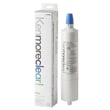
| Bad-tasting water/ice, reduced flow | Water filter | Kenmore refrigerator water filter 9990 5231JA2006E |
| Warm fridge section, poor airflow | Evaporator fan motor or blade | 4681JB1029H motor, 5901JA1021A blade |
Why it matters
Cooling, frost, and ice maker complaints often share the same root causes: airflow, door sealing, and water supply. Addressing those basics first prevents food spoilage, reduces frost buildup, and improves ice quality.
Last updated: January 2026