Owner’s manual
 Error Codes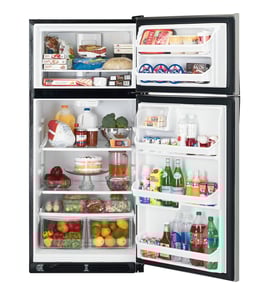



Is there a way to reset a Kenmore Elite refrigerator?
Yes. For a Kenmore top-mount refrigerator like model 25361822106, the most reliable “reset” is a power reset: unplug the refrigerator (or switch off the breaker) for about 5 minutes, then restore power and allow up to 24 hours for temperatures to stabilize. See the 25361822106 owner's manual for control and troubleshooting details.
How to do a safe power reset
- Turn the temperature control to “0” (this stops the compressor but does not remove electrical power).
- Unplug the refrigerator from the wall outlet (grip the plug firmly and pull straight out).
- Wait 5 minutes.
- Plug it back in and set the controls back to your normal settings.
- Give the refrigerator time to recover; cooling performance can take up to 24 hours to fully stabilize.
If it still will not cool after resetting
A reset will not fix an underlying cooling or airflow problem. Check these common items first:
- Make sure the plug is fully seated in the outlet.
- Reset the house circuit breaker or replace the fuse with a 15-amp time-delay fuse if needed.
- Confirm the temperature control is not still set to “0”.
- Wait about 20 minutes in case the refrigerator is in a defrost cycle.
- Verify vents are not blocked by food packages.
Quick guide: “reset” options and what they actually do
| What you do | What it resets | When it helps |
|---|---|---|
| Unplug for ~5 minutes | Control board logic and sensors reboot | Glitches after a power flicker, odd behavior |
| Set control to “0” | Stops compressor only | Short pause for service tasks, not a true reset |
| Breaker off/on | Same as unplugging | When the plug is hard to access |
Why it matters
A proper reset can clear a temporary control issue, but if the refrigerator is not running, is stuck in defrost, or has a cooling-system problem, you will get faster results by using the manual’s “Before you call” checks instead of repeatedly resetting.
Last updated: January 2026
What is the upper part of a fridge called?
On the Kenmore top-mount refrigerator model 25361822106, the upper section is the freezer compartment. It is designed to keep foods frozen, store ice, and circulate cold air so the fresh-food section below stays at safe temperatures (see the 25361822106 owner's manual).
What you will typically find in the upper (freezer) compartment
- Freezer shelves or bins for frozen foods
- Freezer door shelves for smaller items
- Cold air vents (airflow paths between freezer and refrigerator)
- Automatic defrost components (heater and controls)
- Ice-making components on some setups (ice maker and fill system)
Freezer vs. refrigerator section: quick comparison
| Section | Common name | Main job | Typical temperature |
|---|---|---|---|
| Upper section (this model) | Freezer compartment | Freeze and store frozen foods | About 0°F |
| Lower section | Fresh-food compartment | Keep refrigerated foods cold | About 37°F |
Why it matters
Knowing the correct name helps when you are troubleshooting cooling issues, airflow problems, or ice buildup. For example, many “refrigerator not cold enough” complaints start with restricted airflow or frost buildup in the freezer compartment.
Related parts customers often ask about
If you are organizing storage or replacing broken bins and drawers, these are common items for this Kenmore model:
- Frigidaire refrigerator door gallon bin 240338001 (door storage)
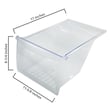
- Crisper drawer - refrigerator storage component by frigidaire 240337103 (fresh-food produce storage)
- Refrigerator light bulb 316538904 (interior lighting)
Last updated: January 2026
What's the average lifespan of a Kenmore refrigerator?
Most Kenmore refrigerators average 12 to 15 years of service life. For your Kenmore top-mount refrigerator 25361822106, consistent care (especially cleaning and keeping doors sealing tightly) is what most often determines whether it reaches the average or lasts longer.
Typical lifespan and what affects it
A refrigerator’s lifespan is mainly driven by heat load, airflow, and how hard the sealed system has to work.
- Condenser coil cleanliness (dirty coils raise compressor run time)
- Door seal condition (air leaks cause longer run times and frost)
- Room temperature and ventilation around the cabinet
- Frequency of door openings and warm food loads
- Power quality (the manual calls for a dedicated 115V, 60 Hz outlet)
Maintenance checklist to help it reach 12 to 15 years
Use these habits to reduce wear on the compressor, evaporator, and fans.
- Vacuum or brush condenser coils regularly (more often with pets)
- Keep door gaskets clean and pliable; wipe with mild soap and water
- Set stable temps (avoid frequent control changes)
- Don’t block interior air vents with food packages
- Keep the unit on a dedicated outlet (no extension cords or switched outlets)
Quick guide: “repair or replace” decision points
| What you’re seeing | Common meaning | Typical next step |
|---|---|---|
| Warm fridge, freezer OK | Airflow or defrost issue | Check vents, frost buildup, fan noise |
| Frost buildup, poor cooling | Defrost system or door leak | Inspect gasket, check defrost components |
| Loud new fan noise | Fan blade or motor issue | Inspect for ice contact or wobble |
| Door won’t seal | Gasket or alignment issue | Clean gasket, warm and reshape, replace if torn |
Why it matters
A refrigerator that runs longer to maintain temperature uses more energy and puts extra stress on the sealed refrigeration system. Simple upkeep often prevents early compressor and evaporator fan failures.
For model-specific operating and care guidance, follow the 25361822106 owner's manual.
Last updated: January 2026