 Installation guide
 Owner’s manual


How big is a 2.2 cubic feet washer?
A 2.2 cubic feet washer refers to the tub capacity, not the outside size. For a Kenmore washer like model 11024812200, most machines in this capacity range are roughly 24 to 27 inches wide, 34 to 39 inches tall, and 24 to 30 inches deep; confirm exact dimensions in the 11024812200 owner's manual.
What “2.2 cu. ft.” means
2.2 cu. ft. is the volume inside the wash basket/tub. It helps you estimate load size, but it does not tell you the cabinet footprint.
Typical real-world capacity expectations:
- About 1 to 2 bath towels plus small items per load (depending on thickness)
- Better for small households, apartments, and lighter weekly laundry
- Overloading reduces cleaning and can cause out-of-balance spinning
Typical exterior dimensions for a 2.2 cu. ft. washer
Most washers around 2.2 cu. ft. fall into one of these common size buckets:
| Washer style | Typical width | Typical height | Typical depth |
|---|---|---|---|
| Compact (often 24-inch class) | 24 in. | 34 to 38 in. | 24 to 27 in. |
| Standard top-load (27-inch class) | 26 to 27 in. | 36 to 39 in. | 25 to 30 in. |
Measuring tips (so you buy the right fit)
Use a tape measure and check these points:
- Width at the widest point (cabinet, not just the lid)
- Depth including hoses and the drain standpipe clearance
- Height to the top of the control panel (lid open clearance if needed)
- Doorway and hallway clearance for moving the washer
- Space for vibration (leave a little side-to-side clearance)
Why it matters
Capacity (2.2 cu. ft.) affects how much laundry you can wash at once; exterior dimensions affect whether the washer fits your laundry space and whether hookups (water inlet valve hoses, drain hose, and power) can be connected without kinks.
Last updated: January 2026
How to hard reset kenmore washer?
A hard reset on your Kenmore washer model 11024812200 is simple: unplug the washer (or switch off the breaker) for 2 minutes, then restore power and try a normal cycle. This clears many temporary control glitches and stuck cycle states.
Hard reset steps (recommended first)
- Turn the washer OFF.
- Unplug the power cord (or turn the circuit breaker OFF).
- Wait 2 minutes.
- Restore power.
- Lift and close the lid once, then select a cycle and press Start.
If it still will not start or finish a cycle
These checks fix the most common “looks dead” or “won’t spin” complaints after a reset:
- Confirm the outlet has power (test with a lamp).
- Make sure the lid is fully closed; a failed lid switch can stop agitation and spin.
- Verify the drain hose is not shoved too far into the standpipe (can cause siphoning and refilling).
- If the washer hums but will not drain, the pump or a clog is likely.
- If it fills but will not agitate, the drive system may be slipping.
| Symptom after reset | Most common cause | What to check next |
|---|---|---|
| No spin, no agitation | Lid not sensed closed | Test/replace washer lid switch WP3949238 |
| Won’t drain | Pump jam or failed | Inspect/replace washer drain pump WP3363394 |
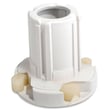
| Fills but won’t agitate | Drive coupling worn | Inspect/replace washer motor coupling 285753A |
Why the reset works
Unplugging removes power from the timer/control and lets it reboot. If the underlying issue is a safety interlock (like the lid switch) or a mechanical problem (like a drain pump blockage), the washer will act up again until that root cause is fixed.
Model-specific tip
For operating and cycle details specific to Kenmore 11024812200, follow the reset and troubleshooting guidance in the 11024812200 owner's manual.
Last updated: January 2026
How much does it cost to replace a washing machine motor?
For Kenmore washer model 11024812200, replacing the drive motor typically costs about $300 to $500 total when you include the motor part plus labor; DIY replacement can cost less if the motor is the only failed component. Confirm the correct procedure in the 11024812200 owner's manual.
What’s included in the total cost
Motor replacement cost is usually a combination of parts, labor, and a service call.
- Drive motor price (part only) varies by model and supplier
- Labor time is commonly 1 to 2 hours for a top-load direct-drive style washer
- Service call/diagnostic fee may apply even if you proceed with the repair
- Additional parts are sometimes needed (coupler, clutch, pump, etc.)
- Taxes and shipping can change the final total
Typical cost ranges (parts and labor)
| Scenario | What you pay for | Typical total |
|---|---|---|
| DIY motor swap | Motor + any small hardware | $150 to $350 |
| Pro repair (most common) | Motor + labor + service call | $300 to $500 |
| Motor plus related drive parts | Motor + coupler/clutch/drive parts | $400 to $700 |
Before you buy a motor, check these common “motor-like” failures
On Kenmore top-load washers, a no-agitate/no-spin complaint is often caused by a drive-train part, not the motor.
- Broken motor-to-transmission coupler: washer motor coupling 285753A
- Lid switch not closing (washer will not spin): washer lid switch WP3949238
- Drain pump jammed (washer will not drain/spin): washer drain pump WP3363394
- Worn clutch causing weak or no spin: clutch 285785
Why it matters
A motor is one of the higher-cost washer parts. Spending a few minutes confirming symptoms and checking the lid switch, drain system, and coupler helps you avoid replacing the drive motor when a lower-cost part is the real cause.
Last updated: January 2026
What is the average lifespan of a Kenmore washer?
A Kenmore washer typically lasts 10 to 15 years with normal household use; for the Kenmore 11024812200, consistent maintenance and quick repairs (especially for draining, filling, and agitation problems) help you reach the higher end of that range. For model-specific care and operating tips, use the 11024812200 owner's manual.
Typical lifespan by washer type
Most Kenmore washers fall into these real-world averages:
| Washer type | Typical lifespan | Notes |
|---|---|---|
| Top-load (traditional) | 12 to 15 years | Simpler drive systems often run longer with basic upkeep |
| Front-load | 10 to 12 years | More wear points (door boot, bearings) and higher spin demands |
| High-efficiency top-load | 10 to 14 years | Depends heavily on load balance and suspension condition |
What shortens washer life fastest
These issues create the most stress on the drive system, tub, and controls:
- Overloading the basket or washing heavy items in one large lump
- Chronic unbalanced loads (shaking, banging, walking)
- Poor draining (standing water, slow spin) that strains the pump and motor
- Hot water sediment or debris clogging the inlet screens and valve
- Ignoring early symptoms like burning smell, grinding, or intermittent agitation
Parts that commonly affect longevity (and what they do)
When a washer is otherwise in good shape, replacing a few wear parts can extend service life:
- Washer lid switch WP3949238: Confirms the lid is closed so the washer can agitate and spin safely
- Washer drain pump WP3363394: Moves water out of the tub during drain and spin
- Washer motor coupling 285753A: Connects the motor to the drive system; protects the motor if the load jams
- Agitator dog 80040: Helps the agitator “grab” and move clothes during the wash action
Why it matters
Knowing the expected lifespan helps you decide whether to repair or replace. If your Kenmore 11024812200 is within the 10 to 15 year window, fixing a single failure (like a lid switch, drain pump, or motor coupling) often restores reliable washing without replacing the whole machine.
Last updated: January 2026





