Installation guide
 Owner’s manual
 Error Codes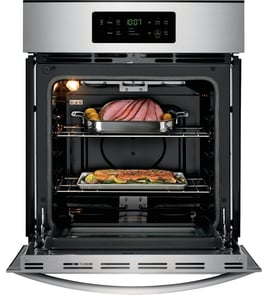


Are wall ovens hard wired or plug in?
For the Kenmore 91147702200 27-inch electric built-in wall oven, the electrical connection is hard-wired (direct-wired) to an approved junction box. A plug and receptacle setup is not permitted for this type of electric wall oven; follow the wiring method shown in the 91147702200 installation guide.
What “hard-wired” means for this oven
Hard-wired means the oven’s flexible conduit is connected inside a junction box using approved connectors, not plugged into a standard outlet.
- Power is shut off at the breaker before any wiring work
- The oven conduit routes to a junction box (not a receptacle)
- A strain relief clamp secures the conduit to the junction box
- Connections are made with properly sized wire nuts
- The oven must be properly grounded per code
Quick comparison: hard-wired vs plug-in
| Connection type | Typical for wall ovens | What you’ll see | Notes |
|---|---|---|---|
| Hard-wired (junction box) | Yes | Conduit into a metal box | Required for this model type |
| Plug-in (cord and outlet) | No | 3- or 4-prong cord | Not permitted for these products |
Installation and safety notes we recommend following
These are the key points that prevent nuisance shutdowns, overheating at connections, and unsafe operation.
- Use an individual, properly grounded branch circuit protected by the correct breaker or fuse (per the rating plate)
- Do not shorten the flexible conduit
- Make sure the strain relief clamp fits the conduit correctly and is tightened securely
- Have a qualified electrician make the final line connections if you are not experienced with electrical work
Why it matters
A wall oven draws high current and generates heat around the cabinet; a direct-wired junction box connection with proper grounding and strain relief helps prevent loose connections, arcing, and heat damage.
Last updated: January 2026
Are electric wall ovens 110 or 220?
The Kenmore 91147702200 27-inch electric built-in wall oven uses a 208/240-volt electrical supply (commonly called “220V”). It is hard-wired (direct-wired) to a junction box, not plugged into a standard 120-volt outlet; see the 91147702200 installation guide.
What voltage does this oven actually use?
This model is designed for a single-phase 60 Hz electrical system that supplies:
- 208Y/120V (common in some apartments/condos)
- 240/120V (common in many single-family homes)
- A dedicated, properly grounded branch circuit protected by a breaker or fuse sized per the rating plate
Quick comparison
| What people call it | Typical supply | Where you see it | Works for this wall oven? |
|---|---|---|---|
| “110V” or “120V” | 120V | Standard outlets | No |
| “220V” or “240V” | 208V or 240V | Hard-wired appliance circuits | Yes |
Plug-in vs hard-wired (important for wall ovens)
For this Kenmore wall oven, the installation instructions specify direct wiring into an approved junction box. A plug and receptacle setup is not permitted for these products.
Before planning an install, we recommend:
- Turning off power at the breaker before any wiring work
- Confirming you have a junction box in the correct cabinet location
- Using a proper strain relief clamp for the conduit
- Following local electrical codes (and NEC guidance for 3-wire vs 4-wire connections)
- Having a qualified electrician make the final connections if you are not experienced with 208/240V circuits
Why it matters
Using the correct 208/240V supply and proper hard-wiring helps the oven heat correctly, protects the control components, and reduces nuisance breaker trips during bake or broil.
Last updated: January 2026
Can a 30 inch wall oven fit in a 30 inch cabinet?
A “30-inch” wall oven usually will not fit a “30-inch cabinet” without verifying the cutout width and required clearances; the cabinet opening often needs to be wider than the oven’s nominal size. For Kenmore model 91147702200 (a 27-inch built-in oven), the installation guide specifies a 25 to 25 1/4 inch cutout width for the cabinet opening.
How to tell if a 30-inch oven will fit
Use the oven’s installation specs, not the label size. Measure the cabinet opening and compare it to the manufacturer’s required cutout dimensions.
- Measure the cutout width at the front and back (cabinets can be out of square)
- Measure cutout height and cutout depth
- Confirm required overlap (trim that covers the cutout edges)
- Verify door swing clearance to nearby drawers, walls, and corners
- Confirm electrical hookup space (junction box location and conduit)
For the most accurate cutout requirements for your exact oven, follow the 91147702200 installation guide.
Typical fit guidance (what “30-inch” usually means)
Most 30-inch wall ovens are designed for a 30-inch cabinet, but the required cutout is commonly slightly larger than the oven chassis and must match the manufacturer’s spec exactly.
| What you’re comparing | What to use | Why it matters |
|---|---|---|
| “30-inch oven” label | Installation cutout width/height/depth | Nominal size is not the cutout size |
| Cabinet size | Actual cutout opening measurements | Face frames and side thickness change the opening |
| Trim overlap | Minimum overlap specs | Prevents gaps and exposed edges |
Why it matters
A wall oven that is too tight can bind in the opening, overheat surrounding cabinetry, or be impossible to secure correctly. Proper cutout sizing also helps ensure safe clearances when the oven door is open.
Last updated: January 2026