Owner’s manual
 Error Codes



How to clear error code on Whirlpool dryer?
On the Whirlpool WED6600VW0 dryer, most display codes clear by pressing a key, restarting the cycle, or canceling and reselecting a cycle. If the code returns right away, use the code’s meaning to guide the next check (power, airflow, or service).
- PF (power failure): Press and hold START to restart the dryer.
- L2 (low or no line voltage): Press any key to clear the code from the display; then correct the power supply issue.
- AF (low airflow): Press any key to clear the code; then correct the venting or lint restriction.
- F# service codes (F1, F2, F20, etc.): These indicate a service condition; the code may clear, but it will return until the underlying problem is fixed.
For the exact button sequence and code list for your control panel, follow the steps in the WED6600VW0 owner's manual.
- Check for a tripped breaker or blown fuse (electric dryers typically use two fuses or breakers).
- Confirm the power cord is installed correctly and the outlet is supplying full voltage.
- Run a Timed Dry (heated) cycle to confirm the heater can turn on.
- Clean the lint screen.
- Check the vent run for kinks, crushing, lint buildup, or a blocked exterior hood.
- Make sure the vent length and number of elbows are within typical recommendations.
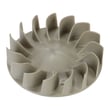
A damaged blower can also reduce airflow; inspect the blower wheel if airflow stays weak after cleaning. If needed, replace the dryer blower wheel WP694089.
| What you want to do | Buttons to press | What happens |
|---|---|---|
| Change cycle after starting | PAUSE/CANCEL twice, then select cycle, press START | Starts the new cycle from the beginning |
| Change an option/modifier mid-cycle | PAUSE/CANCEL once, change option, press START | Continues the cycle |
Codes like L2 and AF often mean the dryer will still run but may not heat or dry properly. Clearing the display is helpful, but fixing the power or vent restriction prevents long dry times, overheating, and repeat shutdowns.
Last updated: February 2026
What are the common problems with Whirlpool dryers?
Common problems we see on Whirlpool dryers like model WED6600VW0 include a dryer that will not start, no heat or weak heat, long dry times from vent restrictions, and noise or thumping from worn drum support parts. Many issues trace back to power supply, airflow, or normal wear items.
- Dryer will not run: door not fully closed, Start not pressed firmly, or a power supply issue (many electric dryers use 240V and can have two breakers/fuses).
- No heat or poor heat: home power issue (often shows as an L2 code), heating circuit problem, or temperature sensing issue.
- Long dry times: crushed/blocked venting (often shows as an AF code), lint buildup, or weak airflow.
- Loud rumbling/squealing: worn drum support rollers, idler pulley, or belt.
- Burning smell on first heat: a brief odor can be normal the first time the heating element is used.
- Confirm the door closes and latches; press and hold Start firmly.
- Check both house breakers or fuses; electric dryers commonly need two.
- Run a Timed Dry heated cycle (not Air Only) to verify heat.
- Inspect the vent path for kinks, crushing, or blockage; clean lint from the lint screen area.
- If the drum turns but heat is inconsistent, focus on temperature sensing and airflow.
| Symptom | Common wear item | Example part for WED6600VW0 |
|---|---|---|
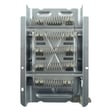
| No heat | Heating element | Dryer element 279838 |
| Overheating, no heat, or cycling heat | Thermal safety parts | Dryer thermal cut-off fuse kit W10169881 |
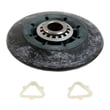
| Thumping/rumbling | Drum support roller | Support WPW10314173 |
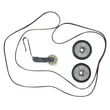
| General drum noise/wear | Belt, rollers, idler (kit) | Dryer repair kit 4392065 |
A restricted vent can cause long dry times and overheating, which can trip thermal safety devices and shorten the life of parts like the heating element, thermostats, and blower components. Fixing airflow and power issues first prevents repeat failures.
For model-specific operating tips, diagnostic codes, and troubleshooting steps, use the WED6600VW0 owner's manual.
Last updated: February 2026
How do I find the model number on my WED6600VW0?
For the Whirlpool WED6600VW0 dryer, the model number and serial number are printed on the model and serial label inside the upper door opening. Open the dryer door and look up along the top of the door opening to find the label; confirm the full model number exactly as shown.
- Open the dryer door fully.
- Look inside the cabinet, not on the door itself.
- Check the upper portion of the door opening (the top lip/inside frame).
- Find the label that lists both model and serial.
- Write the numbers down exactly, including any letters.
Most Whirlpool dryers use a rectangular sticker or metal tag that includes:
- Model number
- Serial number
- Electrical ratings (volts/amps)
- Sometimes a manufacturing code/date
We use the complete model number to match the correct diagrams and parts for your exact dryer configuration. Even one character difference can change compatible items like a heating element, thermistor, or door switch.
| You need this | Because it helps us match | Example part on this model |
|---|---|---|
| Model number | Correct parts list and diagrams | Dryer element 279838 |
| Serial number | Production run details (when needed) | Not always required |
- Copy the model number directly from the label (do not use the number from the control panel).
- If the label is worn, take a clear photo with the door open.
- Use the model number to confirm fit before ordering parts like the heating element wire kit or thermal cut-off fuse kit.
For more label-location details and model identification notes, check the owner's manual.
Last updated: March 2026