




How to find chainsaw model number?
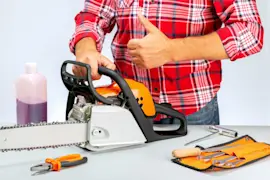
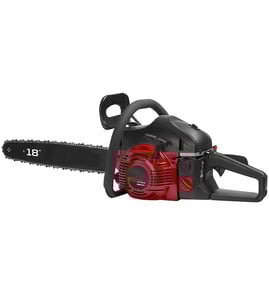
For a Craftsman gas chainsaw, the model number is printed on the saw’s ID label, usually on the engine housing or near the rear handle. For this parts page, the model number you want to match is 358351702.
Where to look on a Craftsman chainsaw
Check these common label locations first:
- Side of the engine/motor casing (near the starter cover)
- Rear handle area (near the trigger)
- Bottom of the saw body (underside of the fuel tank area)
- Near the bar mount area (behind the clutch cover on some models)
What to write down (so parts match)
Model labels can be easy to misread, so we recommend capturing the full ID exactly:
- Full model number (all digits, no missing characters)
- Any prefix/suffix on the label (letters or extra numbers)
- Serial number (helpful for confirming production version)
- Brand name (Craftsman)
Quick check: model number vs. part numbers
Use this as a simple guide when you are shopping for parts.
| Item type | What it looks like | Example from this model page |
|---|---|---|
| Model number | Longer ID for the whole chainsaw | 358351702 |
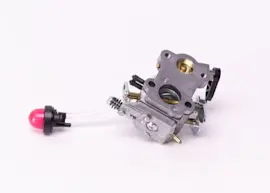
| Part ID / part number | ID for one replaceable part | Ayp chainsaw carburetor 545070601 |
Why it matters
The model number controls which diagrams and parts fit your saw. Even small differences between similar Craftsman chainsaws can change the carburetor, fuel line routing, clutch, or recoil starter parts.
Last updated: February 2026
Should I use 40 1 or 50 1 fuel for a chainsaw?
Use the fuel-to-oil ratio printed on your Craftsman gas chainsaw (model 358351702) or on the engine label; that is the correct mix for this saw. If the label is missing, use 50:1 with quality 2-cycle oil until you restore the label information and the saw runs cleanly.
40:1 vs 50:1: what changes
Both ratios can run a 2-cycle engine, but they behave differently:
- 40:1 adds more oil; more smoke and more carbon buildup.
- 50:1 adds less oil; cleaner exhaust and less plug fouling.
- The correct ratio is the one the carburetor and engine were designed for.
- A wrong ratio often shows up as hard starting, bogging, or excessive smoke.
| Mix ratio | Oil per 1 gallon gas | Typical result |
|---|---|---|
| 50:1 | 2.6 oz | Cleaner running, less carbon |
| 40:1 | 3.2 oz | More smoke, more deposits |
If the saw runs poorly after mixing fuel
Do not change ratios to “tune” performance; fix the underlying fuel, air, or exhaust issue:
- Clean or replace a restricted air filter (mcculloch lawn & garden equipment engine air filter 530057925)
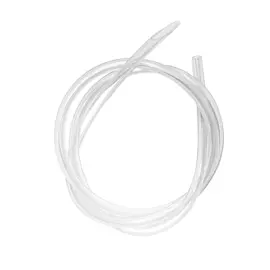
- Replace cracked or leaking fuel lines (chainsaw fuel line kit 581648601)
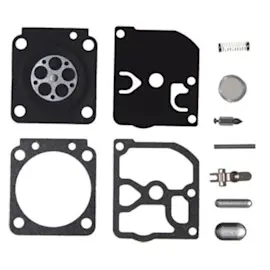
- Service a carburetor that has varnish or a stiff diaphragm (ayp chainsaw carburetor 545070601)
- Clear a plugged spark arrestor that can cause power loss and stalling (ayp chainsaw spark arrestor 545006056)
Why it matters
On a 2-cycle Craftsman chainsaw, the oil mixed into the gasoline provides all engine lubrication. Too much oil increases carbon that can restrict the muffler; too little oil accelerates wear.
Last updated: February 2026
What is the L and H on a Craftsman chainsaw?
On a Craftsman gas chainsaw like model 358351702, L and H are the carburetor mixture adjustment screws: L controls the low-speed (idle to midrange) fuel mixture, and H controls the high-speed (wide-open throttle) fuel mixture.
What L and H actually change
- L (low-speed mixture): Affects starting, idle quality, and acceleration off idle.
- H (high-speed mixture): Affects power at full throttle and engine temperature.
- Idle speed screw (often marked T, LA, or S): Sets how fast the engine idles; it does not change fuel mixture.
Quick adjustment basics (safe starting point)
Make adjustments with the bar and chain installed, chain brake working, and the saw on stable ground.
- Warm the engine for 2 to 3 minutes.
- Turn L slowly in (clockwise) until idle starts to falter, then back out until it idles smoothly and accelerates cleanly.
- Set idle speed with the idle screw so the engine stays running but the chain does not creep.
- Adjust H in very small steps (about 1/8 turn at a time) to avoid running too lean.
Symptoms and what they usually mean
| Symptom | Most common cause | Screw to check first |
|---|---|---|
| Dies when you hit the throttle | Low-speed mixture too lean | L |
| Bogging, smoky exhaust | Mixture too rich | L then H |
| Surges or sounds “screamy” at full throttle | High-speed mixture too lean | H |
| Chain spins at idle | Idle speed set too high or clutch issue | Idle screw, then clutch |
Why it matters
Correct L and H settings protect the engine. A too-lean setting (especially on H) can overheat the saw and shorten engine life; a too-rich setting can foul the spark arrestor and reduce cutting power.
Parts that commonly relate to mixture problems
If tuning does not help, we typically check for restricted airflow, fuel delivery issues, or carburetor wear.
- Ayp chainsaw carburetor 545070601 (hard starting, won’t stay running)
- Mcculloch lawn & garden equipment engine air filter 530057925 (rich running, poor acceleration)
- Chainsaw fuel line kit 581648601 (lean surging, fuel starvation)
- Ayp chainsaw spark arrestor 545006056 (loss of power at higher RPM)
Last updated: February 2026
What spark plug is equivalent to 358351702?
For the Craftsman 358351702 gas chainsaw, a commonly used equivalent spark plug is Champion RN9YC; cross-references often include NGK BPR6ES and NGK BPR6EY. Match the plug’s thread size and reach to your original plug before installing.
Quick equivalents (most common cross-references)
- Champion RN9YC
- NGK BPR6ES
- NGK BPR6EY
- Torch F6RTC (often listed as a cross)
How to confirm you have the right plug
- Read the old plug: the exact plug code is usually printed on the ceramic.
- Match key specs: thread diameter, reach (length), and seat type (gasket vs. taper).
- Check the gap: set the gap to the spec for your saw; many small 2-cycle engines use a gap around 0.020 in., but always match the spec for your original plug.
- Inspect the boot and wire: a loose boot or damaged lead can mimic a bad plug; if needed, check the Craftsman chainsaw wire harness 530057943.
What to do if it still will not start after replacing the plug
A new plug helps only if the engine is getting the right fuel mix and air flow.
- Replace a dirty air filter (see lawn & garden equipment engine air filter 530057925)
- Check for fuel delivery issues (cracked lines, loose fittings)
- If it floods or only runs on choke, the carburetor may need service (see ayp chainsaw carburetor 545070601)
- Make sure the stop switch is not stuck in OFF
Common symptom-to-cause guide
| Symptom | Most likely cause | What to check next |
|---|---|---|
| No start, plug dry | Fuel not reaching cylinder | Fuel lines, tank vent, carburetor |
| No start, plug wet | Flooding | Choke use, carburetor, plug gap |
| Starts then dies | Lean fuel/air issue | Air filter, fuel line leaks |
| Weak/no spark | Ignition issue | Plug, boot, wiring, switch |
Why it matters
Using the correct spark plug type and gap helps the 2-cycle ignition system fire consistently, improves starting, and reduces fouling, especially if the saw sits between uses.
Last updated: February 2026