Owner’s manual
 Error Codes


What is the life expectancy of a Kenmore washer?
Most Kenmore washers, including model 11047512601, typically last 10 to 15 years with normal household use and routine care. Lifespan depends most on load size, how often you run cycles, and whether you keep the washer clean and properly maintained as outlined in the 11047512601 owner's manual.
Typical lifespan and what changes it
A washer’s “expected life” is really a combination of mechanical wear (bearings, belt, pump) and electronic reliability (controls, user interface).
- 10 to 15 years is the normal range for most residential washers
- Heavy weekly usage and frequent oversized loads shorten life
- Good maintenance and correct detergent use help prevent early failures
- Vibration from an unlevel cabinet can accelerate wear on moving parts
- Moisture and residue buildup can lead to odors, leaks, and component stress
Maintenance that helps you reach the high end of the range
Use these habits to reduce strain on the motor, drain system, and door seal.
- Run periodic cleaning cycles and wipe the door area dry after use
- Use the correct amount of HE detergent (too much can cause buildup)
- Avoid consistently overloading; keep loads balanced
- Check inlet hoses periodically and replace if worn or bulging
- Address small leaks quickly to prevent damage to bearings and controls
Common “wear” parts vs. “control” parts (what usually fails first)
These are common categories we see on front-load designs like this Kenmore.
| Part type | What you may notice | Example part for this model |
|---|---|---|
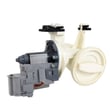
| Drain component | Won’t drain, water left in tub, grinding during drain | Water pump WPW10730972 |
| Door sealing | Leaks at door, mildew odor, visible tears | Washer door boot WPW10111435 |
| Drive system | Squealing, slipping, no tumble/spin | Washer drive belt WP8540101 |
| Door locking | Door won’t lock/unlock, cycle won’t start | Latch WPW10253483 |
Why it matters
Knowing the typical 10 to 15 year lifespan helps you decide whether to repair or replace. If your 11047512601 is under about 8 years old, repairs often make sense; if it is 12+ years old and needs a major control or tub-related repair, it is smart to compare repair cost to replacement value.
Last updated: January 2026
What is the cubic foot of my Kenmore washer model 11047512601?
The exact cubic-foot capacity for Kenmore washer model 11047512601 is listed in the product literature for this specific HE2Plus front-load washer; we recommend confirming it in the 11047512601 owner's manual so you get the correct number for your exact version and color code.
How to find the capacity for model 11047512601
Check these common places first:
- The specifications section in the 11047512601 owner's manual
- The model and serial tag (often around the door opening on front-load washers)
- Any tech sheet stored inside the cabinet (commonly behind the lower front panel)
Typical capacity range for washers like this
Kenmore HE2Plus-style front-load washers in the 110.4751 model family are commonly in this general range:
- About 3.0 to 4.0 cu. ft. for many standard-size front-load designs
- Larger “high capacity” versions can be higher, depending on the exact platform
Quick reference table
| Washer type | Typical capacity range | Best way to confirm |
|---|---|---|
| Standard front-load washer | 3.0 to 4.0 cu. ft. | 11047512601 owner's manual |
| Compact front-load washer | 2.0 to 2.6 cu. ft. | Model tag + manual |
| Large front-load washer | 4.2 to 5.0+ cu. ft. | Manual specs |
Why it matters
Capacity affects how much laundry you can wash per load and how you should dose HE detergent. Overloading can also increase vibration and reduce spin performance, especially on front-load washers.
Last updated: January 2026
What is the UL code on the Kenmore Elite Oasis HE washer?
On Kenmore washers, a UL code means the washer detected an unbalanced load and stopped or limited the spin to protect the tub and suspension. On model 11047512601, start by redistributing the load and confirming the washer is level using the steps in the 11047512601 owner's manual.
What to do first (fast fixes)
- Pause the cycle and open the door when it unlocks.
- Redistribute items evenly; mix large and small items.
- Remove one or two heavy items (blankets, rugs, jeans) and try again.
- Run Drain/Spin (or Spin) with a smaller, balanced load.
- Check that all four feet are firmly on the floor; adjust leveling legs and lock nuts.
Leveling and load tips that prevent UL
A front-load washer like the Kenmore 11047512601 is sensitive to leveling and load type. Use these habits to reduce repeat UL events:
- Keep loads to about 3/4 full; do not pack items tightly.
- Wash single bulky items with 1 to 2 towels to help balance.
- Avoid overdosing detergent; excess suds can reduce proper tumbling and balance.
- Verify the floor is solid; weak or flexing floors amplify vibration.
When UL points to a repair issue
If UL happens with small, normal loads after leveling, a mechanical issue is likely.
| Symptom | Most likely cause | What to check |
|---|---|---|
| Loud banging during spin | Washer not level, load shifting | Feet adjustment, floor stability |
| Repeated UL with any load | Worn shock/suspension or loose counterweight | Inspect mounting hardware and tub movement |
| Won’t drain well, then UL | Water left in tub makes loads heavier and unstable | Drain path and pump performance |
If the washer is not draining fully, inspect the drain system and consider the water pump WPW10730972 if you find the pump is noisy, jammed, or leaking.
Why it matters
UL is a protection stop. Correcting balance and leveling helps the washer reach full spin speed, improves drying time, and reduces wear on the tub, bearings, and drive system.
Last updated: January 2026
How to force a Kenmore Elite washer to drain?
For Kenmore model 11047512601, we force a drain by canceling the current cycle and starting a manual drain routine: press STOP, select RINSE/DRAIN & SPIN, turn 2ND RINSE off, then press and hold START for about 1 second to begin draining (see the 11047512601 owner's manual).
Fast steps to drain it now
- Press STOP once to pause.
- If needed, press STOP twice to cancel the cycle.
- Select RINSE/DRAIN & SPIN.
- Press 2ND RINSE to deselect it.
- Press and hold START (about 1 second) to start draining.
- Wait for the cycle to finish; the door unlocks after the drain/spin completes.
If it still will not drain
A no-drain problem is usually a drain path issue (hose, pump, or a blockage) or a control/lock condition.
- Check the drain hose for kinks, crushing, or a clogged standpipe.
- Make sure the drain hose is not shoved too far into the standpipe; it needs an air gap to prevent siphoning.
- Verify the washer is not showing a locked-control condition.
- If you hear the pump hum but water does not move, the pump or a blockage is likely.
- If the tub is full and the door stays locked, let the washer complete its automatic drain routine.
| What you notice | Most likely cause | What we do next |
|---|---|---|
| Pump runs, little/no water leaves | Clog in pump or hose | Inspect hose routing; check pump area |
| No pump sound at all | Power/control issue | Reset by canceling cycle; retry drain routine |
| Drains slowly | Partial blockage or restricted standpipe | Clear standpipe; re-route hose |
| Water returns to tub | Siphoning | Create air gap; do not seal hose |
Parts that commonly fix a no-drain issue
If troubleshooting points to a failed pump, the correct replacement for this model is the water pump WPW10730972.
Why it matters
Forcing a proper drain protects the door lock system, prevents water from backing up into the tub (siphoning), and reduces the chance of leaks from an overfilled boot or hose.
Last updated: January 2026