Owner’s manual
 Error Codes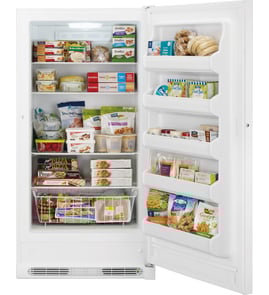




Is FUF14DLRBWW garage ready?
Yes. The GE FUF14DLRBWW is a no-frost upright freezer designed for garage use (garage ready), so it can be installed in a garage as long as you follow the placement, clearance, and leveling requirements in the FUF14DLRBWW owner’s manual.
What “garage ready” means for installation
A garage-ready freezer is built to run reliably in a wider range of ambient temperatures than many standard indoor-only models. Even so, correct setup matters for cooling performance and energy use.
Setup checklist (do these first)
- Place the freezer on a solid, level floor that can support it when fully loaded.
- Keep it out of rain/water exposure and direct sunlight.
- Allow 3 inches of clearance on the top, back, and both sides for airflow.
- Level it front-to-back; raise the front slightly so the door closes easily.
- Do not let packages extend past the front of shelves (helps the door seal).
Quick specs and targets to confirm after setup
| Item to verify | What to look for | Why it matters |
|---|---|---|
| Clearances | 3 in. top, back, sides | Prevents overheating and poor cooling |
| Door closing | Door closes on its own from halfway open | Protects the door gasket seal |
| Location | No rain, no direct sun | Reduces corrosion and temperature swings |
Why it matters
If the freezer is “garage ready” but installed too tight to the wall, out of level, or with the door not sealing, you can still get temperature swings, frost issues around the door, and higher energy use.
When to suspect a problem (not an installation issue)
If the freezer is set up correctly and still struggles to hold temperature, these parts are common suspects:
- Freezer temperature sensor WR55X27914 (incorrect temperature feedback)
- Freezer defrost sensor WR09X27221 (defrost system sensing issues)
- Freezer electronic control board WR55X30692 (cooling/defrost control problems)
Last updated: February 2026
Is it worth repairing an upright freezer?
Yes, repairing a GE upright freezer like model FUF14DLRBWW is usually worth it when the problem is a wearable part or a control issue, and the cabinet is in good shape. It becomes less cost-effective when the sealed system is failing (compressor or refrigerant-related repairs) or when multiple major parts are needed.
Quick way to decide (repair vs. replace)
- Repair it when the freezer still cools somewhat, the door seals well, and the issue points to controls, sensors, or defrost.
- Replace it when cooling is weak or inconsistent and a technician confirms a sealed-system problem.
- Always start with basics: temperature setting, door closing, airflow, and frost buildup.
Common repairs that are often worth it
These are typical “high value” fixes on upright no-frost freezers:
- Temperature sensing issues (erratic temps, short cycling)
- Defrost problems (heavy frost on the back wall, warm cabinet)
- User interface or control board problems (dead display, won’t respond)
- Door sealing problems (frost, sweating, longer run times)
If your symptoms match, use the troubleshooting section in the FUF14DLRBWW owner’s manual to narrow the cause before buying parts.
Parts that can drive the decision
| Repair area | What you might replace | Cost impact (typical) |
|---|---|---|
| Controls/sensing | Sensors, control board, UI | Medium |
| Door sealing | Gasket, hinges/door stop | Low to medium |
| Sealed system | Compressor, refrigerant work | High |
For this model, examples of higher-cost components include the freezer electronic control board WR55X30692 and the compressor assembly; those repairs can quickly approach replacement value.
Why it matters
A freezer that is only slightly off temperature can waste food and energy for weeks. A targeted repair (sensor, defrost, or control) restores stable temperatures and prevents repeat frost buildup, while avoiding unnecessary major-part replacement.
Last updated: February 2026
What is the average lifespan of an upright freezer?
Most upright freezers last 10 to 15 years. For a GE upright freezer like model FUF14DLRBWW, steady temperatures, clean airflow around the cabinet, and a tight door seal help you reach (and often exceed) that typical lifespan; see the FUF14DLRBWW owner's manual for care and cleaning guidance.
What affects lifespan the most
- Room conditions: hot garages and tight enclosures make the compressor work harder
- Door seal condition: a leaking gasket causes longer run times and frost issues
- Coil and airflow cleanliness: dust and blocked vents raise operating temperatures
- How often the door is opened: frequent openings add moisture and heat load
- Power quality/outages: repeated outages can stress electronics and the compressor
Quick maintenance checklist (best ROI)
- Keep the freezer level so the door closes and seals consistently.
- Leave clearance for airflow around the cabinet and vents.
- Wipe the door gasket and mating surface; confirm the door closes without gaps.
- Avoid overpacking; keep air paths open near the evaporator cover.
- After an extended outage, follow the food-safety and recovery steps in the manual.
Typical lifespan by component (what usually fails first)
| Component | Typical role | Common symptom when failing |
|---|---|---|
| Electronic controls | Regulate temperature and defrost | Warm temps, erratic operation |
| Temperature/defrost sensors | Tell the control board what’s happening | Frost buildup or temperature swings |
| Door gasket | Keeps warm air out | Frost, sweating, longer run times |
| Compressor system | Creates cooling | Clicking, no cooling, constant running |
Why it matters
A freezer that runs longer to hold temperature uses more energy and puts extra wear on the compressor and control system. Simple sealing and airflow checks can add years of reliable service.
Last updated: February 2026
What is the best brand upright freezer to buy?
There is no single “best” upright freezer brand for every home; the best choice is the model that matches your space, temperature conditions (garage or indoor), and the features you will actually use. If you already own a GE upright freezer like model FUF14DLRBWW, choosing another GE model often keeps controls and storage layout familiar.
What to compare (more important than the logo)
When we help customers choose an upright freezer, we focus on practical specs and ownership costs:
- Defrost type: no-frost for low maintenance; manual defrost for simplicity
- Capacity: pick the cubic feet that fits your shopping habits and floor space
- Temperature performance: steady operation near 0°F for safe long-term storage
- Installation location: confirm the freezer is rated for your garage or unheated area
- Storage design: shelves, bins, and door storage that match how you organize food
- Serviceability: availability of replacement parts such as sensors, gaskets, and controls
Quick decision table
| If you want... | Prioritize | Why it helps |
|---|---|---|
| Less maintenance | No-frost design | Reduces ice buildup and manual defrosting |
| Lower upfront cost | Fewer electronic features | Simpler designs typically cost less |
| Better organization | More bins and adjustable shelves | Faster access, less door-open time |
| Lower energy use | Tight door seal and good airflow | Shorter run times and fewer temperature swings |
Why it matters for a GE FUF14DLRBWW owner
If you are shopping because your current freezer is not holding temperature, many issues are repairable and cheaper than replacing the whole unit. Common culprits include a failed sensor or control.
- If temperatures swing or the unit runs constantly, check the freezer temperature sensor WR55X27914
- If defrost problems cause frost buildup, check the freezer defrost sensor WR09X27221
- If the display or cooling logic acts erratically, the freezer electronic control board WR55X30692 is a common control component
Where to confirm operating and placement requirements
Use the FUF14DLRBWW owner’s manual to verify temperature control guidance, installation clearances, and operating notes for upright no-frost models.
Last updated: February 2026
Where is the model number on a GE upright freezer?
On the GE upright freezer model FUF14DLRBWW, the model and serial number label is located inside the freezer on the top inner case liner toward the front. We recommend writing down both numbers exactly as shown before ordering parts or scheduling service.
Where to look on model FUF14DLRBWW
Check these common label locations in this order:
- Top inside wall (top inner case liner), near the front (most common for this model)
- Upper side wall inside the cabinet
- Behind the lower kick plate or toe grille area
- Rear exterior panel (less common, but possible)
For the exact location wording and a place to record the numbers, use the FUF14DLRBWW owner’s manual.
What to write down (and why)
Record both identifiers from the label:
- Model number (example format: FUF14DLRBWW)
- Serial number (unique to your unit)
- Any revision or suffix characters shown after the model
- The complete number string (do not shorten it)
Why it matters
The model number narrows your freezer to the correct parts list; the serial number helps match production changes. This prevents ordering the wrong items such as a control board, temperature sensor, or door components.
Quick reference table
| Item you need | Where it’s used | When you’ll be asked for it |
|---|---|---|
| Model number | Identifies the freezer design | Ordering parts, looking up diagrams, manuals |
| Serial number | Identifies your exact unit | Service calls, warranty-related service, production date checks |
Last updated: February 2026
Why does my upright freezer keep frosting up?
Your GE FUF14DLRBWW upright freezer frosts up when warm, humid air gets inside and freezes on cold surfaces. The most common causes are the door being left ajar, frequent door openings, or the door not sealing correctly, especially during high humidity.
Quick checks we recommend first
- Make sure the door closes fully and is not being held open by a package or bin.
- Reduce how often and how long the door is opened.
- Wipe moisture off interior walls and shelves during humid weather.
- Check that the freezer is level so the door seats properly.
- Confirm nothing is preventing the gasket from contacting the cabinet all the way around.
Door seal and closing issues (most common)
A small air leak can create constant frost because moist room air keeps entering the cabinet.
What to look for:
- Gasket looks torn, warped, or hardened
- Frost concentrated near the door opening
- Door needs a push to latch, or pops back open
If the gasket is damaged, replacing the door gasket WR14X27200 restores the seal and typically stops repeat frost buildup.
Defrost system problems (when frost is heavy inside the back panel)
If you see thick frost behind the evaporator cover or airflow seems weak, the defrost system may not be clearing ice.
Common parts involved on this model include:
Symptom guide
| What you notice | Most likely cause | What to do next |
|---|---|---|
| Light frost on walls, worse in humid weather | Normal moisture load | Wipe dry; open door less |
| Frost mainly around the door opening | Door not sealing | Inspect gasket; level freezer |
| Heavy frost, poor cooling, fan airflow reduced | Defrost issue | Check defrost sensor and controls |
Why it matters
Frost buildup reduces airflow and insulation efficiency, so the compressor runs longer, temperatures swing more, and food can develop freezer burn faster.
Reference for model-specific guidance
Use the FUF14DLRBWW owner’s manual troubleshooting section for “Excessive frost buildup” and door-closing checks.
Last updated: February 2026