Owner’s manual
 Error Codes



How to remove bottom grille on GE refrigerator?
On the GE DFE29JSDGSS bottom-mount refrigerator, the bottom grille (base grille) typically comes off by releasing its retaining tabs or removing a couple of mounting screws (if your version uses screws), then pulling the grille straight out and down. For the exact fastener locations and safe handling steps, use the owner's manual.
- Unplug the refrigerator or switch it off at the control before working near wiring.
- Pull the refrigerator straight out a few inches if you need access; avoid twisting it sideways.
- Look along the top edge of the grille for retaining clips or tabs.
- If you see screws, remove them with a Phillips screwdriver and set them aside.
- Pull the grille straight toward you to release the tabs, then lift it away.
- Reinstall by aligning the tabs, sliding the grille into place, and reinstalling any screws.
| What you see | Most likely cause | What to do |
|---|---|---|
| Grille flexes but will not release | Tabs still engaged | Pull from one corner, then the other; keep the pull straight outward |
| Grille feels “locked” | Hidden screws | Check both ends and the lower edge for Phillips screws |
| Grille is stuck to the floor | Leveling legs too low | Raise the front leveling legs slightly, then try again |
| You cannot pull the unit out | Water line or cord binding | Pull straight out slowly; make sure the cord and water line move freely |
Removing the bottom grille gives you access for basic cleaning and inspection (dust buildup can reduce airflow and cooling performance). Pulling the refrigerator straight out also helps prevent floor damage and avoids stressing the power cord or water supply line.
Last updated: February 2026
Is GE DFE29JSDGSS considered high end?
Yes. The GE DFE29JSDGSS is typically considered an upper-tier (premium) GE Profile style refrigerator because it’s a feature-rich French door, bottom-mount design with advanced controls and filtration compared with basic top-freezer models. For model-specific features and control options, use the owner's manual.
We generally classify a refrigerator as high end when it combines premium features, higher component complexity, and a higher replacement-part cost profile.
Common high-end indicators include:
- French door, bottom-mount configuration
- External electronic temperature controls and multiple modes
- Built-in water filtration and dispenser features
- More sensors, control boards, and LED lighting
- Higher-cost assemblies (ice box parts, drawers, door components)
Your model uses an external control style (DFE29 control style family) and is designed around precise temperature management and convenience features.
A few model-relevant examples you’ll see on this refrigerator:
- Factory-recommended temperature targets (37°F fresh food, 0°F freezer)
- Filter status and reset functions
- Door alarm and control lock functions
Higher-end refrigerators usually rely on more electronics and specialized assemblies. On this model, examples include:
- Refrigerator main board assembly WR55X46805 (core control for cooling and features)
- Refrigerator user interface WR55X11144 (display and button inputs)
- Refrigerator led light assembly WR55X11132 (cabinet lighting)
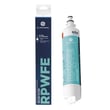
- Refrigerator water filter RPWFE (water filtration)
| GE family | Typical positioning | What you usually get |
|---|---|---|
| GE (standard) | Value to mid-range | Basic cooling, fewer electronics |
| GE Profile (common fit for DFE29 series) | Upper-tier | More features, more controls, more assemblies |
| GE Café / Monogram | Premium to luxury | Design-forward finishes, pro-style options, built-in models |
“High end” usually means better convenience and tighter temperature control, but it also means troubleshooting often involves sensors, boards, and interfaces. When diagnosing issues, we recommend starting with the exact feature set and control behavior shown in the owner's manual.
Last updated: February 2026
What is the most common problem with GE DFE29JSDGSS refrigerators?
The most common issue we see with the GE DFE29JSDGSS refrigerator is a cooling complaint (fresh food or freezer not staying at the set temperature). Many “not cooling” calls trace back to airflow problems, a defrost system issue, or a control/sensor problem; use the owner's manual troubleshooting tips to narrow it down.
- Refrigerator not cooling or uneven temps: evaporator fan not moving air, frost buildup from a defrost failure, or a temperature sensing/control issue
- Ice maker not making ice: ice maker turned off, low water supply, clogged filter, or air in the water line
- Low water flow at dispenser: clogged filter, air trapped after filter change, or a supply/shutoff restriction
- Water leaking: often a clogged/iced drain path or a water supply connection issue
- Strange noises: fan noise, ice maker cycling, or normal operating sounds that change with load and temperature
- Confirm the unit has had time to stabilize: after plugging in or after a long outage, wait 24 hours for both compartments to reach the selected temperatures.
- Check the controls: if water in the reservoir is frozen, set the refrigerator control to a warmer setting and wait 24 hours.
- If water flow is weak after a new filter: dispense water for at least 5 minutes (about 2 gallons) to purge air.
- Verify ice maker is on; then discard the first 24 hours of ice after starting it to avoid taste/odor issues.
| Symptom | Commonly involved part | Example from this model’s parts list |
|---|---|---|
| Warm temps, erratic temps | Temperature sensing | Refrigerator temperature sensor WR55X10025 |
| Frost buildup, poor airflow | Defrost system | Refrigerator defrost heater WR51X10132 and refrigerator defrost bi-metal thermostat WR50X10108 |
| No ice, low water flow | Filtration/water supply | Refrigerator water filter RPWFE and refrigerator water inlet valve WR57X10098 |
Cooling and water/ice issues often share the same root causes: restricted airflow, frost buildup, or restricted water flow. A few quick checks (24-hour stabilization, filter purge, control settings) can prevent unnecessary part replacement and get performance back faster.
Last updated: February 2026