

Where is the part number on a Kenmore dryer?
On a Kenmore dryer like model 11087670100, the model and serial tag (often called the “rating plate”) is usually located on the door opening area, most commonly on the door frame just inside the door. That tag is where you will find the identifying numbers you need to order parts.
Where to look first (fastest checks)
- Open the dryer door and check the door frame around the opening.
- Look on the inside face of the door itself.
- Check the front panel near the door opening (lower left or lower right).
- If you do not see a tag there, check the rear panel of the cabinet.
- Write down the full model number and serial number exactly as shown.
What numbers you might see (and what they mean)
| What you see on the tag | What it’s used for | Example for this page |
|---|---|---|
| Model number | Matches the correct parts list and diagrams | 11087670100 |
| Serial number | Helps identify production run details | Varies by unit |
| Type / code (sometimes) | Extra manufacturing info | Varies by unit |
Why it matters when ordering parts
Kenmore dryers can look similar across many versions, but small design changes affect fit. Using the exact model number helps us match the right gas dryer parts, such as a belt, door switch, or gas ignition components.
If you’re trying to identify a specific replacement part
Once you have the model number, match the symptom to the most common wear items:
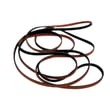
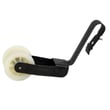
- Drum not turning: check the belt 341241 and idler pulley
- Dryer will not start: check the door switch
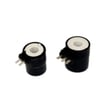
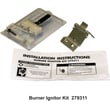
- No heat on a gas dryer: check igniter, radiant sensor, and valve coils
For troubleshooting steps that apply to Kenmore 110-series electronic control dryers, use Kenmore 110 series electronic control model dryer error codes.
Last updated: February 2026
What size dryer is a Kenmore 80 series?
Most Kenmore 80 Series dryers are full-size machines; typical drum capacity is about 6.0 to 7.0 cu. ft. (with some older 80 Series models closer to 5.9 cu. ft.). For Kenmore model 11087670100 (a Whirlpool-built 110-series gas dryer), treat it as a full-size dryer when choosing venting, space, and replacement parts such as the belt 341241.
How to confirm your exact capacity
Capacity varies by the exact 80 Series model and production run, so we recommend confirming using the model tag and basic measurements.
- Find the model tag (usually on the door opening or cabinet frame) and match the full model number.
- Measure the drum (approximate): diameter and depth help estimate cubic feet.
- Compare your dryer’s exterior size to standard full-size footprints.
- If you are shopping for parts, match by model number first, not by “80 Series.”
- If the dryer is noisy or not tumbling, inspect wear items while you are checking size.
Typical size ranges (what “full-size” means)
| Dryer type | Typical capacity | Typical exterior width |
|---|---|---|
| Compact dryer | 3.4 to 4.4 cu. ft. | ~24 in. |
| Full-size dryer (common Kenmore 80 Series) | 6.0 to 7.0 cu. ft. | ~27 in. |
| Large-capacity full-size | 7.2+ cu. ft. | ~27 in. |
Why it matters
Knowing the approximate capacity helps you plan laundry loads, confirm fit in a laundry alcove, and choose compatible accessories. For repairs, “80 Series” is a family name; the model number (11087670100) is what ensures you get the right Kenmore gas dryer parts.
If your goal is troubleshooting rather than capacity, we also use the Kenmore 110 series electronic control model dryer error codes guide to narrow down common failure symptoms.
Last updated: February 2026
How do I know if my Kenmore dryer thermal fuse is blown?
On Kenmore gas dryer model 11087670100, a blown thermal fuse typically shows up as a dryer that will not start (most common) or runs with little to no heat depending on the exact wiring. The sure way to know is a continuity test on the fuse with the dryer unplugged.
Quick symptoms to look for
- Dryer has power but won’t run when you press Start
- Motor hums briefly, then stops (some setups)
- Dryer runs but no heat (less common on many gas dryers)
- Problem started after poor airflow (clogged lint screen or vent)
- Replacing the fuse without fixing airflow causes the issue to return
How we confirm a blown thermal fuse (multimeter test)
- Unplug the dryer (and shut off gas as a safety step).
- Access the thermal fuse (commonly on the blower housing or exhaust duct area).
- Pull the wire connectors off the fuse terminals.
- Set a multimeter to continuity or ohms.
- Touch a probe to each terminal.
What the meter reading means
| Meter result | What it means | What to do next |
|---|---|---|
| Beep or near 0 Ω | Fuse is good | Check door switch, belt switch, motor, or timer/control |
| No beep or OL/infinite | Fuse is blown | Replace the fuse and correct the airflow restriction |
Why the thermal fuse blows (and what to fix)
A thermal fuse is a one-time safety device; it opens when the dryer overheats, and overheating is usually caused by restricted airflow.
- Clean the lint screen and housing
- Check the vent hose for kinks or crushing
- Clear lint buildup in the wall duct to the outside
- Make sure the outside vent hood opens freely
- Inspect the blower area; a damaged wheel can reduce airflow (see dryer blower wheel WP694089)
Related help for Kenmore dryers
If your dryer is displaying a code or you suspect an electronic control issue, use Kenmore 110 series electronic control model dryer error codes to narrow down the failure.
Last updated: February 2026
How to take off the front panel of a Kenmore dryer?
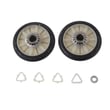
To remove the front panel on Kenmore gas dryer model 11087670100, we disconnect power, open the top, remove the mounting screws, then lift the front panel up and off while supporting the drum. This gives access to common wear parts like the belt 341241 and dryer idler pulley WP691366.
Before you start (safety and prep)
- Unplug the dryer from the wall outlet.
- Shut off the gas supply valve to the dryer.
- Let the dryer cool completely if it was recently running.
- Have a small container ready for screws.
- Take a quick photo of wire connections before disconnecting anything.
Steps to remove the front panel (typical for this style)
- Remove the lint screen (if it’s in the top panel) and any screws near the lint screen housing.
- Release the top panel: insert a putty knife a few inches in from each front corner to release the spring clips, then lift the top.
- Disconnect the door switch wiring: locate the harness connector near the top of the front panel and unplug it.
- Remove front panel screws: take out the screws at the top inside corners (and any screws in the door opening, if present).
- Lift and remove the front panel: pull the panel slightly forward, then lift it up off the lower retaining tabs.
What you can inspect once the front is off
- Drum belt condition (cracks, glazing, slack)
- Idler pulley wear (wobble, squeal, seized wheel)
- Blower wheel lint buildup (airflow problems)
- Front drum support/bearing wear (scraping, thumping)
| Symptom after opening the dryer | Most common area to check |
|---|---|
| Drum won’t turn, motor runs | Belt and idler pulley |
| Squealing or chirping | Idler pulley, drum supports |
| Poor drying, long dry times | Lint chute, blower wheel, venting |
Why it matters
Removing the front panel correctly prevents bent panels, broken clips, and damaged wiring. It also makes belt and drum support repairs faster and helps restore proper airflow and drying performance.
Last updated: February 2026