Owner’s manual
 Error Codes



How many cubic feet is my Kenmore Elite refrigerator?
For Kenmore model 79551814410, the cubic-feet capacity is listed in the specifications information for your exact unit; the most reliable places to confirm it are the product specs section of the 79551814410 owner's manual and the model and serial rating label inside the fresh food compartment.
Check these common locations; they match your exact configuration (ice system, shelves, and bins):
- The specifications section in the 79551814410 owner's manual
- The model and serial tag inside the refrigerator compartment (often on a side wall or near the crisper area)
- A rating label line that may read “Capacity,” “Total volume,” or “Total (cu. ft.)”
- The product information label behind the toe grille or on the cabinet edge (varies by build)
Cubic feet is the published internal volume of the refrigerator and freezer combined; it is not the same as the space you can practically load once shelves, bins, and the ice maker are installed.
| Spec term | What it includes | What it excludes |
|---|---|---|
| Total capacity (cu. ft.) | Fresh food + freezer volume | “Usable” space after shelves, bins, and ice storage |
| Usable space | Real-world storage you can load | Usually not listed as a formal spec |
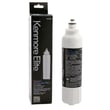
Knowing the exact cubic feet helps us match parts and accessories to your Kenmore refrigerator’s layout, including water and ice components such as the Kenmore refrigerator water filter 9490 ADQ73613402.
Last updated: January 2026
What are the common problems with Kenmore Elite refrigerators?
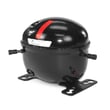
On the Kenmore Elite side-by-side refrigerator model 79551814410, the most common issues we see are cooling problems (often tied to airflow or the sealed system), ice maker and dispenser troubles, and control or sensor faults. Your 79551814410 owner's manual also highlights water pressure and dispenser lock conditions that can mimic “failed” ice and water symptoms.
- Not cooling or warm temperatures: evaporator fan issue, dirty condenser area, thermistor/control problem, or sealed-system/compressor trouble
- Ice maker not making ice: low water pressure, clogged filter, inlet valve issue, or ice maker assembly problem
- Ice will not dispense: control lock enabled, door not fully closed, ice clumping in the bin, or chute frost buildup
- Water dispenser slow: restricted filter, low supply pressure, or inlet valve problem
- Intermittent operation or odd behavior: electronic control board or sensor (thermistor) issues
- Confirm temperatures: set freezer near 0°F and fresh food near 37°F; allow up to 24 hours to stabilize after changes.
- Check Control Lock: if the dispenser is locked, press and hold Lock for about 3 seconds to unlock.
- Verify water pressure (important for ice and water):
- With a water filter installed, typical requirement is 40 to 120 psi.
- Without a filter, typical requirement is 20 to 120 psi.
- Inspect the ice bin: break up clumped cubes; clear chute frost with a plastic utensil.
- Replace the water filter on schedule: many models call for about every 6 months, or sooner if flow drops.
| Symptom | Common part to check | Example part for this model |
|---|---|---|
| Slow water, small cubes, poor ice production | Water filter | Kenmore refrigerator water filter 9490 ADQ73613402 |
| No water to dispenser/ice maker | Water inlet valve | Refrigerator water inlet valve 5221JA2006M |
| Ice not dispensing (mechanical drive) | Auger motor assembly | Refrigerator auger motor assembly 4681JJ1001G |
| Warm freezer, weak airflow | Freezer evaporator fan motor | Refrigerator freezer evaporator fan motor EAU62064602 |
| Erratic temps or false readings | Thermistor | Refrigerator thermistor 6500JB2002T |
Ice and water complaints are often caused by water pressure, a restricted filter, or a locked dispenser, not a “bad ice maker.” Cooling complaints often start with airflow and sensing (fan motor, thermistor) before moving to higher-cost sealed-system parts like the compressor.
Last updated: January 2026
What is the code er 1f on a Kenmore Elite refrigerator?
On Kenmore model 79551814410, the ER 1F (often shown as ER IF) code points to a problem with the freezer ice fan circuit or airflow around the ice maker area. Fixes typically involve clearing ice buildup and, if the problem returns, testing and replacing the failed fan-related component.
- Power reset: unplug the refrigerator (or switch off the breaker) for 5 minutes, then restore power.
- Check for ice buildup around the freezer evaporator cover and ice room area; heavy frost can block the fan.
- Make sure freezer vents are not blocked by food packages.
- Confirm the freezer door closes fully and the door gasket seals all the way around.
- If the unit recently had a power interruption, recheck after temperatures stabilize (24 hours).
| What’s happening | What you may notice | Common next step |
|---|---|---|
| Ice fan not running or running slowly | Little or no ice production, warm ice room, unusual fan noise | Inspect for frost/ice obstruction; then test fan motor |
| Ice buildup restricting airflow | Frost on panels, fan noise changes, intermittent code | Defrost/clear ice; check door sealing and airflow |
| Control not reading fan feedback correctly | Code returns quickly after reset | Diagnose wiring and control logic; replace failed component |
If clearing ice and restoring airflow does not stop ER 1F from returning, a failed motor or control component is often next.
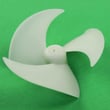
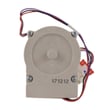
- Refrigerator freezer evaporator fan motor EAU62064602: drives airflow across the evaporator; a weak or stalled motor can trigger fan-related errors.
- Wiring connections to the fan and control (look for loose plugs or pinched wires).
When the ice fan or airflow is compromised, temperatures in the ice-making area rise and frost can spread. That can reduce ice production, cause thaw-refreeze clumping, and strain the cooling system over time.
For model-specific troubleshooting steps and any diagnostic mode details, use the 79551814410 manual.
Last updated: January 2026