Installation guide
 Owner’s manual

How to find model number on Maytag dryer?
On your Maytag gas dryer, the model number is printed on the appliance ID label. For model MGDB855DC0, the label is most often on the door opening (door jamb) or on the back of the cabinet near the top; we use that exact model number to match the correct parts and instructions.
- Open the dryer door and look along the cabinet frame (door opening/door jamb).
- Check the back of the dryer cabinet near the top edge.
- Look around the front frame just inside the door opening.
- If the label is hard to read, use a flashlight and take a close-up photo to zoom in.
The ID label typically includes several fields. Record these so we can match parts accurately.
| Label item | What it’s used for |
|---|---|
| Model number (example: MGDB855DC0) | Ensures parts fit your exact Maytag dryer |
| Serial number | Helps identify production range/version |
| Type of fuel (gas) | Confirms you need gas-dryer specific parts |
Maytag dryers can look similar across model families, but internal components (like the igniter, gas valve coils, or drum support rollers) can vary by model and production run. Using the exact model number prevents ordering the wrong replacement part and speeds up troubleshooting.
Use the diagrams and identification details in the MGDB855DC0 owner’s manual to confirm you are reading the correct label and to locate the model and serial number fields.
Last updated: February 2026
Why is my Maytag dryer leaking water from the bottom?
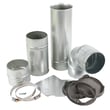
On a Maytag MGDB855DC0 gas dryer, water leaking from the bottom is almost always condensation, not a “water leak.” The most common causes are a restricted vent, a crushed or too-long exhaust run, or a cold garage or laundry room that makes moist air condense inside the cabinet. Use the MGDB855DC0 installation guide venting requirements as your baseline.
- Clean the lint screen completely (wash off any fabric softener film, then dry it).
- Inspect the vent hose behind the dryer for kinks, crushing, or sagging that traps moisture.
- Confirm the exterior vent hood opens freely and is not blocked by lint or a stuck flap.
- Run a timed dry, high heat cycle for 10 to 15 minutes and verify strong airflow outside.
- If the dryer is in a cold space, warm the room or shorten and insulate the vent run.
Condensation can drip down the blower housing or base if airflow is weak.
| Symptom | Most likely cause | What to do |
|---|---|---|
| Water only with long cycles | Vent restriction | Clean/shorten venting, reduce elbows |
| Clothes take too long to dry | Poor airflow | Check blower wheel and vent path |
| Thumping or rumbling plus moisture | Drum support wear causing poor sealing/airflow | Inspect rollers and idler |
If you also hear unusual noise or suspect airflow is weak inside the cabinet, check the dryer blower wheel WP697772 for lint buildup, cracking, or a loose fit on the motor shaft.
A restricted exhaust traps humid air in the dryer, which creates condensation that can drip to the base and also causes long dry times and overheating. Fixing airflow protects components like the thermal fuse and helps the dryer dry faster.
- You smell gas, hear a hissing sound, or suspect a gas connection issue.
- Water is clearly coming from an external source (washer, sink, humidifier, or HVAC drain).
Last updated: February 2026
What's the life expectancy of a Maytag dryer?
A Maytag dryer typically lasts 10 to 13 years. With consistent care (lint removal, good airflow, and prompt repair of wear parts), many Maytag gas dryers like MGDB855DC0 reach 15 years of service.
- Vent restriction (long runs, crushed flex duct, clogged hood)
- Lint buildup in the cabinet or blower housing
- Overloading (extra strain on drum rollers, belt, and motor)
- High heat use on every load (more stress on sensors and fuses)
- Delayed repairs after new noises, burning smells, or weak heat
Use these habits for MGDB855DC0 and most Maytag gas dryers:
- Clean the lint screen every load.
- Check airflow at the outside vent hood; strong flow matters.
- Keep the vent run as short and straight as possible.
- Avoid overfilling the drum; tumbling space reduces strain.
- If dry times increase, address airflow first before replacing parts.
| Task | How often | Why it matters |
|---|---|---|
| Clean vent duct and hood | 1 to 2 times per year | Prevents overheating and long dry times |
| Vacuum lint around dryer and floor | 2 to 4 times per year | Reduces lint pull into the cabinet |
| Inspect for thumping/squealing | Ongoing | Catches roller or pulley wear early |
When a dryer starts squealing, thumping, or rumbling, replacing wear items early can prevent bigger damage.
A dryer’s “end of life” is often caused by airflow and wear parts, not the drum itself. Keeping airflow strong and fixing noise issues early helps MGDB855DC0 dry faster, run cooler, and avoid heat-related shutdowns.
For model-specific care and cleaning guidance, follow the MGDB855DC0 owner’s manual.
Last updated: February 2026
How do I know if my Maytag dryer heating element is bad?
On the Maytag MGDB855DC0 gas dryer, a “bad heating element” is usually not the issue because gas dryers heat with a burner system. If the dryer tumbles but never gets warm, the most common causes are a failed igniter, radiant sensor, gas valve coils, or a blown thermal fuse; confirm with a continuity test and the checks in the MGDB855DC0 owner’s manual.
- Dryer runs and tumbles but blows room-temperature air the entire cycle.
- Heat starts for a few minutes, then quits until the dryer cools down.
- Clothes take much longer than normal to dry.
- Burning smell or repeated “no heat” complaints after cleaning the lint screen.
- Dryer shuts off early (often tied to overheating and a safety fuse opening).
- Airflow: Clean lint screen; check vent for kinks, crushing, or heavy lint buildup.
- Thermal safety: Test the thermal fuse W10909685 for continuity (a blown fuse stops heat on many models).
- Ignition system: If the igniter never glows, test the igniter 279311 and the dryer radiant sensor WP338906.
- Gas valve coils: If the igniter glows and you get flame once, then no flame on later attempts, replace the dryer gas valve coil kit 279834.
- Temperature sensing: If heat is erratic, test the dryer thermistor WP8577274.
| What you observe | Most likely part/system | Good next step |
|---|---|---|
| No glow from igniter | Igniter or radiant sensor | Continuity test igniter and sensor |
| Glow, then no flame | Gas valve coils | Replace coil kit |
| Heat quits quickly, dryer very hot | Vent restriction or thermal cut-off | Clear vent; inspect safety devices |
| No heat at all, dryer still runs | Thermal fuse open | Replace fuse and fix airflow issue |
On a gas dryer, replacing a “heating element” will not restore heat because the burner assembly creates the heat. Correct diagnosis saves time and prevents repeat failures caused by poor venting.
Last updated: February 2026