Owner’s manual
 Error Codes



What is the advantage of a bottom mount fridge?
A bottom-mount refrigerator like the GE GNE27JSMAFSS puts the fresh-food section at eye level and the freezer below, so you reach everyday items more easily and bend less. It also gives you wide refrigerator shelves and door bins where you use them most.
Key advantages you’ll notice day to day
- Less bending: you access the refrigerator compartment far more often than the freezer.
- Better visibility: fresh foods sit higher, so you can see and grab items faster.
- More usable refrigerator storage: wide shelves, full-width drawers, and adjustable bins are easier to organize.
- Freezer organization: the lower freezer drawer/baskets help separate frozen foods by type.
- Convenient features: many bottom-freezer GE designs include options like TurboCool and door alarms (varies by configuration).
How this layout compares
| Layout | Best for | Common tradeoff |
|---|---|---|
| Bottom mount (freezer on bottom) | Frequent fresh-food use, less bending | Freezer items are lower |
| Top freezer | Budget-friendly, simple | Fresh food is lower |
| Side-by-side | Narrow door swing, equal access | Narrower shelf width |
Why it matters
Most households open the refrigerator section many times a day. With a bottom-mount design, the foods you use most are positioned higher, which improves convenience and can make it easier to keep items organized and reduce food getting lost in the back.
Where to confirm features for your exact configuration
GE uses the same model family across multiple feature sets, so details like dispenser style, icemaker location, and control layout can vary. We recommend checking the GNE27JSMAFSS owner’s manual for the feature list and compartment layout that matches your unit.
Last updated: January 2026
What is the most common problem with a GE refrigerator?
For the GE GNE27JSMAFSS bottom-mount refrigerator, the most common customer-reported issues we see across similar GE models are cooling problems (warm fridge or freezer) and ice maker or water dispensing problems. Many of these start with airflow restrictions, dirty condenser coils, or a water filter that is overdue.
Most common symptoms and what they usually point to
- Fridge not cold enough: blocked air vents, door not sealing, evaporator fan issue
- Freezer not cold enough: airflow restriction, frost buildup from a defrost problem
- Ice maker not making ice or slow: water supply issue, clogged filter, inlet valve issue
- Water dispenser slow: filter restriction or air in the water line
- Runs a lot or seems loud: dirty coils, warm room, frequent door openings
For model-specific operating and troubleshooting steps (including control settings and basic checks), use the GNE27JSMAFSS owner’s manual.
Quick checks we recommend first (before replacing parts)
- Confirm temperature settings and allow 24 hours after any adjustment for temps to stabilize.
- Make sure food packages are not blocking interior air outlets.
- Clean condenser coils and verify the unit has proper airflow around it.
- Check door gaskets for gaps, rips, or areas not sealing.
- If ice or water is weak, replace the water filter and purge air from the line.
Parts that commonly relate to these problems on this model
If basic checks do not help, these model-compatible parts are often involved in cooling or ice/water complaints:
| Symptom | Part to consider | What it does |
|---|---|---|
| Warm temps, erratic temps | GE profile refrigerator temperature sensor WR55X10025 | Senses temperature so the control can regulate cooling |
| Ice maker not filling, no water | Refrigerator water inlet valve assembly WR57X30890 | Opens to send water to the dispenser and ice maker |
| Poor airflow, warm fridge | Refrigerator evaporator fan motor WR60X32614 | Circulates cold air through the compartments |
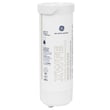
| Slow water, weak ice production | GE refrigerator water filter XWFE | Reduces contaminants; a clogged filter restricts flow |
Why it matters
Cooling and ice maker issues can look “major” but are often caused by simple airflow or water-flow restrictions. Starting with cleaning, sealing, and filter checks helps prevent unnecessary part replacement and protects food temperatures.
Last updated: January 2026
How to remove bottom grille on GE refrigerator?
On the GE GNE27JSMAFSS bottom-mount refrigerator, the bottom grille (base grille) is typically held in place by a few screws and/or retaining tabs. We remove it by taking out the fasteners first, then pulling the grille straight out (or down and out) to release the clips without cracking the plastic.
Steps to remove the bottom grille (base grille)
- Unplug the refrigerator or switch it off before working near wiring or the condenser fan area.
- Look along the top edge and corners of the grille for Phillips-head screws.
- Remove the screws and set them aside.
- Grip the grille at both ends and pull straight outward. If it feels stuck, wiggle gently side-to-side to release the retaining tabs.
- If the grille has lower hooks, lift slightly to unhook it after the top clips release.
What to check if it will not come off
- Confirm all screws are removed (some models use more than two).
- Check for hidden tabs near the ends; use a plastic putty knife to gently depress a tab.
- Make sure the grille is not catching on the flooring or baseboard.
- If the refrigerator was recently moved, verify the grille is not misaligned against the frame.
Reinstalling the grille
To reinstall, align the grille with the openings, engage any bottom hooks first (if present), then press the grille into place and reinstall the screws.
| Task | Tool | Tip |
|---|---|---|
| Remove grille screws | Phillips screwdriver | Support the grille so it does not drop and crack |
| Release retaining tabs | Plastic putty knife (optional) | Avoid metal tools to prevent scratches |
| Reinstall grille | Phillips screwdriver | Do not overtighten screws |
Why it matters
Removing the bottom grille gives access for cleaning and inspection around the lower front area, which can help with airflow, noise checks, and general refrigerator maintenance. For model-specific handling and safety notes, follow the GNE27JSMAFSS owner’s manual.
Last updated: January 2026
Why is my GE bottom freezer icing up?
Ice buildup in the freezer of your GE GNE27JSMAFSS bottom-mount refrigerator is usually caused by warm, moist air leaking in (door not sealing) or by a defrost/drain problem that lets meltwater refreeze. Start with door sealing and airflow checks, then move to the defrost system. See the GNE27JSMAFSS owner’s manual and installation instructions for model-specific operating and care guidance.
Quick checks we recommend first
- Make sure the freezer drawer closes fully and nothing is preventing closure.
- Look for frost concentrated along the drawer edge; that often points to an air leak.
- Confirm food packages are not blocking air outlets; blocked airflow can cause erratic temperatures.
- Check for ice on the freezer floor; that often points to a drain issue.
- Verify the freezer temperature is set correctly and allow 24 hours after any adjustment.
Most common causes (and what to look for)
| What you see | Likely cause | What to do next |
|---|---|---|
| Frost around the perimeter of the drawer | Door gasket not sealing, drawer not closing | Inspect gasket for gaps, tears, or debris; clean and retest seal |
| Solid ice sheet on freezer bottom | Defrost drain restricted, water refreezing | Defrost and clear the drain path; check drain tube for blockage |
| Heavy frost on back wall inside freezer | Defrost system not melting frost | Check defrost heater circuit and related components |
Parts that commonly solve icing and frost problems
If your troubleshooting points to a failed component, these model-compatible parts are common fixes:
- Refrigerator freezer door gasket (dorian gray) WR14X30142 if the drawer edge is frosted or the seal is loose.
- Defrost heater WR51X30141 if frost builds up on the evaporator area because defrost heat is not working.
- Drain tube WR02X30155 if meltwater cannot drain and refreezes in the bottom of the freezer.
Why it matters
Excess frost makes the evaporator work harder, reduces airflow, and can lead to warmer freezer temperatures, longer run times, and ice maker issues. Fixing the air leak or defrost/drain cause restores normal cooling and prevents repeat icing.
Last updated: January 2026
How to order GE appliance parts?
To order parts for your GE GNE27JSMAFSS bottom-mount refrigerator, we recommend using the model number to match parts to your exact configuration. Once you confirm the model and serial label location, you can shop by model and then choose the exact replacement part you need.
Find the model number first (so you get the right fit)
Your GE GNE27JSMAFSS model and serial numbers are typically on a label inside the fresh food compartment on the left side, near the middle. Confirming this label helps prevent ordering a similar-looking part that will not fit.
- Open the fresh food (refrigerator) door
- Look on the left interior wall near the middle
- Write down the full model number (GNE27JSMAFSS)
- Record the serial number too (helpful for revisions)
- Use the model number to filter parts to compatible options
For more model-specific details on locating the label and using features, see the GNE27JSMAFSS owner’s manual.
Choose the part category that matches your symptom
If you are ordering because something is not working, match the symptom to the part type first. Common examples for this model family include water filtration, ice maker, and cooling-related components.
| Symptom | Common part type to check | Example part for this model |
|---|---|---|
| Water tastes bad or flow is slow | Water filter | GE refrigerator water filter XWFE |
| No ice or poor ice production | Ice maker components | Refrigerator ice maker WR30X35287 |
| Temperature seems off | Sensor/control components | GE profile refrigerator temperature sensor WR55X10025 |
Ordering tips that save time
- Compare your old part to the replacement photos and description
- Check for multiple similar parts (color, revision, or mounting differences)
- Replace related wear items together when it makes sense (for example, filter plus bypass plug if needed)
- Keep your receipt and note the install date for maintenance parts
Why it matters
Ordering by the exact model number (GNE27JSMAFSS) helps ensure the part matches your refrigerator’s design and electrical connections, which reduces returns and gets your refrigerator back to normal faster.
Last updated: January 2026
Why is my GE refrigerator leaking water from the bottom?
Water leaking from the bottom of your GE GNE27JSMAFSS refrigerator is most often caused by a defrost drain that’s clogged or frozen, which makes meltwater overflow and run down to the floor. Less commonly, a cracked drain pan or a leaking water supply connection can cause the same symptom; see the GNE27JSMAFSS owner’s manual & installation instructions.
Quick checks you can do safely
- Unplug the refrigerator before removing panels or reaching near wiring.
- Look for ice buildup on the freezer floor; that often points to a blocked defrost drain.
- Check the drain pan underneath for cracks, shifting, or overflow.
- Inspect the water line and fittings at the back for drips (especially if you have an icemaker or dispenser).
- Confirm the refrigerator is level front-to-back and side-to-side; poor leveling can affect drainage.
Most common cause: clogged or frozen defrost drain
During defrost, water should flow through a drain trough and down a drain tube to the pan. If the drain freezes or plugs with debris, water backs up and leaks out.
If you find repeated drain backups, inspect the drain path components used on this model, including the drain tube WR02X30155 and the drain trough WR17X30140.
What to do
- Remove visible ice with a hair dryer on low (keep heat moving; do not overheat plastic).
- Flush the drain opening with warm water using a turkey baster.
- Clear the drain tube with a flexible plastic zip tie (avoid sharp tools that can puncture tubing).
If the leak is related to the water system
If the puddle appears after dispensing water or after the icemaker cycles, focus on the inlet valve and tubing.
| Symptom | Likely area to check | What it suggests |
|---|---|---|
| Leak only when dispensing | Dispenser tubing/reservoir | Loose connection or split line |
| Leak after ice maker fills | Inlet valve and supply line | Valve seepage or fitting drip |
| Slow fill plus dripping | Filter housing/valve | Restriction causing pressure issues |
A common part involved in water-supply leaks is the refrigerator water inlet valve assembly WR57X30890.
Why it matters
A bottom leak can damage flooring and can also lead to ice buildup in the freezer, poor cooling airflow, and recurring defrost drain clogs if it’s not corrected.
Last updated: January 2026