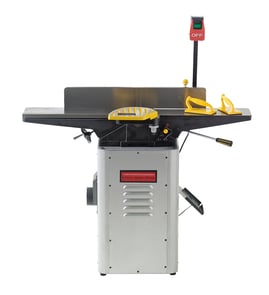

Who makes the best jointer planer combo?
The “best” jointer/planer combo depends on your budget, shop space, and how wide you need to joint and plane; in the premium category, Felder (Hammer) and SCM (Minimax) are widely regarded as top-tier choices, while brands like Jet are often considered solid mid-range options. For Craftsman model 11320621, we focus on keeping your jointer/planer running safely and accurately with the right replacement parts and maintenance.
How we recommend choosing the best combo for your shop
- Capacity first: match the machine’s jointing and planing width to your typical stock.
- Cutterhead type: straight knives cost less; helical/spiral heads run quieter and reduce tear-out.
- Fence and table rigidity: heavier cast-iron components typically hold settings better.
- Dust collection design: better chip evacuation helps prevent snipe and clogging.
- Changeover time: faster jointer-to-planer switching matters if you alternate operations often.
Quick comparison: what “best” usually means
| What you value most | What to look for | Typical tradeoff |
|---|---|---|
| Best surface finish | Helical/spiral cutterhead | Higher upfront cost |
| Best accuracy | Heavy tables, stout fence, precise adjustments | More weight, more space |
| Best value | Proven mid-range brand, good parts availability | Fewer premium features |
| Best for small shops | Compact footprint, easy changeover | Narrower capacity |
Why it matters for your Craftsman 11320621
Even if you upgrade later, getting consistent results from a jointer/planer comes down to alignment and sharp cutting edges. When a machine starts leaving ridges, snipe, or chatter, the fix is often maintenance-related (knife condition, table alignment, belt condition, or fasteners working loose) rather than the brand name.
Parts and support for this model
We list replacement parts for Craftsman 11320621 by model so you can match components correctly; if you are also shopping for accessories or cross-checking model details, search by model number on Sears PartsDirect. For model-number tips, use how to find your appliance model number (and what it means for parts).
Last updated: February 2026
Can I use my jointer as a planer?
No. On a Craftsman 11320621 jointer/planer, the jointer function is designed to flatten one face and straighten an edge; a planer function is designed to make the opposite face parallel and bring the board to a consistent thickness. Using a jointer like a planer is unsafe and will not produce uniform thickness.
What each tool is meant to do
- Jointer: creates one flat reference face and a straight, square edge.
- Planer (thickness planer): makes the second face parallel to the first and sets final thickness.
- Why it matters: a planer references off the already-flat face; a jointer does not control thickness across the full board.
What to do instead (safe, accurate workflow)
- Joint one face until it is flat.
- Joint one edge square to that face.
- Plane the opposite face until the board reaches your target thickness.
- Rip to width, then lightly joint the sawn edge if needed.
- For twisted or bowed stock, start with shorter passes and remove small amounts per pass.
Quick comparison
| Task | Best tool | Result you can expect |
|---|---|---|
| Flatten one face | Jointer | Flat reference surface |
| Make faces parallel | Planer | Uniform thickness |
| Remove cup/bow quickly | Jointer first | Less tear-out, better control |
| Final thickness sizing | Planer | Repeatable thickness |
Why it matters for results and safety
Trying to “thickness” a board on the jointer can lead to snipe-like gouges, tapering (wedge-shaped boards), and higher kickback risk because the machine is not controlling thickness relative to a reference face.
Parts and diagrams help
If you are setting up or restoring your Craftsman 11320621 (for example, checking fence alignment, cutterhead condition, or drive components), use the model-specific parts diagrams to identify the correct replacements. If you do not see what you need listed, search by model number on Sears PartsDirect.
Last updated: February 2026
Is a planer worth it without a jointer?
Yes, a planer can still be worth it without a jointer, but it will not fully replace what a jointer does. With your Craftsman 11320621 jointer/planer setup in mind, the jointer’s job is to flatten one face and square one edge; the planer then makes the opposite face parallel and brings boards to consistent thickness.
What you can do with only a planer
A planer is great when your lumber already has at least one reasonably flat reference face (or you create one).
- Make boards a consistent thickness for cabinet parts and trim
- Clean up rough-sawn surfaces for a smoother finish
- Match thickness across multiple boards for glue-ups
- Reduce minor cup or twist when you use a sled/shims technique
- Reclaim slightly uneven boards (within reason) for shop projects
What a jointer adds (and why it matters)
A jointer creates the flat reference surfaces that make planing accurate. Without a jointer, a planer can follow the existing warp and simply make the board uniformly warped.
Why it matters
- Flat face: needed so boards sit stable on a table saw or workbench
- Square edge: needed for tight panel glue-ups and straight rip cuts
- Less waste: you remove less material when you start with a true reference face
Practical alternatives if you do not have a jointer
You can still get excellent results by adding a few techniques and accessories.
| Goal | Without a jointer | Typical approach |
|---|---|---|
| Flatten one face | Possible | Planer sled plus shims/hot glue to stabilize the board |
| Straighten an edge | Possible | Table saw with a straight-line rip jig or a track saw guide |
| Square an edge to a face | Limited | Joint one face first (sled), then use a fence-guided ripping method |
Parts and support for your Craftsman 11320621
If you are maintaining the cutterhead, drive system, or guards on your Craftsman 11320621 jointer/planer, we recommend using the model number to match the correct replacement parts and diagrams. You can also search by model on Sears PartsDirect to find additional Craftsman power tool parts.
Last updated: February 2026
Is an 8 inch jointer worth it?
Yes, an 8-inch jointer is worth it if you routinely joint boards wider than 6 inches and you want fewer workarounds. Craftsman model 11320621 is a 6-inch class jointer/planer; moving up to 8 inches mainly adds capacity, longer beds, and easier flattening of wider stock.
When an 8-inch jointer is the right upgrade
- You regularly face-joint boards in the 6 to 8 inch range
- You build table tops, panels, or wide shelving from rough lumber
- You want to avoid ripping wide boards just to joint them
- You value longer infeed/outfeed beds for straighter results
- You have space and dust collection for a larger machine
When a 6-inch class jointer is still the better buy
- Most of your stock is 6 inches wide or less (rails, stiles, face frames)
- You are comfortable with the rip, joint, re-glue workflow for wider boards
- Your budget is better spent on sharp knives, a planer, or dust control
- Shop space and mobility matter more than extra width
Quick comparison (typical)
| Feature | 6-inch class jointer (like 11320621) | 8-inch jointer |
|---|---|---|
| Practical face-joint width | Up to about 6 inches | Up to about 8 inches |
| Common workaround for wider boards | Rip and re-glue | Often not needed |
| Bed length and support | Shorter | Longer |
| Best fit | Smaller projects, tight shops | Wider stock, fewer compromises |
Why it matters
Jointer width determines how often you change your workflow. If you frequently buy rough hardwood, an 8-inch jointer saves time and preserves more of the board’s original width.
Parts and model-number tip
When you maintain Craftsman 11320621 (knives, belts, guards, switches), match parts by the full model number. If you do not see what you need listed for this model, search by model number on Sears PartsDirect. For help locating the tag, use how to find your appliance model number (and what it means for parts).
Last updated: February 2026