Installation guide
 Owner’s manual



What is the average lifespan of a Kenmore washer?
A Kenmore washer typically lasts 10 to 15 years with normal household use. For Kenmore model 11028832700, lifespan depends most on load size, installation conditions, and routine care; following the maintenance guidance in the 11028832700 owner's manual helps you reach the higher end of that range.
Typical lifespan by washer type
Most Kenmore washers fall into these real-world averages:
| Washer type | Typical lifespan | Notes |
|---|---|---|
| Top-load (direct-drive style) | 12 to 15 years | Often simpler mechanically; good durability with balanced loads |
| Top-load (belt or more complex drive) | 10 to 14 years | More wear points; maintenance matters |
| Front-load | 10 to 12 years | More sensitive to moisture, seals, and bearing wear |
What shortens washer life fastest
We see these habits and conditions reduce washer life the most:
- Overloading or packing the tub so items cannot move freely
- Unbalanced loads (single heavy items) that strain suspension and drive components
- Poor installation conditions, such as an unlevel floor or installing on carpeting
- Low temperatures (at or below 32°F) that can leave water inside and cause damage
- Ignoring early symptoms like burning smell, grinding, slow drain, or no spin
Maintenance that extends lifespan
These steps make the biggest difference year over year:
- Keep loads balanced and avoid overfilling
- Use the correct water temperature and detergent amount for the cycle
- Periodically inspect fill hoses and the drain path for kinks or restrictions
- Confirm the washer sits on a level, sturdy floor and does not rock
- Follow seasonal care and winterizing guidance in the 11028832700 installation guide
Common wear parts (and what they affect)
If performance drops, these parts are frequent culprits on many Kenmore top-load washers:
| Symptom | Common part to check | What it impacts |
|---|---|---|
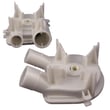
| Won’t drain or drains slowly | Washer drain pump WP3363394 | Drain speed and spin completion |
| Won’t spin or stops when lid opens | Washer lid switch assembly WP8318084 | Spin safety circuit |
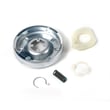
| Agitator not moving properly | Agitator dog 80040 | Agitation action |
Why it matters
A washer that is level, not overloaded, and maintained per the manual runs with less vibration and heat. That reduces stress on the drive system, suspension, and seals, which are the components that most often determine whether you get 10 years or closer to 15.
Last updated: January 2026
How to read a Kenmore model number?
Kenmore model numbers (including 11028832700) start with a 3-digit prefix that identifies the manufacturer, followed by digits that define the base design and the exact version. We use the full model number to match the correct washer parts and documentation.
How the Kenmore model number is structured
Most Kenmore model numbers follow this pattern:
- Prefix (first 3 digits): manufacturer code (for example, 110)
- Middle digits: the base model design family
- Ending digits: specific variations (features, production changes, color, or revisions)
For this washer, the model label is typically located under the washer lid, and the manual recommends recording the complete model and serial number for service and parts matching.
Where to find the model number on model 11028832700
Check these common locations:
- Under the washer lid on the model and serial number label
- On the rim of the tub opening (visible with the lid open)
- On the cabinet near the lid hinge area
Use the exact characters as printed (all digits, no spaces) when ordering parts or looking up diagrams.
Why the full model number matters for parts
Small digit changes can point to different internal designs, which affects fit and function.
| What you’re doing | Why the full model number matters |
|---|---|
| Ordering a replacement part | Prevents wrong-fit parts (mounting, wiring, hose routing) |
| Using troubleshooting steps | Ensures the correct procedures and safety notes |
| Checking installation requirements | Confirms drain, water supply, and leveling guidance |
Quick example using this washer
- 110 = manufacturer prefix used on many Kenmore washers
- 28832 (example grouping) = base design family
- 700 (example grouping) = version/revision identifiers
For model-specific details and label location, use the 11028832700 owner's manual.
Why it matters
Using the complete Kenmore model number is the fastest way to get the right washer parts (like a lid switch assembly, drain pump, or motor coupling) and avoid returns caused by minor model variations.
Last updated: January 2026
How do I know if my washing machine sensor is bad?
On Kenmore washer model 11028832700, a bad sensor usually shows up as the washer not filling to the right level, not draining, or not agitating or spinning correctly. Before blaming a sensor, we first rule out simple causes like an open lid, kinked hoses, or a drain hose installed too low.
Quick symptoms that point to a sensor-type problem
- Water level is clearly wrong (overfilling, underfilling, or filling then stopping unexpectedly)
- Cycle seems to get “stuck” filling or draining
- Agitation or spin is inconsistent even with a normal-size load
- Washer stops mid-cycle after starting normally
- Performance changes after moving the washer or after hose/standpipe changes
Fast checks to do first (often not a bad sensor)
These checks match common causes called out for this washer’s operation and setup.
- Confirm the lid is fully closed; this model will not agitate or spin with the lid open
- Make sure both hot and cold faucets are turned on
- Inspect inlet hoses for kinks; straighten as needed
- Check the drain hose height; the top of the drain hose should be at least 39 in. (99 cm) above the floor
- Reset a tripped breaker or replace a blown fuse if the washer is dead
For step-by-step operating and troubleshooting basics, use the 11028832700 owner's manual.
What “sensor” usually means on this washer
On many Kenmore top-load designs like 11028832700, the most common “sensor” complaints relate to water level control and safe operation.
| What you notice | Most likely system involved | What it affects |
|---|---|---|
| Wrong water level or endless fill/drain | Water-level pressure system (switch + hose) | Fill level, agitation timing |
| Won’t spin/agitate with lid closed | Lid safety circuit | Spin/agitate enable |
| Drains poorly or leaves water | Drain system | Drain and spin performance |
If the washer will not spin or agitate, the lid safety circuit is a prime suspect; the washer lid switch assembly WP8318084 is the model-matched part commonly involved.
Why it matters
A true sensor or switch problem can make the washer overfill, fail to spin, or run a cycle that never completes. Catching the real cause early also prevents unnecessary part replacement and helps protect floors from leaks.
Last updated: January 2026
How to hard reset kenmore washer?
To hard reset your Kenmore washer model 11028832700, unplug it (or switch off the breaker) for 2 minutes, then restore power. This clears many temporary control glitches; if the washer still will not start or complete a cycle, follow the reset and restart steps in the 11028832700 owner's manual.
Hard reset steps (safe, works for most Kenmore washers)
- Turn the cycle control knob to Off.
- Unplug the washer (or turn off the breaker).
- Wait 2 minutes.
- Plug the washer back in (or turn the breaker on).
- Select a normal cycle and pull the knob (or press Start, if your console has a Start button).
- If the washer was paused mid-cycle, close the lid and restart.
If it still will not run: quick checks that look like a “reset” problem
These issues commonly prevent agitation or spin even after a power reset:
- Lid not fully closed or lid switch not sensing closed.
- Drain problem leaving water in the tub.
- Load is off-balance, causing the washer to stop or struggle to spin.
- Drive system issue (coupler or clutch slipping).
| Symptom after reset | Most likely area | Common next step |
|---|---|---|
| Won’t start or stops when lid opens | Lid switch circuit | Inspect/replace washer lid switch assembly WP8318084 |
| Hums but won’t agitate/spin | Drive coupling | Inspect/replace coupling 285753A |
| Won’t drain or leaves water behind | Drain pump or blockage | Check hoses, then inspect washer drain pump WP3363394 |
Why it matters
A hard reset only clears a temporary “stuck” condition. If a safety switch (like the lid switch) or a mechanical part (like the coupling or drain pump) is failing, the washer can act dead or stop mid-cycle even though power is restored.
Good practice after a reset
- Keep the load size reasonable so items move freely.
- Balance bulky loads (towels, jeans, blankets) evenly around the basket.
- Use the cycle and water level settings recommended in the 11028832700 owner's manual.
Last updated: January 2026