Installation guide
 Owner’s manual
 Error Codes


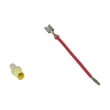
What does F1 mean on my dryer?
On a Whirlpool WED75HEFW1 dryer, an F1 code typically points to an electronic control problem (the main control board is detecting a fault). In most cases, the dryer will stop running or behave erratically until the underlying control or wiring issue is corrected; see the WED75HEFW1 installation guide for safe power-disconnect steps before any checks.
What to do first (safe, quick checks)
- Unplug the dryer (or switch off the breaker) for 1 minute, then restore power and try a cycle.
- If the code returns, disconnect power again and check for a loose harness connection at the control area (no pinched wires).
- Make sure the terminal block connections are tight and not overheated; a poor power connection can cause control faults.
- If the dryer starts and then faults, avoid repeated restarts; that can worsen heat or wiring damage.
- If you see any burnt smell or discoloration at wiring, stop and have it serviced.
Likely causes of an F1 code
Common issues we see across Whirlpool electronic-control dryers include:
- Main electronic control board failure
- User interface (console) communication problem
- Loose or damaged wire harness connection
- Power supply issue (intermittent L1/L2, poor terminal block connection)
Parts that may be involved
If troubleshooting points to a failed control or console connection, these model-compatible parts are often checked during diagnosis:
| Symptom with F1 | What it often indicates | What to inspect |
|---|---|---|
| F1 appears immediately on power-up | Control self-test failure | Harness plugs, control board area |
| F1 appears mid-cycle | Heat, vibration, or power interruption affecting controls | Terminal block, wiring, vibration-related looseness |
| Buttons act odd, display glitches | Console/UI issue | Console connection and interface assembly |
Related part pages for this model:
- Dryer user interface assembly W10919207 (console interface that sends commands to the control)
- Dryer wire harness W11025125 (wiring that connects the controls and components)
Why it matters
An F1 code is not just a nuisance; it usually means the dryer’s controls cannot reliably manage motor and heat operation. Fixing the root cause helps prevent no-start problems, overheating, and repeat shutdowns.
Helpful reference
For more code definitions and what they mean on Whirlpool electronic-control dryers, use our Whirlpool electronic control model dryer error codes guide.
Last updated: January 2026
Is a 7.4 cu ft dryer big?
Yes. A 7.4 cu. ft. drum is considered a large-capacity size for a Whirlpool dryer like model WED75HEFW1, and it is typically big enough for bulky items (comforters) and larger family loads, so you can dry more per cycle.
What “7.4 cu. ft.” means in real use
A larger drum gives clothes more room to tumble, which can improve airflow and reduce wrinkling when loads are sized correctly.
- Handles bulky items more comfortably than mid-size drums
- Helps reduce the number of loads for families
- Works best when you avoid packing the drum tightly
- Pairs well with sensor cycles because airflow stays consistent
Quick capacity comparison
| Dryer drum size | Common label | Best for |
|---|---|---|
| 5.0 to 6.5 cu. ft. | Standard | Singles, couples, smaller loads |
| 6.6 to 7.0 cu. ft. | Medium-large | Mixed household laundry |
| 7.1 cu. ft. and up | Large | Families, bulky bedding |
Tips to get the best drying performance from a large drum
Even with a large-capacity dryer, drying results depend heavily on venting and lint control.
- Clean the lint screen before every load; replace it if it is torn or warped using the dryer lint screen W11758174
- Keep loads “loose” in the drum; overloading can cause long dry times
- Use the correct cycle (bulky, towels, timed dry) for the fabric type
- Make sure the dryer is level so the moisture sensing system works correctly
- Verify your venting setup meets the requirements in the WED75HEFW1 installation instructions
Why it matters
Choosing the right capacity helps prevent long dry times, overheating, and uneven drying. With a 7.4 cu. ft. drum, you get the benefit of fewer loads, but only if airflow (lint screen and vent) stays clear.
Last updated: January 2026
What is the life expectancy of a Whirlpool dryer?
Whirlpool dryers, including model WED75HEFW1, typically last 10 to 15 years with normal household use. Airflow and heat management matter most; a clean lint path and properly installed venting help prevent overheating that can shorten the dryer’s service life. See WED75HEFW1 installation instructions for venting and clearance requirements.
What affects lifespan the most
These are the biggest real-world factors that shorten or extend life on a Whirlpool dryer like the WED75HEFW1:
- Restricted venting (crushed duct, long runs, too many elbows)
- Lint buildup in the lint screen area or exhaust ducting
- Overloading (extra strain on the belt, rollers, and motor)
- Frequent high-heat cycles with poor airflow
- Ignoring early symptoms like squealing, thumping, or long dry times
Maintenance checklist (best return)
We recommend this routine to help your WED75HEFW1 reach the full 10 to 15 years:
- Clean the lint screen every load; wash and dry it occasionally to remove residue
- Check airflow at the outside vent hood; weak airflow usually means a restriction
- Keep the dryer level so the drum rides correctly on support components
- Avoid overloading; split heavy loads like towels and jeans
- If dry times increase, stop and inspect venting before continuing to run heated cycles
Wear parts that often make an older dryer noisy or inefficient
Many dryers can be kept running longer by replacing common wear items when symptoms start.
| Symptom | Likely wear area | Example compatible part for WED75HEFW1 |
|---|---|---|
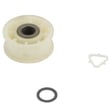
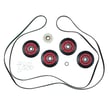
| Squealing or chirping | Idler pulley/belt path | Dryer idler pulley W10837240 |
| Thumping or rumbling | Drum support rollers | Dryer drum support roller WPW10314173 |
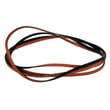
| Drum not turning well, burning rubber smell | Belt and pulley system | Dryer drive belt 661570V |
Why it matters
A dryer that runs with restricted venting operates hotter and longer, which increases wear on the heating system, motor, and drum support components. Good airflow is the simplest way to protect performance and extend service life.
Last updated: January 2026