Owner’s manual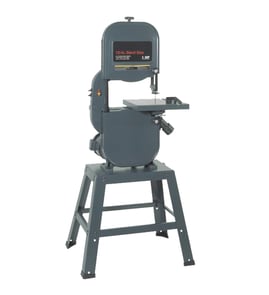

How do I know the size of my bandsaw blade?
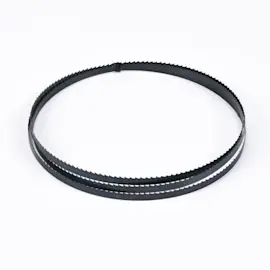
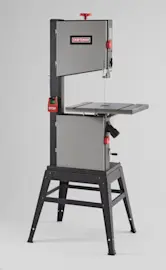
For your Craftsman 113244580 9" 2-wheel band saw, blade “size” means blade length, blade width, and teeth per inch (TPI). We confirm the saw is designed to run common narrow blades (such as 1/8", 1/4", and 3/8") and you can identify your exact blade by measuring length, width, and TPI, then setting tension correctly using the guide in the 113244580 owner's manual.
What to measure (the 3 specs that matter)
- Blade length: the total loop length of the blade.
- Blade width: measure from the tooth tip to the back edge of the blade.
- TPI (teeth per inch): count teeth across 1 inch; higher TPI for thinner material, lower TPI for thicker stock.
How to measure blade length safely
- Unplug the saw and remove the switch key before handling the blade.
- If the blade is off the saw, coil it flat on the floor.
- Mark a starting point (the weld is easiest).
- Use a tape measure along the blade’s edge; roll the blade as you measure until you return to the mark.
- The total distance is your blade length.
Blade width guidance for this model
The manual shows tension reference positions for these blade widths on the tension knob:
| Blade width | Typical use on a 9" band saw | What you’ll notice |
|---|---|---|
| 1/8" | Tight curves | Smallest turning radius, easiest to twist if guides are loose |
| 1/4" | General curve cutting | Good balance of control and stability |
| 3/8" | Straighter cuts, resawing | Tracks straighter, larger minimum curve radius |
Why it matters (fit, tracking, and cut quality)
Using the correct blade length and setting proper tension helps prevent blade slipping, poor tracking, and premature blade breakage. The manual also notes that overtensioning can contribute to blade breakage, while undertensioning can let the blade slip on the wheels.
After you identify the blade, set it up correctly
- Close the band saw cover after installing the blade.
- Adjust blade tension using the tension adjustment knob.
- Set the upper guide assembly to clear the workpiece by about 1/8 inch while cutting.
- Re-adjust blade guides and backup bearings when you change blade width.
Ordering the right blade
Once you have the blade length, width, and TPI, match those specs when shopping. You can also search by model number 113244580 on Sears PartsDirect to find compatible blades and other band saw parts.
Last updated: February 2026
What are the specs of the Craftsman 12 inch bandsaw 113244580?
The Craftsman 113244580 is a two-wheel 9-inch band saw (not a 12-inch model). For the most accurate model-specific specifications (capacity, blade size range, table details, and electrical requirements), we recommend using the 113244580 owner's manual, which is written specifically for this saw.
Key specs to confirm for model 113244580
Because this is a 9-inch 2-wheel band saw, these are the specs that matter most for setup and blade selection:
- Wheel size and saw class: 9-inch, two-wheel band saw
- Blade length and width range: check the manual before buying blades
- Maximum cutting capacity: throat and max cut height depend on the frame and guide setup
- Table size and tilt range: affects bevel cuts and resaw stability
- Motor and electrical requirements: voltage, amperage, and circuit protection
- Guide and tension system details: impacts tracking and cut accuracy
Where to find the exact specs (fastest way)
We use the model-specific documentation to match parts and settings correctly.
- Open the 113244580 owner's manual.
- Look for sections labeled specifications, assembly, and adjustments.
- Record your model and serial number from the plate on the saw base; that helps ensure you match the correct version when ordering parts.
Common “specs” people mix up (9-inch vs 12-inch)
If you are comparing saws, these items are often confused between different Craftsman models:
| Spec item | What it affects | Why it matters |
|---|---|---|
| Throat depth | How wide a workpiece you can cut | Determines max width before hitting the frame |
| Max cut height | How thick a board you can cut | Key for resawing |
| Blade length | What blades fit | Wrong length will not tension or track |
| Blade width | Curve cutting vs straight cutting | Wider blades track straighter |
Why it matters
Using the correct 113244580 specs prevents buying the wrong blade length, setting incorrect tension, or using an undersized circuit. It also helps you identify the right repair parts (switch, cord, motor, guides) when troubleshooting.
Parts and manuals
For replacement parts and diagrams for Craftsman 113244580, use the parts list for this model; for broader model searches and ordering, use Sears PartsDirect.
Last updated: February 2026
What is the 3-tooth rule for bandsaws?
The 3-tooth rule means you choose a band saw blade tooth pitch (TPI) so at least three teeth are in the cut at all times. On a Craftsman 113244580 9-inch 2-wheel band saw, this helps prevent tooth snagging and stripping, improves chip clearance, and produces a smoother, safer cut.
How to apply the 3-tooth rule (quick method)
- Measure the material thickness where the blade enters the cut.
- Pick a blade pitch so 3 or more teeth span that thickness.
- Thin stock needs more TPI (finer teeth) so the blade does not grab.
- Thick stock can use fewer TPI (coarser teeth) for faster cutting and better chip removal.
- If the saw slows down, reduce feed pressure and let the blade cut at its own rate.
- Keep the upper blade guide assembly just above the workpiece before you start cutting.
- Use clamps, jigs, or fixtures for small pieces so your fingers never go under the blade guard.
Simple TPI selection table (rule-of-thumb)
Use this as a starting point, then fine-tune for wood type, cut quality, and curve radius.
| Material thickness | Typical blade pitch to keep 3+ teeth engaged | Best for |
|---|---|---|
| 1/8 in to 1/4 in | 14 to 24 TPI | Thin strips, small parts |
| 1/4 in to 3/4 in | 6 to 10 TPI | General woodworking |
| 3/4 in to 2 in | 3 to 6 TPI | Thicker stock, faster ripping |
Why it matters on the Craftsman 113244580
This saw is designed to cut safely at its intended rate. When tooth pitch is too coarse for the thickness, the blade can hook the work and break teeth; when it is too fine for thick stock, gullets pack with sawdust, heat builds up, and the saw bogs down.
Setup checks that support better blade life
These steps work with the 3-tooth rule to reduce vibration and premature dulling.
- Set the upper guides to clear the workpiece by about 1/8 inch.
- Let the blade reach full speed before feeding the work.
- Do not force the cut; steady, moderate feed pressure cuts straighter.
- If you hear unfamiliar noise or heavy vibration, shut the saw off and correct the issue.
- For blade tracking, guide adjustment, and safe cutting practices, follow the 113244580 owner's manual.
To look up diagrams and replacement items by model number, search Sears PartsDirect.
Last updated: February 2026