Owner’s manual
 Error Codes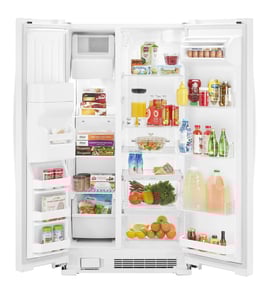


How many cubic feet is a Kenmore Elite refrigerator?
Kenmore Elite refrigerator capacity depends on the exact model. For Kenmore Elite 10650793000 (side-by-side), the cubic-foot capacity is listed on the model’s rating label and in the specifications section of the 10650793000 owner's manual; use those sources to match the correct total capacity for your exact unit.
How to find the cubic-foot capacity for model 10650793000
Use these quick checks (fastest first):
- Check the model and serial tag inside the fresh food compartment (often on a side wall or ceiling area); capacity is commonly printed with other specs.
- Look in the specifications area of the 10650793000 owner's manual.
- If you have the original sales paperwork, look for “total capacity” or “cu. ft.”
- Compare your refrigerator’s shelf and bin layout to the “Parts and features” section to confirm you are using the correct manual for the exact model.
Typical capacity ranges (helpful for a quick estimate)
Most side-by-side refrigerators like the Kenmore Elite 10650793000 fall into a fairly narrow range. Use this as a practical estimate until you confirm the exact spec:
| Refrigerator style | Typical total capacity | Notes |
|---|---|---|
| Side-by-side | 20 to 26 cu. ft. | Often split close to 50/50 between fresh food and freezer |
| French door | 25 to 30+ cu. ft. | Usually larger fresh food section |
| Top freezer | 14 to 21 cu. ft. | Common in apartments and smaller kitchens |
Why it matters
Knowing the correct cubic-foot capacity helps us match the right parts and maintenance items (like shelves, drawers, and water filtration components) and it also helps you compare energy use and storage space accurately.
Related parts that can affect usable space (not total capacity)
These parts do not change the official cubic feet, but they can change how much you can actually store:
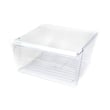
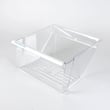
- Cracked or missing drawers: refrigerator crisper pan WP2188656
- Damaged deli storage: refrigerator meat pan WP2188664
- Broken shelf supports or frames: refrigerator shelf frame WPW10141748
Last updated: January 2026
What are the common problems with Kenmore Elite refrigerators?
Common problems on the Kenmore Elite 10650793000 side-by-side refrigerator include warm temperatures from dirty condenser coils or airflow issues, frost buildup from a defrost or door-seal problem, ice maker not making ice due to freezer temperature or water supply issues, and normal-to-loud operating noises. Use the 10650793000 owner's manual troubleshooting checks first.
Most common symptoms and what to check first
- Not cooling well: confirm doors fully close; clean condenser coils; verify door gaskets seal all the way around.
- Runs a lot: after cleaning coils and confirming good door seal, longer run times can be normal on high-efficiency models.
- Too much noise: compare the sound to the normal operating sounds described in the manual.
- Ice maker not producing ice: verify freezer is cold enough; wait 24 hours after hook-up; confirm the shut-off arm is down (ON); make sure the water shut-off valve is open.
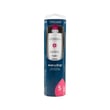
- Water dispenser flow is slow: remove the filter cartridge and test flow; if flow improves, replace the filter.
Parts that commonly relate to these problems (when symptoms match)
If your troubleshooting points to a failed component, these model-matched parts are commonly involved:
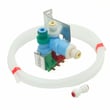
- Water not dispensing or ice maker not filling: refrigerator inlet valve W10408179
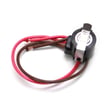
- Frost buildup or warm freezer with icing: refrigerator heater WP2323198, refrigerator defrost bi-metal WPW10225581
- Water filter leaks or poor filtration housing issues: refrigerator water filter housing WP2186443
Quick symptom-to-likely-cause guide
| Symptom | Most common checks | Parts often involved |
|---|---|---|
| Refrigerator warm | Dirty condenser coils; doors not fully shut; gasket not sealing | (Cleaning and sealing first) |
| Frost/ice buildup | Door gasket sealing; defrost system operation | Defrost heater; defrost bi-metal |
| No ice | Freezer temp; shut-off arm; water valve open | Inlet valve; ice maker components |
| Slow water flow | Filter installed full or misinstalled | Filter housing (if leaking/damaged) |
Why it matters
Cooling, ice production, and water dispensing all depend on good airflow, tight door seals, and a working defrost and water-supply system. Addressing the simple checks first (doors, coils, filter) prevents unnecessary part replacement and helps restore normal temperatures faster.
Last updated: January 2026
What is the code er 15 on a Kenmore refrigerator?
On a Kenmore Elite refrigerator model 10650793000, an ER 15 code points to a problem the refrigerator is detecting in the in-door ice maker sensor circuit (the sensor may be disconnected, shorted, or not being read correctly). Ice production commonly stops until the issue is corrected; this protects the ice maker from running in an unsafe condition.
What to check first (quick, no-parts steps)
- Power reset: unplug the refrigerator (or turn off the breaker) for 5 minutes, then restore power.
- Confirm the ice maker is turned on and the freezer temperature is set correctly (most side-by-sides make ice best around 0°F).
- Check for an ice jam in the chute or bucket that could prevent normal sensing.
- Make sure the ice bin is fully seated and the door closes tightly.
- If the dispenser area is dim or you are working in low light, replace the bulb so you can inspect safely.
Common causes and likely fixes
ER 15 is usually tied to a sensing or communication issue at the ice maker. These are the most common real-world causes:
- Loose or oxidized connector at the ice maker or door harness
- Pinched or broken wiring in the freezer door hinge area
- Ice maker sensor failure (internal to the ice maker assembly on many designs)
- Control or optics style sensing issue (depending on configuration)
Parts that may be involved on this model
These parts are not “automatic” replacements, but they are commonly involved when diagnosing ice and dispenser issues:
| Symptom you notice | What it often points to | Example part for this model |
|---|---|---|
| No ice and ER 15 persists after reset | Ice maker sensing or control issue | Refrigerator emitter control board W11629974 |
| Ice maker fills poorly or not at all | Water supply or valve issue | Refrigerator inlet valve W10408179 |
| Dispenser area dark while troubleshooting | Lighting issue at dispenser | Dispenser bulb WP22002263 |
Why it matters
When the refrigerator cannot trust the ice maker sensor signal, it may stop cycling the ice maker to prevent overfilling, motor strain, or repeated fault conditions. Fixing the root cause restores normal ice production and helps avoid intermittent freezing or dispensing complaints.
Where to find model-specific guidance
For control locations, wiring routing, and ice maker/dispenser checks specific to Kenmore Elite 10650793000, use the 10650793000 owner's manual.
Last updated: January 2026
What are the dimensions of a Kenmore Elite?
For Kenmore Elite side-by-side refrigerator model 10650793000, the overall size is typically about 36 inches wide, 69 to 71 inches tall, and 33 to 35 inches deep (deeper when you include handles). For the exact published measurements for your unit, use the 10650793000 owner's manual.
Typical dimensions you should plan around
Most Kenmore side-by-side refrigerators in this series fit a standard 36-inch opening, but height and depth vary based on hinges, leveling legs, and handle style.
- Width: ~36 inches (door-to-door at the widest point)
- Height: ~69 to 71 inches (floor to top of hinge cover)
- Depth (cabinet): ~33 to 35 inches
- Depth (with handles): often 2 to 4 inches deeper than cabinet depth
- Clearance: leave space for door swing and airflow behind the cabinet
How to measure your refrigerator the same way specs are listed
Use a tape measure and check three spots: width, height, and depth. Measure with the refrigerator in its normal, leveled position.
| Measurement | Measure from | Include |
|---|---|---|
| Width | Left door edge to right door edge | Door edges, not just cabinet |
| Height | Floor to top hinge cover | Account for leveling legs |
| Depth | Back panel to front-most point | Do one measurement without handles and one with handles |
Why it matters
Correct dimensions prevent problems like doors hitting walls, drawers not pulling out fully, or the refrigerator sitting too tight to the wall (which can reduce cooling performance and make water line routing harder).
Last updated: January 2026