Owner’s manual
 Error Codes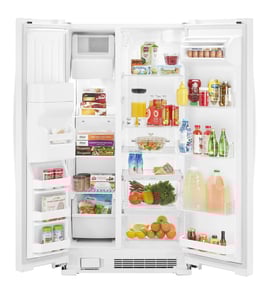



What are the main 5 parts of a refrigerator?
The main five parts that make a refrigerator cool are the compressor, condenser coil, evaporator coil, metering device (capillary tube or expansion device), and a temperature control (thermostat or electronic control). Together, these parts move heat out of your Amana SXD26VW-P1315202WW so food stays cold.
The “cooling system” parts (the core 5)
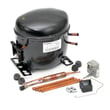
- Compressor: pumps refrigerant through the sealed system; it is the starting point for the cooling cycle.
- Condenser: releases heat to the room (often underneath or behind the cabinet).
- Metering device (capillary tube/expansion device): drops refrigerant pressure so it can absorb heat.
- Evaporator: absorbs heat inside the freezer and refrigerator compartments.
- Temperature control (thermostat or electronic control): tells the system when to run to maintain set temperatures.
Common “support” parts people also mean
These are not part of the core refrigeration cycle, but they are major functional parts on many side-by-side refrigerators:
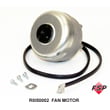
- Evaporator fan motor: circulates cold air from the evaporator through the compartments.
- Defrost heater: melts frost off the evaporator so airflow stays strong.
- Door gaskets: keep warm, humid air out; the manual emphasizes keeping gaskets clean and pliable.
- Ice maker and water system: adds ice and chilled water when equipped.
Quick reference table
| Part | What it does | Common symptom when it fails |
|---|---|---|
| Compressor | Moves refrigerant | Warm fridge/freezer, clicking, no steady run |
| Condenser | Dumps heat | Poor cooling, hot cabinet sides, long run times |
| Evaporator | Absorbs heat inside | Warm temps, frost buildup, weak airflow |
| Metering device | Controls refrigerant flow | Poor cooling, uneven temps |
| Temperature control | Cycles cooling on/off | Too warm or too cold, inconsistent temps |
Model-specific examples you can shop by name
If you are diagnosing cooling or ice issues on this model, these parts are commonly involved:
- Refrigerator compressor W10160407
- Evaporator motor WP10513803
- Refrigerator heater WP12049801
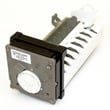
- Refrigerator ice maker D7824706Q
Why it matters
Knowing the “core 5” helps you separate sealed-system cooling problems (compressor, condenser, evaporator, metering device) from airflow, defrost, or ice maker issues. That saves time when troubleshooting symptoms like warm temperatures, frost buildup, or no ice.
For control locations, feature details, and care steps (like keeping condenser coils clean), use the owner's manual.
Last updated: February 2026
What are the most commonly replaced parts in a refrigerator?
In most refrigerators (including the Amana SXD26VW-P1315202WW), the parts we see replaced most often are the ice maker and water system parts, door and light switches, cooling fan components, and defrost or control components. These parts wear with normal use and can cause no-ice, warm temperatures, leaks, or noise.
Most common parts and what they affect
- Ice maker and related hardware: no ice, small cubes, or jams (see refrigerator ice maker D7824706Q)
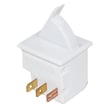
- Door and light switches: interior light issues, fan behavior changes when the door is open (see refrigerator switch W11396033 and refrigerator switch W11384469)
- Evaporator fan motor: warm refrigerator section, weak airflow, unusual fan noise (see evaporator motor WP10513803)
- Defrost heater components: frost buildup on the evaporator, poor cooling (see refrigerator heater WP12049801)
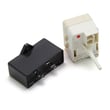
- Controls and sealed system start components: intermittent cooling, clicking, compressor not starting (examples include refrigerator control R0161092 and refrigerator capacitor W10613606)
Quick symptom-to-part checklist
| Symptom | Most likely part area | Example part on this model |
|---|---|---|
| No ice or ice maker stops mid-cycle | Ice maker module, ejector, fill system | Refrigerator ice maker D7824706Q, refrigerator ejector WP627843 |
| Fridge warm but freezer cold | Evaporator fan, airflow/defrost | Evaporator motor WP10513803 |
| Heavy frost on back freezer wall | Defrost system | Refrigerator heater WP12049801 |
| Light does not turn on or stays on | Door/light switch | Refrigerator switch W11396033 |
| Clicking, humming, or no start | Start components, compressor system | Refrigerator capacitor W10613606, refrigerator compressor W10160407 |
How we recommend choosing the right replacement part
- Match your model number SXD26VW-P1315202WW and confirm the part fits your exact configuration.
- Use the symptom first (no ice, warm temps, leak, noise), then narrow to the system (ice, airflow, defrost, electrical).
- Check for simple causes before ordering: clogged filter, blocked vents, door not sealing, or a tripped breaker.
- For disassembly steps and safety notes, follow the owner's manual.
Why it matters
Replacing the correct “high-failure” part first can restore normal temperatures and prevent food spoilage, while avoiding unnecessary sealed system work (compressor, drier, tubing) that is more complex and costly.
Last updated: February 2026
What causes a side-by-side refrigerator to stop cooling?
A side-by-side refrigerator like the Amana SXD26VW-P1315202WW usually stops cooling because airflow or heat removal is blocked (dirty condenser coils, blocked air grilles), controls are set incorrectly, or the unit is in a normal defrost cycle. Less commonly, a fan, start component, or compressor issue is involved.
Quick checks we recommend first (fastest fixes)
- Confirm the refrigerator is plugged in and the outlet has power.
- Make sure the freezer control is turned on and not set to “off.”
- Wait about 40 minutes; if lights work but the fans and compressor are off, it can be in a defrost cycle.
- Check that the rear air grille (behind the crisper area) is not blocked by food packages.
- Clean the condenser coils; dust buildup reduces cooling and can lead to compressor problems.
Most common causes and what they look like
| What’s happening | Likely cause | What you’ll notice |
|---|---|---|
| Fridge warm, freezer also warming | Dirty condenser coils or poor airflow | Unit runs a lot, cabinet feels warm on sides |
| Freezer cold, fridge warm | Blocked air grille/vents or evaporator fan issue | Weak airflow into fresh food section |
| Everything warm, lights on | Defrost cycle or control/start issue | Compressor and fans not running |
Parts that commonly relate to “not cooling” symptoms
If the refrigerator has power and settings are correct, cooling problems often come down to airflow or the sealed system. For airflow-related symptoms, these parts are commonly involved:
- Evaporator motor WP10513803 (moves cold air through the compartments)
- Refrigerator evaporator fan R0000199 (fan assembly that helps circulate air)
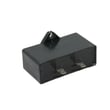
- Refrigerator capacitor W10613606 (start/run component that can affect compressor operation)
- Refrigerator compressor W10160407 (sealed-system component; typically a technician-level repair)
Why it matters
Cooling failures can be caused by simple maintenance issues. For this model, cleaning the condenser coil every 3 months helps prevent reduced cooling performance, higher energy use, and premature compressor failure.
Where to find model-specific steps
Use the owner's manual for the “Before calling for service” checks and the condenser coil cleaning procedure.
Last updated: February 2026