

How do I tell what model my Kenmore dryer is?
Your Kenmore dryer’s model number is printed on the appliance ID label; for Kenmore units it often starts with a 3-digit prefix such as 110. For your dryer, the model number you want to match when ordering parts is 11086872100.
Where to find the model number label
Check these common locations on Kenmore dryers:
- Inside the door opening on the front panel (most common)
- On the door frame or the cabinet lip around the opening
- On the back panel of the dryer cabinet
- Near the lint screen housing (some designs)
- On the side panel near the bottom edge (less common)
What to write down (and why)
Record the full model number exactly as shown, plus any extra identifiers on the label.
| What to capture | Example | Why it matters |
|---|---|---|
| Model number | 11086872100 | Ensures parts diagrams and fit are correct |
| Serial number | Varies | Helps date the unit and confirm production run |
| Type/fuel | Gas or electric | Prevents ordering the wrong heating parts |
Quick tips to avoid ordering the wrong part
Even one digit off can change the drum size, door style, or wiring.
- Match the model number character-for-character (no spaces)
- Use the full number, not just the “110” prefix
- If the label is worn, take a clear photo and zoom in
- Confirm the symptom before buying parts (start, heat, noise, door not closing)
- When the dryer will not start, common suspects include the door switch and drive system
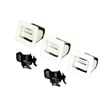
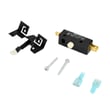
If your dryer will not start and the door feels “closed” but the dryer acts open, the dryer door switch W10820036 is a common wear item to check on Kenmore model 11086872100.
Why it matters
The model number ties your dryer to the correct parts list, including critical fit items like the drum belt, motor, and door components. Using the exact model number helps you avoid returns and gets your dryer repaired faster.
Last updated: February 2026
How to remove the front panel on a Kenmore dryer?
On Kenmore dryer model 11086872100, we remove the front panel by disconnecting power, releasing the top, removing the front-panel mounting screws (often inside the door opening and/or along the top edge), then lifting the panel up and off while supporting any connected wiring.
Before you start (safety and access)
- Unplug the dryer from the wall outlet.
- If it is a gas dryer, shut off the gas supply valve.
- Pull the dryer forward so you can reach the back and sides.
- Have a small container ready for screws.
- Take a quick photo of any wire connections before disconnecting them.
Typical front panel removal steps
- Release the top panel: Insert a putty knife a few inches in from each front corner to pop the spring clips, then lift the top.
- Remove screws in the door opening: Open the door and remove the screws that secure the front panel to the cabinet.
- Remove any top-edge screws: Some versions also have screws along the top edge of the front panel (visible with the top lifted).
- Disconnect wiring: If the door switch is mounted to the front panel, unplug the harness from the dryer door switch W10820036.
- Lift the front panel off: Tilt the panel forward slightly, then lift it up to unhook it from the lower retaining tabs.
What you can service once the front is off
Common repairs that require front access include:
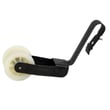
- Replacing a broken drum belt (belt 341241)
- Inspecting the idler and belt routing
- Checking the blower housing area for lint buildup
- Accessing the drum front support components
Quick reference: what you may see and what it means
| What you see | What it usually indicates | What to do next |
|---|---|---|
| Door switch wires attached to front panel | Front panel cannot fully come off yet | Unplug the door switch harness |
| Top won’t lift after using putty knife | Clips not fully released or screws still installed | Recheck clip locations and look for hidden screws |
| Panel feels “hung” at the bottom | Panel is still on lower tabs | Lift straight up, then pull forward |
Why it matters
Removing the front panel correctly prevents bent cabinet edges, broken plastic clips, and damaged wiring. It also gives you safe access to key wear parts like the drum belt, idler pulley, and door switch.
Last updated: February 2026
What size dryer is a Kenmore 11086872100?
The Kenmore dryer model 11086872100 is a full-size, 27-inch class dryer. For planning fit and load size, most Kenmore 110-series dryers use a standard full-size cabinet footprint and a large-capacity drum; confirm your exact clearances by measuring your unit and installation space.
What “size” means for this dryer
When customers ask about dryer size, it usually comes down to fit, not just drum volume.
- Cabinet width class (full-size is typically 27 inches wide)
- Overall depth (varies most by door style and vent hookup)
- Height (often around the upper-30-inch range)
- Drum capacity (full-size dryers are commonly in the larger-capacity range)
Typical planning ranges (use for space planning)
These are common ranges for full-size Kenmore 110-series dryers like model 11086872100; use them as planning guidance, then measure your dryer for exact numbers.
| Item to plan for | Typical full-size range | What to check at home |
|---|---|---|
| Width | ~27 in. | Measure side-to-side at the widest point |
| Height | ~38 to 40 in. | Measure floor to top of cabinet |
| Depth | ~29 to 33 in. | Include door and vent clearance |
| Capacity | Large-capacity class | Match washer load size and drying time |
How to measure correctly
- Measure width, height, and depth of the cabinet (not just the drum opening)
- Add at least a few inches behind the dryer for the vent and power cord
- Confirm door swing clearance so the door opens fully
- If the dryer is in an alcove, measure the opening at the narrowest point
Why it matters
Correct sizing prevents a crushed vent (poor airflow), a blocked door, or a dryer that cannot be leveled properly. Good airflow also protects heating components such as the thermal cut-off.
Parts that affect real-world “capacity” (drying performance)
Restricted airflow can make loads feel “too big” because drying slows down.
- Dryer lint chute assembly W11117429 (lint path restriction reduces airflow)
- Dryer blower wheel WP694089 (damaged wheel lowers air movement)
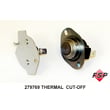
- Cut-off 279769 (opens if overheating occurs, often tied to airflow problems)
For a quick overview of dryer components and how they relate to capacity and airflow, use: what are the main parts of a clothes dryer.
Last updated: February 2026