Owner’s manual
 Error Codes


How do I know what model Kenmore refrigerator I have?
For Kenmore refrigerator model 79571023011, the model and serial number are printed on an identification label inside the fresh food (refrigerator) compartment; on this model, it’s located on the right-hand side of the refrigerator compartment. Use that exact model number to match the correct parts and manual.
Check these common label locations first (starting with the one confirmed for this model):
- Right-hand side wall of the refrigerator compartment (fresh food section)
- Side wall near the crisper drawers
- Ceiling area inside the refrigerator compartment
- Behind or beside a crisper drawer (you may need to slide the drawer out)
- Behind the lower kick plate or base cover area
After you locate the label, write down the full model number and serial number exactly as shown.
- Use the model number to pull up the correct diagrams and parts list for your refrigerator
- Use the serial number when you need production details or service history
- Keep a photo of the label on your phone for quick reference
- Store the information with your purchase paperwork
| What you’re looking for | What it’s used for | Tip |
|---|---|---|
| Model number (example: 79571023011) | Ensures correct parts fit and correct instructions | Match every digit; one missing digit can change parts |
| Serial number | Identifies the specific unit | Helpful when troubleshooting recurring issues |
Kenmore model numbers often look similar across different refrigerator styles. Using the exact model number prevents ordering the wrong door gasket, water inlet valve, or control board, and it ensures you’re following the right procedures in the 79571023011 owner's manual.
Once you confirm your model, you can confidently choose replacement parts that fit 79571023011, such as:
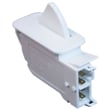
- Refrigerator door switch 6600JB1010A (door light and door-ajar sensing)
- Refrigerator door gasket MDS64172919 (helps prevent warm air leaks and frost)
- Refrigerator water tubing MJU62070602 (water supply routing for dispenser or ice maker)
If you’re ordering parts, start with the parts list for model 79571023011; for broader model searches, use Sears PartsDirect.
Last updated: February 2026
How to tell if a Kenmore refrigerator compressor is bad?
On your Kenmore 79571023011 bottom-mount refrigerator, a bad compressor usually shows up as poor cooling with the unit trying to run (often with repeated clicking) or running constantly without reaching temperature. Keep in mind that this model’s high-efficiency compressor can run longer than older refrigerators and still be normal.
We recommend ruling out common “looks like a compressor” issues first:
- Confirm the refrigerator has had up to 24 hours to cool after being plugged in or after major loading.
- Check that doors fully close and gaskets seal; warm air leaks can cause long run times.
- Listen for normal operating sounds (pulsating or high-pitched running sound can be normal on high-efficiency compressors).
- Clean dust from the condenser area; dirty coils can reduce cooling and increase run time.
- Verify the controls are set correctly and not in a special mode.
For model-specific operating notes and troubleshooting, use the 79571023011 owner's manual.
These symptoms, especially in combination, are the strongest indicators:
- Not cooling in both fresh food and freezer while the unit repeatedly tries to start.
- Clicking every few minutes (start attempt, then shutoff) with little or no sustained running.
- Compressor very hot to the touch after repeated start attempts (use caution).
- No steady hum/vibration from the compressor when cooling is demanded.
- Good airflow inside (evaporator fan running) but temperatures still climb.
| Check | What it tells you | Who should do it |
|---|---|---|
| Door seal and door closing | Air leaks can mimic sealed-system failures | DIY |
| Condenser cleaning | Heat rejection problems can mimic compressor weakness | DIY |
| Listen for start-click cycles | Suggests start device, control, or compressor issue | DIY |
| Electrical tests (amperage, winding continuity) | Confirms compressor and start circuit condition | Technician |
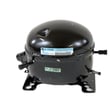
If testing confirms the compressor is failed, the replacement part for this model is the refrigerator compressor TCA36411702.
A compressor diagnosis affects cost and downtime. Many cooling complaints are caused by airflow restrictions, dirty condenser coils, or door sealing problems; fixing those restores normal temperatures without sealed-system work.
Last updated: February 2026
What are the most common problems with Kenmore refrigerators?
The most common problems we see on Kenmore refrigerators like model 79571023011 are weak or no cooling, ice maker and water dispenser issues, water leaks, doors not sealing or closing, and unusual noises. Many fixes start with cleaning, airflow checks, and basic adjustments in the owner's manual.
- Not cooling or warm temperatures: dirty condenser coils, blocked vents, incorrect control settings, or an evaporator fan issue.
- Ice maker not making ice: ice bin not seated or ice uneven in the bin, ice compartment door not fully closed, or water supply problems.
- Water leaking or puddles: clogged/iced drain path or a water line/tubing issue.
- Doors not closing or poor seal: refrigerator not level, bins or shelves out of position, food packages blocking the door, or sticky/worn gaskets.
- Compressor seems to run too much: warm room conditions, frequent door openings, adding a lot of food, or dirty condenser coils.
- Confirm temperatures and settings: verify the controls are set for normal household conditions.
- Clean the condenser area: dirty coils reduce heat transfer and make the compressor work harder.
- Check door closure: push doors firmly shut; make sure shelves, bins, and baskets are fully seated.
- Inspect gaskets: clean the gasket and the surface it touches; a thin coat of appliance polish or kitchen wax after cleaning can reduce sticking.
- Look for airflow blockage: avoid packing food tightly against vents.
| Symptom | Common part to check | Example part on this model page |
|---|---|---|
| Interior light issues or door-ajar behavior | Door switch | Refrigerator door switch 6600JB1010A |
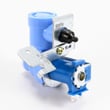
| Water dispenser/ice maker not filling | Water inlet valve, tubing | Lg refrigerator water inlet valve MJX41178908, refrigerator water tubing MJU62070602 |
| Warm fridge, noisy fan area | Evaporator fan motor/blade | Refrigerator evaporator fan motor 4681JB1027C |
| Frost, moisture, or poor door seal | Door gasket | Refrigerator door gasket MDS64172919 |
Catching airflow, coil, and door-seal problems early helps your refrigerator hold temperature, reduces run time, and prevents secondary issues like frost buildup, leaks, and ice maker performance problems.
For model-specific operating, cleaning, and troubleshooting steps (including door alignment and coil cleaning guidance), use the owner's manual. For replacement parts beyond the list shown for this model, search by model number on Sears PartsDirect.
Last updated: February 2026
Why is there ice on the bottom of my freezer side by side?
Ice building up on the freezer floor is almost always caused by a defrost drain problem: meltwater from the defrost cycle cannot flow to the drain pan, so it refreezes at the bottom. On Kenmore model 79571023011, clearing the drain path and drain tube typically fixes it; see the 79571023011 owner's manual for safety and access guidance.
Most cases come down to one of these issues:
- The defrost drain hole is blocked by ice or debris
- The drain tube is restricted, so water backs up and refreezes
- The freezer door is not sealing well, adding humidity that turns into frost and ice
- The refrigerator is not level, so water does not flow correctly toward the drain
We recommend this approach because it addresses the most common root cause first.
- Unplug the refrigerator before working in the freezer
- Remove the lower freezer basket/drawer to access the floor area
- Melt the ice buildup with warm water (never use sharp tools)
- Flush the drain with hot water; a small amount of baking soda dissolved in hot water helps break up residue
- Confirm water flows freely to the drain pan underneath
If the drain tube is cracked, loose, or repeatedly clogs, replacing the drain tube is a reliable long-term repair; the refrigerator drain tube 5251JA3003D is a listed match for this model.
If you clear the drain and ice returns quickly, warm humid air is likely getting in.
- Inspect the gasket for gaps, tears, or hardened sections
- Clean the gasket and the cabinet sealing surface
- Make sure drawers and baskets are not preventing the door from closing
| Symptom | More likely cause | What you will notice |
|---|---|---|
| Sheet of ice on freezer floor | Clogged drain | Water/ice concentrated at the bottom |
| Frost on packages and walls | Door not sealing or frequent openings | Frost crystals on food and liners |
| Puddle under refrigerator | Drain overflow | Water near front or under unit |
A blocked defrost drain can lead to recurring ice buildup, poor airflow, and temperature swings. Fixing the drain early helps protect food quality and reduces strain on the cooling system.
For ordering model-correct replacement parts, use the parts list for 79571023011 or search by model on Sears PartsDirect.
Last updated: February 2026