Owner’s manual



What are the common issues with Chamberlain 1265LM?
The most common issues we see with the Chamberlain 1265LM garage door opener are safety reversing sensor (Protector System) alignment or wiring problems, remote or wall control issues, and travel/force settings that make the door stop or reverse. Start by checking the sensors first because the door will not close if they are not connected and aligned (see the 1265LM owner's manual).
Most common problems (and what they look like)
- Safety reversing sensors (Protector System) misaligned or blocked: door starts down then reverses, or will not close at all.
- Sensor wiring issues: intermittent closing, sensor lights not steady, opener behaves inconsistently.
- Remote control or keypad problems: no response, short range, works only sometimes (often battery or programming related).
- Wall control issues: door works from remote but not from the wall button (or vice versa).
- Travel limit or force setting out of adjustment: door does not open fully, closes then reverses, or stops mid-travel.
- Noisy operation: chain slack (some slack is normal when the door is closed), worn door hardware, or dry rollers/hinges.
Quick checks we recommend (in order)
- Clear and align the safety sensors: make sure both sensor lenses are clean and aimed at each other.
- Verify the sensors are connected: the 1265LM relies on the Protector System to close the door.
- Try the wall control: if the wall control works but remotes do not, focus on remote batteries and programming.
- Check travel and force settings: adjust only in small increments and retest.
- Inspect the door itself: a binding door can mimic opener problems.
Symptom-to-cause guide
| Symptom | Most likely cause | Best first step |
|---|---|---|
| Door will not close | Protector System not aligned/connected | Align sensors and check wiring |
| Door reverses while closing | Travel/force setting or door binding | Check door movement by hand, then adjust |
| Remote works only up close | Battery, interference, or remote wear | Replace battery, reprogram |
| Opener hums but door does not move | Door jam or internal drive issue | Disengage trolley and test door balance |
Why it matters
On the 1265LM, the safety reverse system is a core safety feature; if the Protector System is not connected and properly aligned, the opener is designed to prevent closing. Fixing sensor alignment and basic adjustments often restores normal operation without replacing major components.
Helpful troubleshooting resources
- Use the Chamberlain error codes guide to interpret flashing-light patterns and narrow the fault quickly.
Last updated: February 2026
Are 1265LM and Chamberlain parts interchangeable?
Yes. Your Chamberlain 1265LM is a Chamberlain-built garage door opener, so many replacement parts that fit Chamberlain openers of the same design family are interchangeable. The safest way to confirm a match is to cross-check the part name and model compatibility in the owner's manual.
What is usually interchangeable (and what is not)
Parts interchangeability depends on the opener’s drive type, wiring style, and control board generation. In practice, these items are commonly compatible across closely related Chamberlain-built models:
- Remote controls and keyless entry pads (when they use the same “learn”/radio system)
- Safety sensor sets (photo eyes) and sensor wiring
- Wall control stations (only when the connector type and logic board support match)
- Gear and sprocket style drive components (when the rail and drive system are the same)
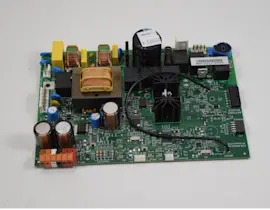
- Logic/control boards (only when the board revision and connector layout match)
Quick compatibility checklist for 1265LM
Use this checklist before ordering any garage door opener parts:
- Confirm the exact model number on the opener’s front panel label (1265LM)
- Identify the drive type (chain vs belt) and rail style
- Compare wire terminals and plug connectors (especially for wall control and sensors)
- Match the part description to the symptom (for example, “won’t close” often points to sensors)
- Verify any programming steps after replacement (remotes, travel limits, force settings)
Common “mix-and-match” scenarios
| Scenario | Usually works? | What to verify first |
|---|---|---|
| Chamberlain remote on a Chamberlain-built opener | Often | Learn button/radio type and programming steps |
| Safety sensors between similar models | Often | Sensor style, alignment, and wiring |
| Wall control swap | Sometimes | Connector type and control board support |
| Logic board swap | Sometimes | Board revision, terminals, and feature set |
Why it matters
Using a part that is close but not truly compatible can cause issues like a door that will not close unless the Protector System is aligned and connected, intermittent remote operation, or incorrect travel/force behavior. The Chamberlain error codes guide helps narrow the failure to the right system before you buy parts.
Last updated: February 2026
Is it cheaper to repair or replace a garage door opener?
Repairing a Chamberlain 1265LM garage door opener is usually cheaper when the problem is isolated (safety sensor alignment, wall control, remote programming, light not working). Replacing the opener is the better value when the unit is older, has repeated failures, or needs major internal repairs plus setup and safety testing (see the owner's manual).
Quick decision guide (repair vs replace)
Use these checkpoints to decide fast:
- Repair when the door is fine and the opener issue is simple (sensor blocked, travel/force needs adjustment, light bulb issue).
- Repair when the opener runs but reverses or stops and the fix is adjustment, alignment, or wiring.
- Replace when the opener motor hums and will not run repeatedly, or the unit has frequent breakdowns.
- Replace when parts and labor approach the cost of a new opener, especially if multiple components are failing.
- Replace when you want newer convenience features (for example, smart controls or battery backup).
Typical cost comparison (what most homeowners see)
Costs vary by region and door size, but these ranges are common.
| Option | Typical total cost | Best for |
|---|---|---|
| Minor repair/adjustment | $100 to $250 | Sensors, force/travel settings, wall control issues |
| Moderate repair | $200 to $500 | Electrical troubleshooting, worn components, repeated service calls |
| Replace opener (unit + install) | $350 to $1,000+ | Older openers, major failures, feature upgrades |
Model-specific checks that often point to a repair
The 1265LM manual highlights a few issues that are commonly fixable without replacing the opener:
- Door reverses and opener lights blink: check for an obstruction and align the safety reversing sensors.
- Opener lights do not turn on: replace the bulb (75 watts maximum).
- Opener strains or needs maximum force: test door balance by disconnecting the trolley and moving the door by hand; do not increase force to compensate.
- Occasional force/travel changes: normal over time; weather can affect travel and may require adjustment.
For step-by-step troubleshooting patterns and light blink meanings, use Chamberlain error codes.
Why it matters (safety and long-term cost)
A garage door opener depends on a properly balanced door and a working safety reversal system. After any force or travel adjustment, the safety reversal system needs to be tested so the door reverses on contact with a 1-inch object (or a 2x4 laid flat). A “cheap” fix that skips testing can create repeat problems and safety risks.
Last updated: February 2026