 Owner’s manual
 Error Codes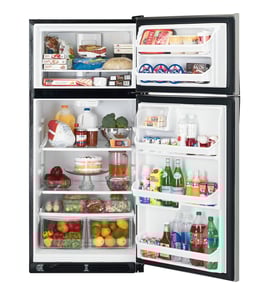


What are the most common problems with Kenmore refrigerators?
The most common problems we see with Kenmore refrigerators like model 11161212611 are cooling issues, water leaks, ice maker troubles, frost buildup, and unusual noises. Many are caused by airflow restrictions, dirty condenser coils, a failing evaporator fan, or door seal problems; use the owner's manual for model-specific checks and safety notes.
Common symptoms and what they usually point to
- Not cooling or weak cooling: dirty condenser coils, blocked air vents, evaporator fan not running
- Freezer cold but fridge warm: airflow damper issue, iced-over evaporator, fan problem
- Water under the fridge or inside compartments: clogged/iced defrost drain, loose water line (if equipped)
- Frost buildup: door left ajar, torn/warped door gasket, defrost system issue
- Noisy operation: fan blade hitting ice, worn fan motor, items vibrating on cabinet
Quick DIY checks we recommend first
- Confirm temperatures: set fridge to about 37°F and freezer to about 0°F.
- Check airflow: make sure packages are not blocking vents in the refrigerator or freezer.
- Clean condenser coils (if accessible): dust buildup commonly causes warm temps and long run times.
- Inspect door seals: close a sheet of paper in the door; if it slips easily, the gasket may not be sealing.
- Listen for fans: you should typically hear a steady fan sound when the compressor is running.
Safety note for service and defrosting
This model uses flammable refrigerant (R600a). We recommend following the safety guidance in the owner's manual, including avoiding puncturing refrigerant tubing and not using mechanical devices to speed up defrosting.
Helpful guide if you see an error code
If your display shows an error code, use our Kenmore 111 model top freezer refrigerator error codes guide to match the code to likely causes and next steps.
What’s “normal” vs. a sign you need repair
| What you notice | Often normal | Often needs attention |
|---|---|---|
| Short buzzing/clicking | Ice maker cycling, relay click | Repeating loud clicks with no cooling |
| Light frost on walls | After door openings | Heavy frost blocking vents |
| Water drops | Occasional after defrost | Puddles, recurring leaks |
Why it matters
Cooling, airflow, and sealing problems can raise food temperatures, increase energy use, and create ice or water buildup that leads to bigger failures (fans icing over, drain freezing, or extended compressor run time).
Last updated: February 2026
What water filter fits my Kenmore fridge?
For Kenmore refrigerator model 11161212611, the correct water filter is the one specified for that exact model in the product documentation and parts list. Use your model number to match the filter style and connection type, then replace it on schedule to keep water flow and taste normal.
How to identify the right filter for model 11161212611
- Confirm the model number on the rating label inside the fresh food compartment: 11161212611.
- Check the filter location (inside compartment, base grille, or inline on the water line).
- Match the filter by shape and locking method (push-in, quarter-turn, or twist-lock).
- Match the water line connection if it uses an inline filter.
- Use the filter part information listed in the 11161212611 owner's manual.
Replacement timing and what to expect
Most refrigerator water filters are replaced about every 6 months, or sooner if water flow slows or taste and odor return.
Common signs it is time to replace:
- Slower dispenser flow
- Cloudy ice or smaller cubes
- Off taste or odor
- Filter indicator light (if your refrigerator has one)
Quick troubleshooting if the new filter does not work
| Symptom | Most common cause | What we do next |
|---|---|---|
| No water after replacement | Air trapped or filter not fully seated | Reinstall and fully lock the filter; dispense several cups of water |
| Leaking at filter | O-ring not seated or housing not aligned | Remove, inspect O-rings, reinstall straight |
| Low flow | Clogged filter or low supply pressure | Replace filter if old; verify household water supply is fully on |
Why it matters
Using the correct filter for Kenmore 11161212611 protects the water system from leaks and poor flow, and it helps maintain better-tasting water and ice.
For step-by-step filter guidance and filter type basics, use how to replace the water filter in a Kenmore refrigerator.
Last updated: February 2026
Which is better, top mount or bottom mount refrigerator?
A top-mount (top-freezer) refrigerator like Kenmore model 11161212611 is the better pick when you want a simpler, typically lower-cost design with easy freezer access. A bottom-mount is better when you want fresh-food items at eye level and less bending for everyday use.
Quick comparison
| Feature | Top mount (freezer on top) | Bottom mount (freezer on bottom) |
|---|---|---|
| Most convenient access | Freezer | Fresh food |
| Typical price | Lower | Higher |
| Layout and serviceability | Simpler, fewer drawer/rail parts | More drawers/rails, more parts to maintain |
| Best fit for | Budget, reliability, smaller kitchens | Convenience, organization, frequent fridge use |
How we recommend choosing
- Pick top mount if you want a straightforward layout and you use the freezer often.
- Pick bottom mount if you reach into the refrigerator section many times per day.
- Choose based on who uses it most; bending and reach height matter for comfort.
- Measure your kitchen clearances (door swing, depth, and height) before deciding.
- Consider organization style; bottom mounts usually offer more freezer drawer organization.
Model-specific notes for Kenmore 11161212611
Your 11161212611 is a top-mount design, so it naturally favors freezer access and a simpler internal layout. For the exact specifications for your unit (capacity, dimensions, electrical rating, and safety information), use the 11161212611 owner's manual.
Why it matters
The “better” style is the one that matches your daily habits. The wrong layout can mean constant bending, awkward reach, and less usable storage for the foods you buy most.
Last updated: February 2026
How to tell cubic feet of Kenmore refrigerator by model number?
For Kenmore model 11161212611, the capacity is listed as 14.2 cu. ft. in the specifications section of the 11161212611 owner's manual. The most reliable way to confirm cubic feet is to match the model number on the rating label to the spec line that shows “cu ft”.
Fastest way: check the rating label
The rating label ties the model number to the official capacity.
- Open the fresh food (refrigerator) compartment
- Look on an inside side wall, near the crisper area, or behind a drawer
- Confirm the model number reads 11161212611
- Find the line that shows “cu ft” or “capacity”
- Take a clear photo so you can zoom in and read it accurately
Confirm in the manual (specs)
We use the manual specs because they are the manufacturer-provided capacity for this exact model.
| Spec item | What to look for |
|---|---|
| Model number | 11161212611 |
| Refrigerator type | Top-mount (top freezer) |
| Capacity | 14.2 cu. ft. |
If the label is missing: estimate cubic feet by measuring
This gives a close estimate of interior volume; usable space is always less because of shelves, ducts, and the light housing.
- Measure interior width, height, and depth (in inches)
- Multiply:
W x H x Dto get cubic inches - Divide by 1728 to convert to cubic feet
- Measure the freezer and fresh food sections separately, then add them
Why it matters
Cubic feet helps us confirm you are comparing the right refrigerator size and can also help when matching fit-related items like shelves and door bins for Kenmore top-mount refrigerators.
Last updated: February 2026
How to tell what model Kenmore refrigerator?
Your Kenmore refrigerator’s model number is printed on the appliance ID label; for Kenmore model 11161212611, use that exact number to match the correct parts diagrams, specifications, and troubleshooting information in the 11161212611 owner’s manual.
Where to find the model and serial label
Check these common label locations first:
- Inside the fresh food (refrigerator) compartment on a side wall near the crisper drawers
- Inside the fresh food compartment on the ceiling or upper side wall
- Along the door frame perimeter (visible when the door is open)
- Behind or just above the lower front toe grille or kick plate
- On the back exterior panel near the bottom
What to write down (and why)
Record the information exactly as shown on the label.
- Model number (example: 11161212611) for parts compatibility
- Serial number for build-specific variations
- Electrical ratings (voltage/amps/watts) for service checks
Quick checklist
| Label item | What it’s used for | Tip |
|---|---|---|
| Model number | Matching parts and diagrams | Copy every digit exactly |
| Serial number | Identifying production run details | Take a clear photo |
| Ratings | Troubleshooting and safe servicing | Note watts/amps if listed |
Why it matters
Kenmore model numbers prevent wrong-part orders and speed up troubleshooting. For example, Kenmore “111” series refrigerators can have different shelves, door bins, or optional ice maker configurations even when they look similar.
Safety when checking behind panels
If you need to remove the toe grille or look behind the unit:
- Unplug the refrigerator before removing panels
- Move the refrigerator carefully to avoid damaging the floor and water line (if equipped)
- Do not puncture or bend sealed refrigerant tubing
Last updated: February 2026





