Error Codes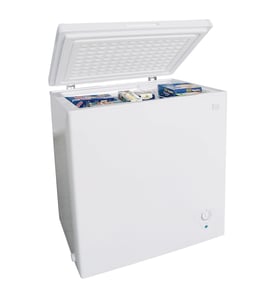



How do I reset a chest freezer?
To reset your Kenmore chest freezer model 2539137180, unplug it (or switch off the breaker) for about 30 seconds, then restore power and let it run. If lights keep blinking or it still will not cool after a few hours, focus on power and temperature control checks.
Quick reset steps
- Unplug the freezer from the wall outlet.
- Wait 30 seconds (this clears many control and compressor start conditions).
- Plug it back in.
- Set the temperature control to a mid-range setting.
- Allow 4 to 24 hours for temperatures to stabilize after a reset.
What to check if it still will not run or cool
- Outlet power: Test the outlet with a lamp or small appliance.
- Breaker/GFCI: Reset the tripped breaker or GFCI outlet.
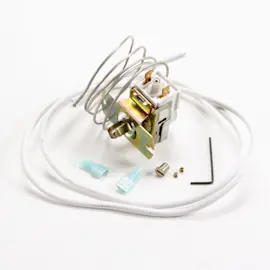
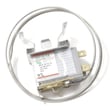
- Temperature control: If the control is not closing the circuit, the compressor may never start; the thermostat 5304496560 is the common control part tied to this symptom.
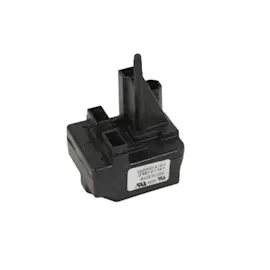
- Compressor start issues: A failed start component can prevent starting or cause repeated clicking.
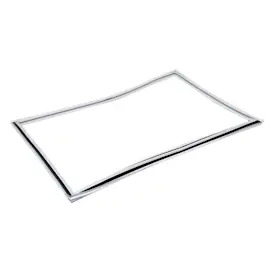
- Lid seal and loading: A poor seal or warm, overpacked contents can make it seem like the reset did not work.
Symptom guide after a reset
| What you notice | What it usually means | What we recommend |
|---|---|---|
| Runs quietly, no clicking | Normal operation | Wait 4 to 24 hours for full pull-down |
| Clicking every few minutes | Start problem or low voltage | Check outlet voltage; consider service |
| Lights blink but cooling is weak | Control or sealed-system issue | Verify settings; check thermostat 5304496560 |
| No sound at all | No power or open control circuit | Check outlet, cord, and control |
Why it matters
A reset restores power to the compressor circuit and can clear temporary lockups. If the freezer immediately returns to blinking lights, clicking, or no cooling, the issue is usually electrical (power supply, thermostat) or a compressor start condition that needs diagnosis.
Last updated: January 2026
How many cubic feet is Kenmore freezer Model 2539137180?
We size Kenmore chest freezer model 2539137180 by its interior storage volume (cubic feet). For this specific model, the exact cubic-foot capacity is typically listed on the model and serial tag or the original product specifications; use the tag information to match the correct capacity for your unit.
Where to find the cubic-foot capacity
Check these common locations on a Kenmore chest freezer:
- The model and serial tag inside the cabinet (often on an inner wall)
- The rating label near the lid opening
- The original sales/spec sheet for model 2539137180
- The product packaging or owner paperwork (if you still have it)
If the label is worn or missing, we recommend confirming the model number first using how to find your appliance model number (and what it means for parts).
Quick way to estimate capacity (if you need a ballpark)
If you need an estimate while you confirm the label, most chest freezers fall into these common ranges:
| Chest freezer size class | Typical capacity range |
|---|---|
| Compact | 5 to 9 cu. ft. |
| Medium | 10 to 16 cu. ft. |
| Large | 17 to 25 cu. ft. |
A rough estimate can be made by measuring the interior (in inches) and using:
- (Length x Width x Height) / 1728 = cubic feet
Why it matters
Capacity affects how you organize food, how long it takes to pull down to temperature after loading, and which accessories fit best (like baskets). If you are replacing storage hardware, matching the model helps ensure fit.
Parts that often relate to storage and organization
- Basket 216848200 (helps organize smaller items)
- Lid hardware and latch components if the lid does not close smoothly
- Temperature control parts if the freezer will not hold set temperature
Last updated: January 2026
What are the most common issues with 2539137180?
The most common issues we see with the Kenmore 2539137180 chest freezer are temperature control problems (too warm or too cold), lid sealing and latch issues that let warm air in, and power or start problems that stop the compressor from running. Many of these symptoms trace back to the thermostat, door hardware, or wiring connections.
Common symptoms and what they usually point to
- Freezer not cold enough: thermostat out of calibration, lid not sealing, frequent lid openings, heavy frost buildup
- Freezer too cold or freezing everything solid: thermostat contacts sticking closed
- Compressor won’t start or clicks: start components or electrical supply issue; sometimes a weak capacitor
- No power at all: outlet/cord issue, damaged wiring, loose connections
- Lid won’t stay shut or won’t lock: worn latch/lock parts, misaligned lid, damaged handle
Parts that commonly solve these problems
If your symptoms match, these model-specific parts are common fixes for the 2539137180:
- Temperature control: thermostat 5304496560
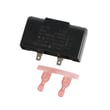
- Compressor start/run help: capacitor 5304464438
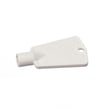
- Lid closure and security: lock 5303925134, latch catch 216117701, handle (almond) 216204801, key 297147700
- Electrical connection issues: plug 5303208663, hrnss pwr cr 216149300
Quick checks we recommend before replacing parts
- Confirm the freezer is on a dedicated, working outlet and the plug fits tightly.
- Set the control to a colder setting and wait 24 hours for temperature to stabilize.
- Check the lid gasket area for gaps, debris, or ice preventing a full seal.
- Listen for repeated clicking or humming (often points to start/capacitor issues).
- Inspect visible wiring for damage and tight connections (unplug first).
Symptom-to-part cheat sheet
| Symptom | Most likely area | Part to consider |
|---|---|---|
| Too warm | Temperature control or air leaks | Thermostat 5304496560, latch catch 216117701 |
| Too cold | Temperature control | Thermostat 5304496560 |
| Clicks, won’t start | Start/run electrical | Capacitor 5304464438 |
| Lid won’t secure | Hardware | Lock 5303925134, handle (almond) 216204801 |
Why it matters
Chest freezers rely on a tight lid seal and stable thermostat control; small air leaks or a drifting control can cause long run times, food thawing, or excessive frost that reduces efficiency.
Last updated: March 2026