Installation guide
 Owner’s manual
 Error Codes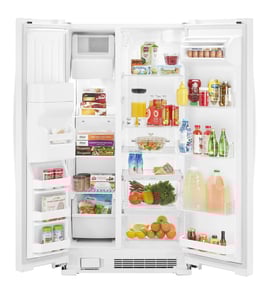
Does KitchenAid make a 33 inch wide refrigerator?
Yes. KitchenAid makes 33-inch-wide refrigerators, including several 33-inch full-depth models. Your KitchenAid KSCK25FVMS00 is a side-by-side refrigerator model; for exact cabinet width and clearance requirements, use the measurements and installation notes in the installation guide.
How to confirm “33-inch wide” for your space
Refrigerator width can be listed as a nominal size (marketed width) while the actual cabinet width and required clearances are slightly different. We recommend checking:
- Cabinet width (case width, not including handles)
- Door swing clearance (especially on a side-by-side)
- Hinge-side clearance (to fully open doors and remove bins)
- Depth with doors and handles (for walkway and counter alignment)
- Water line routing space (if you use the dispenser or ice maker)
Typical sizing: nominal vs. actual
Most “33-inch” refrigerators are designed to fit a 33-inch opening, but they often need a little extra room for airflow and door swing.
| What you’re measuring | What it means | What to expect |
|---|---|---|
| Nominal width | The marketed size class | Listed as 33 inches |
| Cabinet width | The actual box width | Usually just under 33 inches |
| Required opening | Space needed to install and operate | Often 33 inches plus clearance |
Why it matters
If the opening is tight, a refrigerator can rub cabinets, doors may not open fully, and airflow can be restricted. That can lead to warmer temps, more run time, and faster wear on sealed system components like the compressor and evaporator.
Related parts and setup tips for KSCK25FVMS00
If you are installing or moving this refrigerator, these model-matched parts are commonly involved in water and ice setup:
- Refrigerator water filter EDR3RXD1 (filter replacement after installation or water line work)
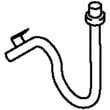
- Refrigerator water tube 8201597 (if the supply line or internal tubing is damaged)
- Refrigerator ice maker 2198597 (if the unit is missing an ice maker or needs replacement)
Last updated: February 2026
How to adjust temperature on KitchenAid side by side refrigerator?
On your KitchenAid KSCK25FVMS00 side-by-side refrigerator, you adjust temperatures from the dispenser control panel by entering “adjust mode,” then raising or lowering the refrigerator and freezer set points. Factory recommended settings are 37°F (refrigerator) and 0°F (freezer); see the steps in the owner's manual.
Steps to change the refrigerator and freezer set points
- If the display backlight is off, press any button once to wake it up (the first press only turns on the backlight).
- Press and hold COOLING for 3 seconds to enter adjust mode.
- Adjust the refrigerator set point:
- Press LOCK to lower the set point (colder).
- Press OPTIONS to raise the set point (warmer).
- Adjust the freezer set point:
- Press ICE to lower the set point (colder).
- Press LIGHT to raise the set point (warmer).
- Press COOLING to exit adjust mode, or wait about 15 seconds and it will exit automatically.
Temperature ranges (what you can set)
| Compartment | Set point range | Factory recommended |
|---|---|---|
| Refrigerator | 33°F to 45°F | 37°F |
| Freezer | -5°F to 5°F | 0°F |
Before you change settings (quick checks)
- Wait 24 hours after installation before loading food so temperatures can stabilize.
- If temps seem off, check that air vents are not blocked before adjusting controls.
- Make changes in small steps (about 1 degree at a time), then give the unit time to respond.
- Setting colder than recommended will not cool faster.
- If food is freezing in drawers/bins, use the drawer/door air controls to reduce cold airflow to those areas.
Why it matters
Correct set points help keep milk and juice as cold as you like and keep ice cream firm without over-freezing foods. Small, measured adjustments also prevent temperature swings that can lead to spoilage or frost issues.
Last updated: February 2026
What causes a KitchenAid refrigerator to stop cooling?
A KitchenAid KSCK25FVMS00 side-by-side refrigerator usually stops cooling because airflow or heat removal is compromised (dirty condenser coils, blocked vents, or a failed evaporator fan), or because a control or sealed-system component is not operating correctly. Start with power, control settings, and airflow checks before replacing parts.
Quick checks we recommend first
- Confirm the refrigerator is plugged into a grounded 3-prong outlet and the outlet has power.
- Make sure the temperature controls are turned on and set correctly.
- If it was just installed or moved, allow a full 24 hours to reach normal temperatures.
- Clean condenser coils (dust buildup makes it hard to shed heat).
- Check that air vents inside both compartments are not blocked by food packages.
- Verify both doors close fully and the gaskets seal all the way around.
Common causes and what you will notice
| Likely cause | Typical symptoms | What to do next |
|---|---|---|
| Dirty condenser coils | Warm temps, compressor runs a lot | Clean coils and recheck temps after several hours |
| Evaporator fan issue | Freezer cold but fridge warm, weak airflow | Inspect fan area for ice buildup; troubleshoot fan |
| Defrost problem (ice buildup on evaporator) | Frost on back wall of freezer, reduced airflow | Defrost and diagnose defrost components |
| Control problem | Temps drift, fan/compressor behavior seems abnormal | Check wiring connections; consider control diagnostics |
| Sealed-system issue (compressor, evaporator, dryer) | Poor cooling in both sections, long run times | Professional sealed-system diagnosis is typically needed |
Parts that are often involved (when symptoms match)
If your symptoms point to a specific failure, these model-compatible parts are commonly involved:
- Refrigerator evaporator fan blade WP2169142 (air movement across the evaporator)
- Refrigerator electronic control W11629974 (manages cooling functions)
- Refrigerator compressor W10276644 (sealed-system component)
- Drier tube WPW10143759 (sealed-system component)
- Refrigerator evaporator WP2188823 (sealed-system component)
Why it matters
Cooling problems are often airflow-related, and those are the fastest to fix (coils, vents, fan, defrost ice). Ruling out simple airflow and control-setting issues first helps avoid unnecessary parts replacement and gets temperatures back to safe food-storage ranges sooner.
Helpful DIY guidance
- Use our step-by-step article: how to fix your evaporator cooling fan
- For model-specific operating and troubleshooting steps, follow the owner's manual
Last updated: February 2026
Why is my KitchenAid side by side refrigerator leaking water?
Water leaks on a KitchenAid KSCK25FVMS00 side-by-side refrigerator usually come from a clogged or frozen defrost drain, a dispenser that was not fully flushed after a filter change, or a water filter that is loose or installed incorrectly. Use the checks below, then confirm model-specific steps in the owner's manual.
Quick checks (most common causes)
- Look for a clogged or frozen defrost drain: water can back up and spill into the fresh food section or onto the floor.
- Check the water filter seating: a filter that is cross-threaded, not fully locked, or clogged can cause dripping or spurting at the dispenser.
- Flush the water system after filter changes: trapped air can cause splashing and “leaks” at the dispenser.
- Inspect the water line path: tubing can weep at a connection or rub and develop a pinhole.
- Check door closure and gasket condition: poor sealing can increase frost, which can contribute to drain icing.
Where the water is leaking matters
| Leak location | Most likely cause | What to do first |
|---|---|---|
| Under crisper or inside fridge | Defrost drain clogged or frozen | Clear ice/debris; verify drain pan flow |
| From dispenser area | Filter not seated, system not flushed, or glass not held long enough | Reseat filter; flush several gallons |
| Behind unit or under back | Water tube/connection seep, or supply line issue | Inspect tubing and fittings for moisture |
Step-by-step: dispenser and filter leak checks
- Remove and reinstall the filter so it fully seats and locks.
- Dispense water for several minutes total to purge air (especially after a new filter).
- If dripping continues, replace the filter with the correct one for this model: refrigerator water filter EDR3RXD1.
- If you have a reverse osmosis system, confirm it meets the refrigerator’s water supply requirements in the manual.
Step-by-step: defrost drain leak checks
- Unplug the refrigerator.
- Remove items near the bottom of the fresh food section and look for ice or standing water.
- Melt any visible ice with warm (not boiling) water and clear debris.
- Verify water can flow to the drain pan underneath.
Why it matters
A small leak can quickly turn into floor damage, ice buildup, and poor cooling. Fixing the source early also helps your ice maker and water dispenser work consistently.
Last updated: February 2026