Installation guide
 Owner’s manual
 Error Codes


What are signs of a bad dryer heating element?
On the Kenmore dryer model 11064992301, the most common sign of a bad heating element is that the dryer runs and tumbles normally but produces little to no heat, so clothes stay damp or take much longer to dry. A hot, “electrical” odor or repeated breaker trips can also point to a heating problem.
- Dryer tumbles but there is no heat on heated cycles
- Dry times suddenly get much longer (even with a clean lint screen)
- Heat is inconsistent (warm sometimes, cool other times)
- A burning smell during normal use (not just first-time use)
- The dryer’s breaker trips or a fuse blows during heating
Our installation checks for this style of electric dryer are a good first step:
- Make sure you are using a heated cycle, not an air/no-heat cycle
- Confirm the dryer is plugged into a grounded outlet and power is on
- Check for two fuses or two circuit breakers; both must be on for full heat
- After about 5 minutes on a full heat cycle, open the door and feel for heat
- If there is still no heat after power checks, stop and move to component testing
For cycle selection and care guidance, follow the 11064992301 owner’s manual.
| What you see | More likely cause | What to check next |
|---|---|---|
| Tumbles, no heat | Power supply issue (one leg out) | Both breakers/fuses, terminal connections |
| Tumbles, no heat | Thermal cut-off or high-limit issue | Overheating from restricted venting |
| Tumbles, weak heat | Airflow restriction | Lint screen, vent duct, outside hood |
| Tumbles, no heat | Heating element failure | Element continuity, visible coil damage |
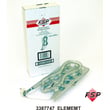
If you determine the element is failed, the correct replacement for this model is the dryer heating element WP3387747.
Running with low or no heat wastes energy and can mask airflow problems that overheat the heater circuit. Restoring proper heat and airflow helps protect components like the thermistor, thermal cut-off, and wiring.
Last updated: January 2026
How to tell if a dryer switch is bad?
On Kenmore dryer model 11064992301, a bad switch is usually confirmed when the dryer will not start even though power is available and the door is fully closed. We verify the switch by unplugging the dryer and checking the switch for continuity with a multimeter.
Many “bad switch” symptoms are actually power or control setup issues. Before you open the console, confirm these basics:
- The dryer is plugged into a grounded outlet and power is on.
- A cycle is selected and the control is in a running position.
- The PUSH TO START button is pressed firmly.
- The door is fully closed (a door switch issue can mimic a start switch problem).
- House fuses are good; many electric dryers use two fuses or breakers.
For model-specific operating steps and control descriptions, use the 11064992301 owner's manual.
Safety first: unplug the dryer (or shut off the breaker) before accessing wiring.
- Disconnect power.
- Access the switch (start switch or door switch, depending on what you are testing).
- Pull the wires off the switch terminals (note positions or take a photo).
- Set your multimeter to continuity or lowest ohms.
- Test the switch:
- Not pressed / OFF: should read open (no continuity).
- Pressed / ON: should read closed (continuity, near 0 ohms).
| Test result | What it usually indicates | Next step |
|---|---|---|
| Always open | Switch contacts not closing | Replace the switch |
| Always closed | Switch contacts stuck closed | Replace the switch |
| Changes correctly | Switch is likely OK | Check power, timer/control, motor circuit |
If the switch tests good, these are common next suspects on a Kenmore dryer:
- Door switch (door not registering as closed)
- Timer contacts (cycle not sending power to the motor)
- Drive motor circuit issues
- Loose wire connection at the terminal block (power supply)
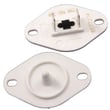
If the door is not consistently “clicking” closed, inspect the latch/strike; the strike 279570 is a common wear item.
A failed start or door switch prevents the motor circuit from energizing, so the dryer will appear completely dead even when the outlet has power. Confirming continuity avoids replacing good parts and speeds up the repair.
Last updated: January 2026
Can I replace a dryer heating element myself?
Yes. On Kenmore dryer model 11064992301, replacing the heating element is a common DIY repair if you’re comfortable using basic hand tools and following safety steps. The key is disconnecting power, documenting wire locations, and reassembling the heater housing exactly as it was.
- Unplug the dryer (or switch off the breaker) before servicing.
- Confirm the dryer is fully de-energized before touching wiring.
- Let the dryer cool completely if it was recently running.
- Take a clear photo of every wire connection before you remove it.
- Avoid bending or damaging the heater housing and nearby ducts.
For model-specific safety and service guidance, follow the 11064992301 owner's manual.
Most electric dryers like this Kenmore use a heater assembly that can be removed and swapped without special tools.
- Remove the appropriate access panel to reach the heater housing.
- Label and disconnect wires from the heater terminals.
- Remove mounting screws and slide out the heater assembly.
- Transfer any sensors mounted to the housing (if present) to the replacement assembly.
- Reinstall the assembly, reconnect wires, and reassemble panels.
A common replacement part for this model is the dryer heating element WP3387747.
After reassembly, we recommend verifying basic operation before running a full load.
| Check | What you should see | If not |
|---|---|---|
| Drum runs | Motor turns and drum tumbles | Recheck door closure and wiring connections |
| Heat present | Warm air within about 5 minutes | Check both breakers/fuses and heater circuit parts |
| Airflow | Strong airflow at the outside vent hood | Clean/repair venting restrictions |
A failed heating element is a top cause of “dryer runs but won’t heat,” but restricted airflow can also cause overheating and repeat heat failures. Keeping the lint screen and exhaust vent clear helps the new element last.
Last updated: January 2026
How to hard reset a Kenmore dryer?
To hard reset your Kenmore dryer model 11064992301, unplug the power cord (or switch the breaker off) for 1 to 5 minutes, then restore power and try a cycle again. If it still will not run, the issue is usually power supply, door switch, or airflow related, not a reset.
- Turn the Cycle Selector to OFF.
- Unplug the dryer (or turn both dryer breakers off, if applicable).
- Wait 1 to 5 minutes.
- Restore power.
- Close the door firmly.
- Select a cycle and press PUSH TO START.
For control and cycle details specific to this dryer, use the 11064992301 owner's manual.
The manual’s troubleshooting for “dryer will not run” points to a few common checks:
- Confirm the dryer is plugged into a grounded outlet.
- Check house power; many dryers use 2 fuses or 2 circuit breakers, so verify both are on.
- Make sure the door is fully closed; a failed door switch can prevent starting.
- Verify the controls are set to a running position (not OFF).
- Press the Start button firmly.
| What you see | Most likely check | What to do next |
|---|---|---|
| No lights, no response | Power supply | Check both breakers/fuses, outlet power |
| Lights on, won’t start | Door circuit | Inspect/replace dryer door switch WP3406107 |
| Starts then stops quickly | Overheat protection/airflow | Clean lint screen and venting |
A hard reset only clears a temporary control state. If the dryer is losing power, not sensing the door closed, or overheating from restricted venting, it will keep failing until the underlying cause is fixed.
Last updated: January 2026